Introduction: A Common Misunderstanding
A frequent claim is made that America was founded as a “godless” nation because the Constitution does not explicitly mention God and the Declaration of Independence refers to God only a handful of times. This argument misunderstands both how America was formed and where its legal and moral assumptions came from.
To understand the founding of the United States, we must begin where the founders themselves began—not with the federal Constitution, but with the states, their constitutions, and the moral framework already assumed by the people.
1. America Was First a Collection of Christian States
Before there was a United States Constitution, there were thirteen individual colonies turned states, each with its own constitution. These state constitutions reveal what kind of people the founders assumed would govern and be governed.
At the time of the founding:
- Nine of the original thirteen states required officeholders to be Bible-believing Christians.
- All thirteen required a declaration of religious faith to serve in public office.
- Most required Protestant Christianity, with Maryland as the Catholic exception—yet even Maryland still required a declaration of faith.
- Several state constitutions explicitly included confessions such as “I profess faith in the Lord Jesus Christ as my Savior.”
This matters because the federal Constitution was never intended to redefine morality or belief. It assumed a pre-existing moral culture already formed at the state and community level.
2. The Constitution Was Structural, Not Moral
The Constitution does not outline moral law. It outlines government structure.
Why?
Because the founders assumed that moral law already existed—and that it did not come from the state.
The Constitution presupposes:
- A people capable of self-governance
- Leaders restrained by conscience
- Citizens shaped by virtue, not coercion
This is why the Constitution limits government power rather than expanding it. It assumes that internal moral restraint—not external force—would govern behavior.
That moral restraint came from Christianity.
3. The Founders and Christianity
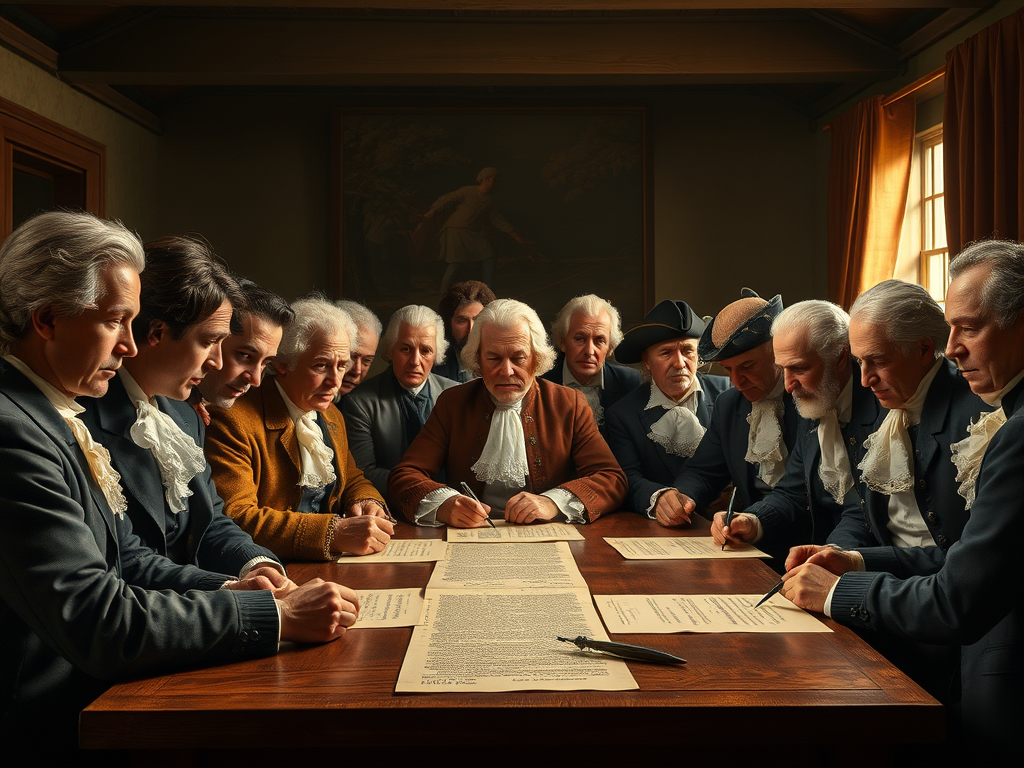
Historically, 55 of the 56 signers of the Declaration of Independence were Bible-believing, church-attending Christians. Their personal writings, sermons, letters, and public statements confirm this repeatedly.
They did not see Christianity as optional to liberty.
They saw it as essential.
Christian belief formed:
- Their understanding of human dignity
- Their view of justice and law
- Their concept of rights as endowed, not granted
4. Common Law and Its Biblical Roots
American law did not emerge in a vacuum. It inherited English Common Law, systematized by William Blackstone, who was openly Christian.
Blackstone taught that law ultimately flowed from God’s moral order, revealed in Scripture.
Three foundational principles of Common Law are explicitly biblical:
- Presumption of Innocence
Scripture requires witnesses and condemns false accusation. - Due Process
Biblical law demands careful inquiry before judgment. - Trial by a Jury of Peers
Judgment belongs to the community, not arbitrary power.
These principles are summarized in Leviticus 19, which commands that justice must not favor the rich or the poor. Justice must be blind.
This idea carries into the New Testament:
“There is neither Jew nor Greek, slave nor free… you are all one in Christ Jesus.”
This is not Enlightenment philosophy.
It is biblical anthropology.
5. God in the Declaration of Independence
It is often claimed that God is mentioned “only four times” in the Declaration—as if this minimizes His role. In fact, those references are theological and decisive.
The Declaration appeals to:
- “The Laws of Nature and of Nature’s God”
- A “Creator” who endows rights
- “The Supreme Judge of the world”
- “Divine Providence”
The final paragraph of the Declaration reads not like a legal clause, but like a prayer.
When the founders appealed to the “Supreme Judge of the universe,” they were not appealing to an abstract deity. In their worldview, judgment belonged to Jesus Christ, whom Scripture identifies as the one appointed to judge the living and the dead.
6. Scripture and the Founding Mind
At the time of the founding, the most cited book—religious or secular—was not John Locke, Montesquieu, or Blackstone.
It was the book of Deuteronomy.
Deuteronomy is Moses’ farewell address—a comprehensive teaching on law, justice, leadership, accountability, and covenant responsibility. It outlines how a free people are to govern themselves under God.
The founders recognized that liberty requires:
- Moral law
- Personal responsibility
- Submission to a higher authority than the state
7. What the Founders Themselves Said
John Adams famously wrote:
“Our Constitution was made only for a moral and religious people. It is wholly inadequate to the government of any other.”
This statement is not incidental—it is foundational.
The American system assumes:
- Virtue without compulsion
- Freedom governed by conscience
- Law restrained by morality
Remove Christianity from the people, and the system collapses.
8. The Present Crisis Explained
We are not living through a constitutional crisis because the Constitution failed.
We are living through a crisis because:
- We no longer have a Christian people
- But we still have a Christian form of government
The two are incompatible.
Liberty cannot survive without virtue.
Virtue cannot survive without moral truth.
And moral truth, historically and theologically, came from Christianity.
Conclusion: Liberty Requires Faith
The American experiment did not assume perfect people. It assumed redeemed people, governed by conscience, accountable to God.
You cannot sustain liberty without Christianity—not because Christianity enforces power, but because it restrains it.
The founders understood this clearly.
The question is whether we still do.
 John Hargrove Seeking Truth and Reality