
Feb 15 2026 John 4 Deeper Dive
February 15, 2026
Introduction to the Study
John 4 follows immediately after Jesus’ conversation with Nicodemus, a religious leader who came at night. Now Jesus travels through Samaria—a deliberate route many Jews avoided—and speaks openly with a woman at noon. The chapter moves from personal encounter to community belief, from misunderstanding to recognition, from sign-seeking to faith.
Topic 1: Breaking Barriers (John 4:1-9)
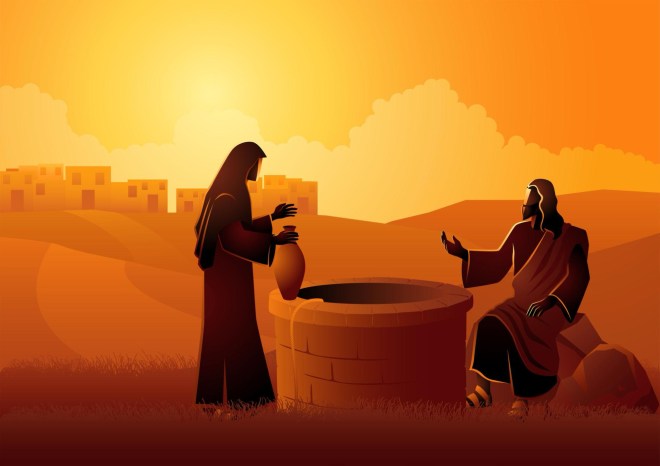
Read John 4:1-9 together
Before discussing, notice:
- Who initiates the conversation and what He requests
- The time of day (verse 6)
- Geographic details (verses 3-5)
- The woman’s response and what surprises her
- What barriers exist between these two people
Background Context
Samaritans and Jews shared ancestry but differed over where to worship (Jerusalem vs. Mount Gerizim) and which books constituted Scripture. By the first century, mutual hostility was deep. Jewish men typically did not speak with women in public, particularly not alone. Wells were common meeting places, but noon was an unusual time—most drew water in cooler morning or evening hours.
Discussion Questions
What do you notice about how Jesus positions Himself in this encounter?
- He is tired, thirsty, alone and asks for help
- What does this say about the way He meets people, even when there’s distance or differences in the way?
The woman says, “How is it that you, a Jew, ask for a drink from me, a woman of Samaria?”
- What assumptions does her question reveal?
- What has Jesus already communicated simply by asking?
What might explain why she came to draw water at noon rather than morning or evening?
- The text doesn’t explicitly say—what possibilities exist?
- How does considering this shape how you read the encounter?
Connection: Look back at John 3:16. How does Jesus’ presence in Samaria demonstrate what that verse declares?
Topic 2: Living Water and Misunderstanding (John 4:10-15)
Read John 4:10-15 together
Notice the pattern:
- What Jesus offers (verse 10)
- How the woman understands it (verses 11-12)
- How Jesus clarifies (verses 13-14)
- What the woman asks for (verse 15)
Discussion Questions
Jesus speaks of “living water” while the woman thinks about well water.
- What does she understand “living water” to mean?
- What does Jesus mean by it?
- How does He move from the physical to the spiritual?
The woman references “our father Jacob” and the well he gave.
- What might this tell you about how she sees her own identity and history?
- How does Jesus respond to her appeal to tradition and ancestry?
Jesus says whoever drinks the water He gives “will never be thirsty again.”
- How does this compare to the water from Jacob’s well?
- What kind of thirst is He addressing?
The woman says, “Sir, give me this water so that I will not be thirsty or have to come here to draw water.”
- Is she being sincere, sarcastic, or still misunderstanding?
- What does her request reveal about what she hears?
Connection: Look at John 3:3-5 where Jesus tells Nicodemus about being born of water and Spirit. How do these two conversations compare in method and response?
Topic 3: Worship in Spirit and Truth (John 4:16-26)
Read John 4:16-26 together
Follow the movement:
- Jesus’ instruction and the woman’s response (verses 16-18)
- Her theological question (verse 19-20)
- Jesus’ answer about worship (verses 21-24)
- Her statement about the Messiah (verse 25)
- Jesus’ revelation (verse 26)
Discussion Questions
Jesus tells her, “Go, call your husband and come here.”
- Why might Jesus redirect the conversation this way?
- What does her answer reveal, and how does Jesus respond?
Notice: Jesus knows her situation but doesn’t condemn her.
- What does He do instead?
- How does this shape your understanding of His purpose in revealing what He knows?
The woman shifts the conversation: “I perceive that you are a prophet. Our fathers worshiped on this mountain…”
- Is this a deflection, a genuine question, or both?
- What might she be hoping to resolve?
Jesus says the hour is coming when worship will not be about location but about “spirit and truth.”
- What does He mean by worshiping “in spirit and truth”?
- How does this address her question?
- How does it go beyond her question?
The woman says, “I know that Messiah is coming… He will tell us all things.”
- What does this reveal about Samaritan expectations?
- Why might she bring this up now?
Jesus responds, “I who speak to you am he.”
- This is one of the clearest self-revelations in John’s Gospel. To whom does Jesus say it?
- What has happened in this conversation that leads to this moment?
Connection: Compare this with John 3:1-2 where Nicodemus comes to Jesus. How do these two encounters differ in setting, directness, and outcome?
Topic 4: Testimony and Belief (John 4:27-42)
Read John 4:27-42 together
Track what happens:
- The disciples’ return and their silence (verse 27)
- The woman’s action and words (verses 28-29)
- The townspeople’s response (verse 30)
- Jesus’ teaching about harvest (verses 31-38)
- The progression of belief (verses 39-42)
Discussion Questions
The disciples are surprised to find Jesus talking with a woman, “yet no one said…”
- What does their silence suggest?
- What are they learning about Jesus through observation?
The woman leaves her water jar and goes to the town.
- What might leaving the jar indicate?
- What does her testimony focus on? (verse 29)
She says, “Come, see a man who told me all that I ever did. Can this be the Christ?”
- How would you describe her certainty or uncertainty in this statement?
- What makes her testimony effective?
Jesus tells the disciples about food they don’t know about, then speaks of harvest.
- What “food” is He referring to?
- What “harvest” does He see?
- How do verses 35-38 relate to what just happened with the woman?
Many Samaritans believe because of the woman’s testimony (verse 39), then more believe because of Jesus’ word (verses 40-42).
- What is the progression of faith here?
- What do the townspeople say about the relationship between her testimony and their own encounter?
They say, “We know that this is indeed the Savior of the world.”
- What title do they give Jesus?
- How does this compare to how Nicodemus addressed Him? (John 3:2)
- What has moved them from curiosity to conviction?
Topic 5: Faith and Signs (John 4:43-54)
Read John 4:43-54 together
Notice:
- Where Jesus goes and how He’s received (verses 43-45)
- Who approaches Jesus and what he asks (verses 46-47)
- Jesus’ statement about signs (verse 48)
- The official’s response (verse 49)
- The progression of the healing (verses 50-53)
- The result (verse 53)
Discussion Questions
Jesus says, “Unless you see signs and wonders you will not believe.”
- Who is He speaking to?
- Is this a rebuke, an observation, or both?
- How does this relate to what just happened in Samaria where many believed without seeing signs?
The official persists: “Sir, come down before my child dies.”
- What does his persistence reveal?
- What is he asking Jesus to do?
Jesus says, “Go; your son will live.” And the text says, “The man believed the word that Jesus spoke to him.”
- What does the official believe at this point?
- What evidence does he have?
- How is this different from demanding a sign first?
The servants meet him with news that his son is alive, and he asks when he began to recover.
- Why does the timing matter?
- What does this confirm?
The text says, “He himself believed, and all his household.”
- How does this belief differ from his initial belief in verse 50?
- What has moved from trust in Jesus’ word to fuller faith?
Connection: Look back at the Samaritan woman’s testimony (verses 28-29) and the townspeople’s belief (verse 42). How do these different paths to faith—testimony, personal encounter, signs—relate to each other in this chapter?
Closing
Patterns Across John 4
Before leaving this chapter, consider:
How does Jesus cross boundaries in this chapter?
- Geographic, ethnic, religious, social, gender
- What does this reveal about the scope of His mission?
What forms of “thirst” or need appear in this chapter?
- Physical, spiritual, relational, theological
- How does Jesus address each?
How do people move from misunderstanding to recognition?
- The woman, the townspeople, the official
- What role does Jesus’ word play in each case?
What does this chapter reveal about worship?
- Location vs. spirit and truth
- The relationship between knowing Jesus and worshiping rightly
Question to Carry Forward
John 4 begins with Jesus tired and thirsty, asking for water. It ends with a child healed at a distance and a household believing.
What do you see about who Jesus is and how He works that you didn’t notice before reading this chapter carefully?
Let this question shape how you read the rest of John’s Gospel.
For Further Study
Connections to explore:
- John 4:14 and John 7:37-39 (living water and the Spirit)
- John 4:23-24 and John 14:6 (truth and worship)
- John 4:42 and John 1:29 (Savior of the world / Lamb of God)
- John 4:50 and John 20:29 (believing without seeing)
Questions the text doesn’t fully answer:
- Why did the woman come to the well at noon?
- What happened to the woman after her testimony?
- How did Jesus spend those two days in Samaria?
These silences are not failures of the text. They remind us to focus on what is revealed rather than speculate about what isn’t.
 John Hargrove Seeking Truth and Reality