
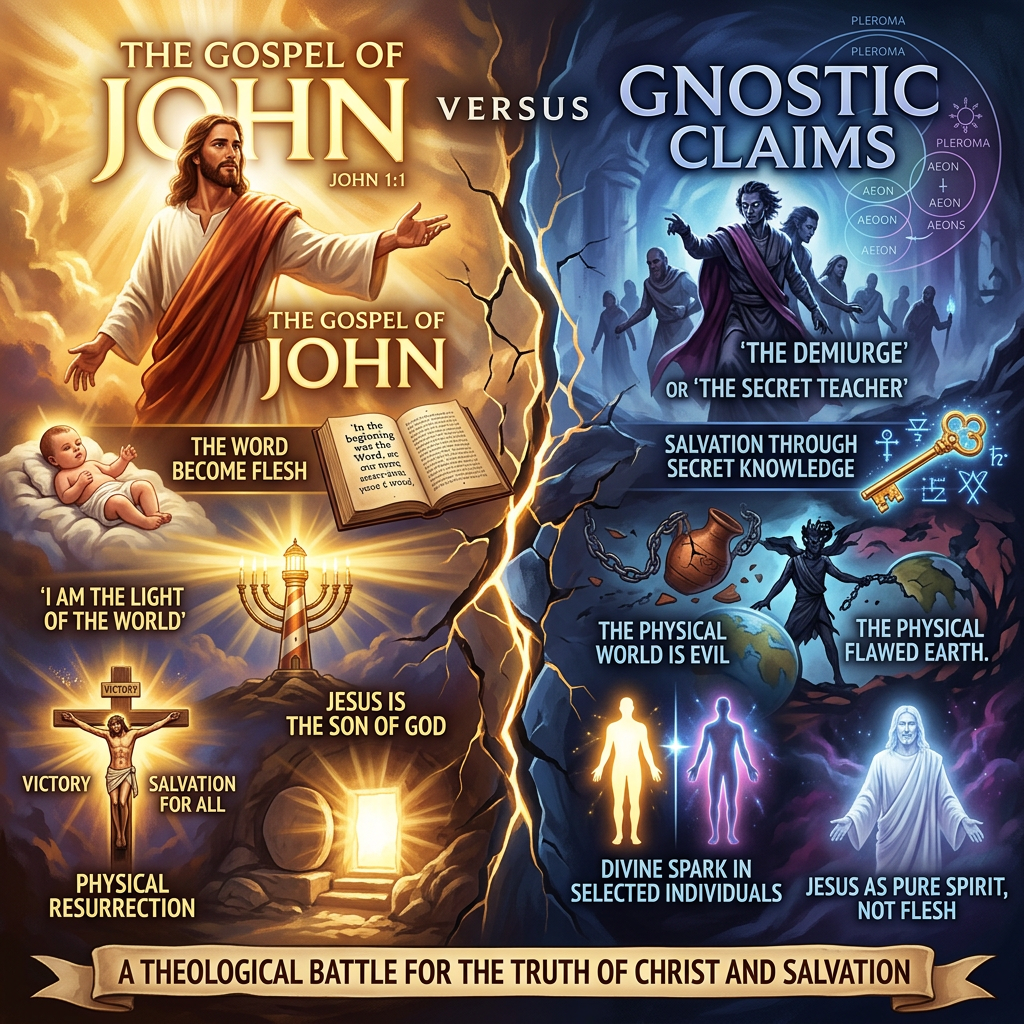
Claim 1: Gospel of John Is Gnostic Based on Logos Language
- The phrase “the word (logos) became flesh” makes John’s Gospel Gnostic
- This statement does not contradict Gnosticism but confirms it
Claim 2: Early Church Fathers Are Unreliable
- The early church fathers had an agenda to make John’s Gospel not Gnostic
- Their opinions cannot be trusted due to this bias
Claim 3: Physical Details in John 11 Are Not Emphasized
- The resurrection of Lazarus mentions his dead body but doesn’t “emphasize” it
- The physical aspects are not an important part of the story
- The real emphasis is in verse 42 about belief, which I “seem to overlook”
Claim 4: John 11:42 Disproves the Trinity
- God obviously sent Jesus
- If Jesus was God, this wouldn’t make sense
- This verse disproves the Trinity doctrine
Implicit Claims Underlying the Argument
- Using Gnostic vocabulary makes a text Gnostic
- Modern scholarly reconstructions are more reliable than ancient testimony
- Purpose and physical detail are mutually exclusive emphases
- The Trinity requires Jesus to be identical to the Father
- Sending language is incompatible with divine identity
Logical Examination of Your Claims
Thank you for taking time to engage thoughtfully with these questions. I’d like to respectfully examine the logic of your points.
Your Claim: “The word (logos) became flesh is what makes it gnostic it doesn’t contradict it”
Your argument assumes that using Gnostic vocabulary equals adopting Gnostic theology. This conflates language with doctrine. By this standard, Paul quoting pagan poets in Acts 17:28 would make Acts a pagan text.
Gnosticism’s foundational premise is ontological dualism: spirit equals good, matter equals evil. From this premise flows the conclusion that a divine being cannot truly unite with matter without contamination. John 1:14 explicitly violates this premise by stating the Logos became flesh. The Apocryphon of John, Treatise on Resurrection, and Gospel of Philip all deny true incarnation for precisely this reason.
Your argument appears self-defeating. If Logos became flesh is Gnostic, then anti-Gnostic statements would have to deny the Incarnation entirely. Your claim confuses vocabulary overlap with theological agreement and overlooks that John’s statement directly contradicts the Gnostic cosmology that makes incarnation impossible.
Your Claim: “The early church fathers had an agenda to make it not gnostic. Their opinion cannot be trusted”
Your argument dismisses first and second-century witnesses who knew the apostles or their disciples as biased, while accepting 20th-century scholars reconstructing hypothetical myths from third-century sources. This applies an inconsistent standard of evidence.
You’re attacking the source rather than evaluating their evidence. Having an agenda doesn’t automatically make testimony false. Irenaeus explicitly states he learned from Polycarp, who knew John. That’s a two-generation chain. Dismissing it requires showing factual error, not merely asserting bias.
If we can’t trust anyone with theological investment, then we can’t trust Gnostic texts either, nor modern scholars who also have methodological and ideological commitments. Your claim would effectively render all historical testimony inadmissible.
If the church fathers made it not Gnostic, this implies John’s Gospel was originally received as Gnostic and later reinterpreted. There’s no textual evidence supporting this. The earliest manuscript evidence already contains John 18 with no indication of Gnostic interpretation.
Your Claim: “The resurrection of Lazarus does mention his dead body but doesn’t ’emphasize’ it… The real emphasis… is in verse 42”
Your argument assumes emphasis on purpose excludes emphasis on physicality. John emphasizes both. The sign’s purpose is testimonial, but the sign itself is irreducibly physical. You cannot separate what the sign points to from what the sign actually is.
John devotes significant space to physical details: Lazarus has been dead four days, Martha objects to opening the tomb because of decomposition, Jesus has the stone removed, calls with a loud voice, and Lazarus emerges still bound in grave clothes. If these details are incidental, why would John include them? Ancient writers didn’t waste words.
The testimonial purpose you highlight in verse 42 depends on the physical reality. If Lazarus’s body is not truly dead and truly raised, the sign proves nothing. A spiritualized resurrection would not generate the response John describes—many of the Jews who had seen what he did believed in him. Physical observation requires physical reality.
Verses 38-44 form a narrative unit. Verse 42 explains the purpose, but the action that follows is intensely physical. Choosing one explanatory verse and declaring it the real emphasis while dismissing the surrounding action appears arbitrary.
Your Claim: “Obviously, God sent Jesus. If Jesus was God this wouldn’t make sense. There goes the trinity idea”
Trinitarian theology does not claim Jesus is the Father. It distinguishes three persons sharing one divine nature. The Father sending the Son is not a contradiction of Trinitarianism—it’s a core component of it. Your argument appears to address a position Trinitarianism does not hold.
John’s Gospel holds together multiple affirmations: Jesus is sent by the Father, Jesus is distinct from the Father, and Jesus shares divine identity. John does not see these as contradictory. Dismissing the Trinity based on one verse requires setting aside how John weaves these threads throughout the Gospel.
The Trinity affirms that Father and Son are equal in essence but distinct in role. The economic Trinity includes sending and being sent. This does not negate the ontological Trinity. Your claim appears to conflate these categories.
If Jesus is not God, how does he raise the dead by his own word, forgive sins, claim pre-existence before Abraham, and receive worship without rebuke? Your solution to one alleged problem creates several larger ones.
Respectful Summary
Your arguments rest on conflating vocabulary with theology, selectively dismissing historical evidence based on bias while accepting later reconstructions, imposing false dichotomies on narrative emphasis, and addressing a version of Trinitarian theology that differs from what the doctrine actually teaches. I appreciate your engagement with these serious questions and hope this examination helps clarify where the logical tensions lie.

