John 12
Source of Old Faith Church
Purpose and Guiding Principle
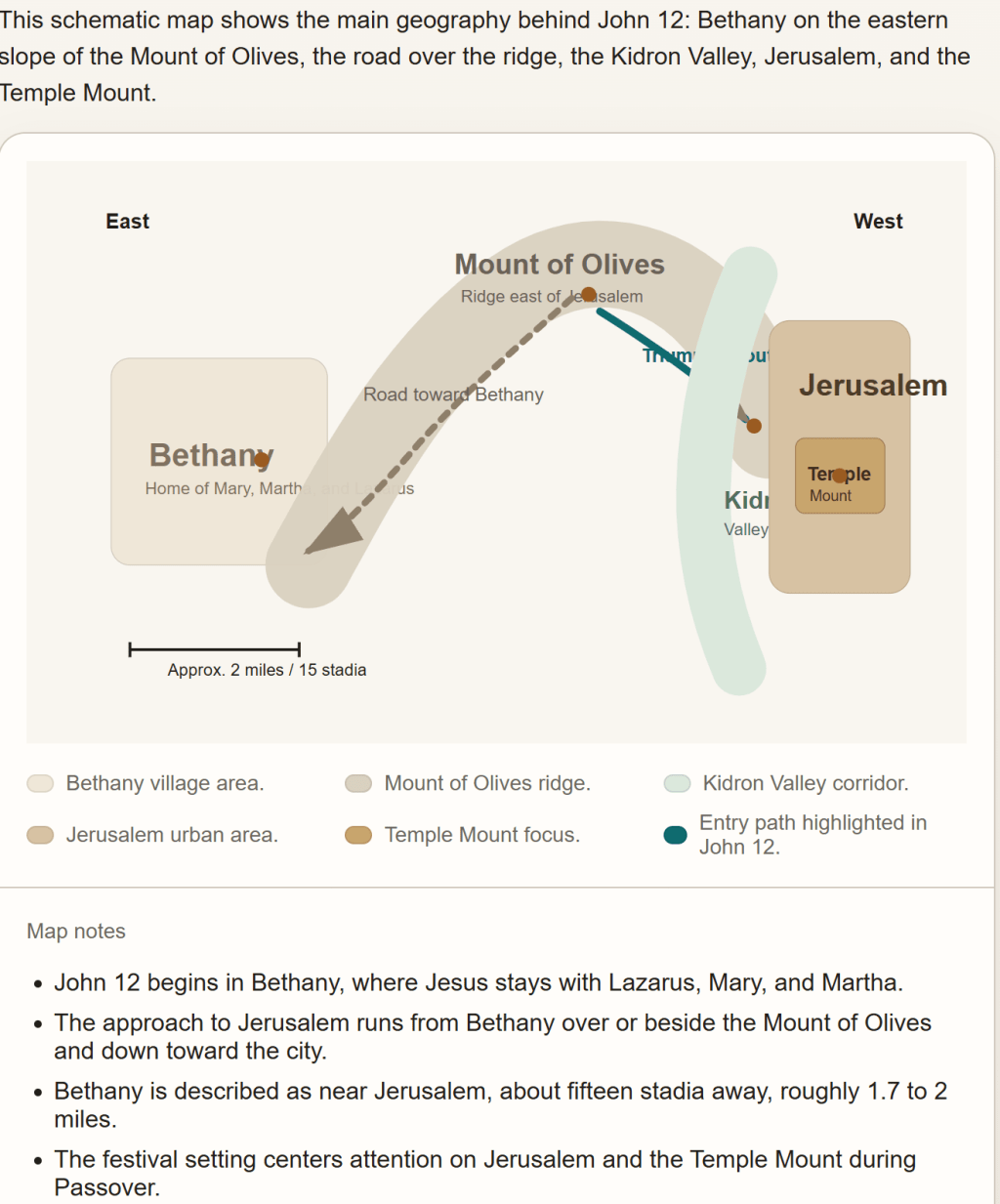
John 12 is a turning-point chapter. It gathers worship, public witness, the approaching cross, spiritual blindness, and Jesus’ final public appeal before the Passion. This session slows down to observe what the chapter actually shows us about Jesus and about the hearts of those who encountered Him.
| Guiding PrincipleJohn 12 reveals what different hearts do when Jesus is near. Our task is to observe carefully before we draw conclusions. |
Scripture Flow Overview
- John 12:1-8 — Mary anoints Jesus; Judas objects
- John 12:9-11 — Many come to see Lazarus; chief priests plan to kill him
- John 12:12-19 — The triumphal entry into Jerusalem
- John 12:20-26 — Greeks seek Jesus; the hour has come; the grain of wheat
- John 12:27-36 — Jesus’ troubled soul; the voice from heaven; walk while you have the light
- John 12:37-43 — Unbelief, Isaiah’s prophecy, judicial blindness
- John 12:44-50 — Jesus’ final public declaration
Observation: What Does the Text Say?
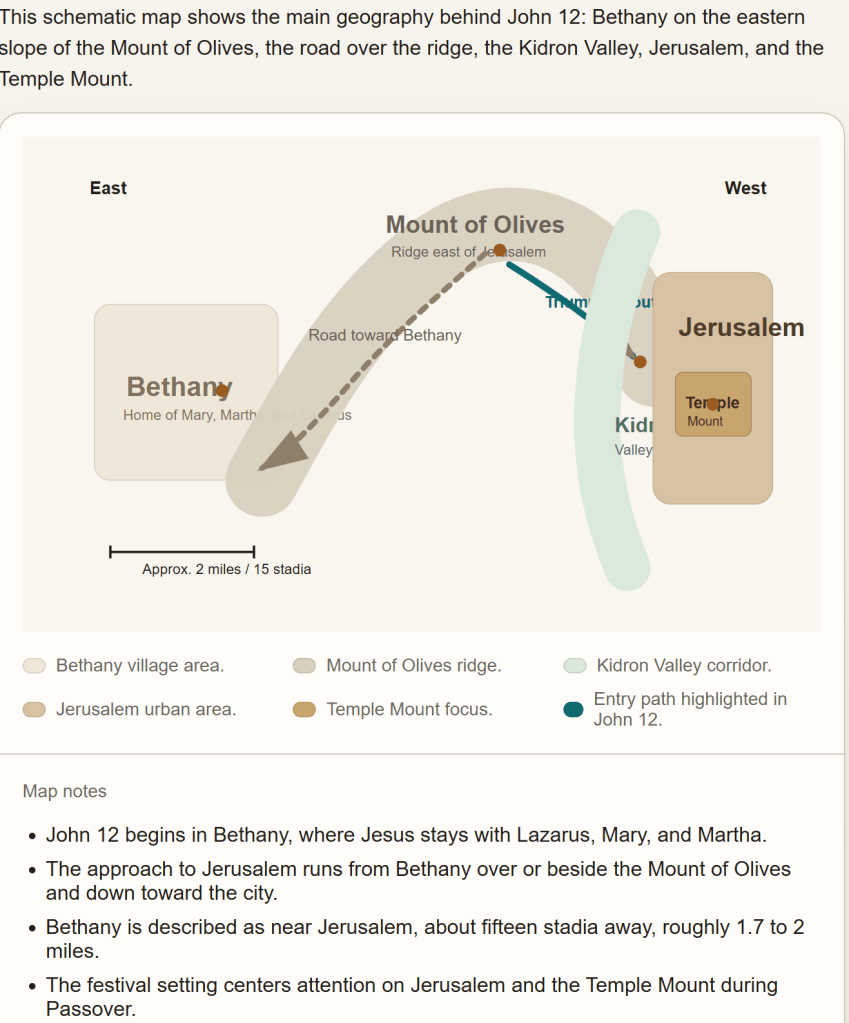
Read John 12 as a complete unit before answering. Notice what is happening at each location, who is speaking, and what actions each person takes.
1. How many different locations appear in this chapter? What happens at each one?
2. List every character who makes a decision or takes an action in John 12. What does each one do?
3. What repeated words or phrases do you notice? What themes keep returning?
Context: What Helps Us Understand the Text?
John 12 opens six days before Passover. The raising of Lazarus in chapter 11 has just happened. The religious leaders are now actively plotting to kill Jesus. The Passover crowd is large and politically charged.
| Irenaeus of Lyons (c. 180 AD)“The same God who gives light also inflicts blindness upon those who do not believe — not because the light is evil, but as the sun blinds diseased eyes: the problem is not in the sun, but in the eye.” (Against Heresies, IV.29) |
In John 12:38-40, John quotes from two separate sections of Isaiah. The first quote (v. 38) is from Isaiah 53:1, the Servant Song. The second (v. 40) is from Isaiah 6:9-10, the prophet’s commissioning. John holds both together deliberately.
4. Why might John connect Isaiah 53 and Isaiah 6 in the same passage? What does each text contribute?
5. John 12:37 says they “did not believe” even after many signs. John 12:39 says they “could not believe.” How do you understand both statements being true at the same time?
| On Hardening and Human ResponsibilityThe order in John 12 matters. First (v. 37): they saw the signs and would not believe — human responsibility. Then (v. 39-40): God’s judicial confirmation falls on persistent unbelief. The hardening is not arbitrary; it is the confirmation of a direction already chosen. |
Interpretation: What Does the Text Mean?
John 12 is structured around decision. Every scene presents Jesus and asks what the people near Him will do with what they see and hear.
Mary (vv. 1-8)
She anoints Jesus with costly perfume. Judas calls it waste. Jesus calls it preparation for His burial.
6. What is the difference between Mary’s understanding of Jesus and Judas’s understanding? What does each one value?
The Crowd (vv. 12-19)
They welcome Jesus as a king with palm branches. They shout Hosanna. But John notes they did not understand what was happening until after the resurrection.
7. What kind of king does the crowd appear to want? How does Jesus’ entry on a donkey (Zechariah 9:9) respond to that expectation?
The Grain of Wheat (v. 24)
“Unless a grain of wheat falls into the ground and dies, it remains alone; but if it dies, it bears much fruit.”
8. Jesus says this first about Himself. Then He applies the same pattern to His followers (v. 25-26). What does this suggest about the relationship between His death and the life of those who follow Him?
The Leaders Who Believed (vv. 42-43)
Many rulers believed in Jesus but would not confess Him publicly because they feared being put out of the synagogue. John’s diagnosis: “They loved the praise of men more than the praise of God.”
9. These people are described as believing. What was preventing them from following through? What does John’s diagnosis tell us about the nature of their belief?
Reflection and Formation
John 12 does not ask us to identify who around us is blind or resistant. It asks us to look at our own posture toward the light we have been given.
10. Jesus says in verse 35: “Walk while you have the light, so that darkness does not overtake you.” What is the difference between studying the light and walking in it?
11. The leaders in verse 42-43 were afraid of public cost. Where is the pressure between approval from people and faithfulness to God most present in your own life?
12. Lazarus does nothing in this chapter except exist as evidence of what Jesus has done (vv. 9-11). What does that suggest about the role of a changed life in witness?
| Formation AnchorSpiritual blindness grows when revealed truth is repeatedly resisted. Spiritual sight is sustained when we humble ourselves before Christ and obey the light we already have. |
Discipleship Anchor
Jesus does not close this chapter with a threat. Even after describing judicial blindness and the failure of the leaders, He cries out publicly one more time:
“Whoever believes in Me does not believe in Me alone, but in the One who sent Me.” (John 12:44)
Judgment is real in John 12. But the call to believe is still being sounded. The severity of the warning and the persistence of the invitation both belong to this chapter.
Source of Old Faith Church | Deeper Dive | Gospel of John Series
When the Light Becomes Judgment
Blindness, Hardening, and the Call That Remains — John 12:37–43
Source of Old Faith Church • Deeper Dive • Gospel of John Series
THE PASSAGE — READ BEFORE ANSWERING
| John 12:37–40Even after Jesus had performed so many signs in their presence, they still did not believe in him. This was to fulfill the word of Isaiah the prophet: ‘Lord, who has believed our message and to whom has the arm of the Lord been revealed?’ For this reason they could not believe, because, as Isaiah says: ‘He has blinded their eyes and hardened their hearts, so they can neither see with their eyes, nor understand with their hearts, nor turn — and I would heal them.’ |
| John 12:42–43Many even among the leaders believed in Jesus. But because of the Pharisees they would not openly acknowledge their faith for fear they would be put out of the synagogue. For they loved human praise more than praise from God. |
OBSERVATION — WHAT DOES THE TEXT SAY?
Look at the verses above before answering. Notice what is stated, what order things appear in, and what is left unresolved.
1. Read verses 37 and 39 side by side. Verse 37 says they “did not believe.” Verse 39 says they “could not believe.” Both are in the same passage. What is the difference between these two statements?
_________________________________________________________________________
_________________________________________________________________________
_________________________________________________________________________
2. The passage quotes two separate sections of Isaiah — Isaiah 53:1 in verse 38, and Isaiah 6:9–10 in verse 40. What does each Isaiah text contribute? Why might John place them together?
_________________________________________________________________________
_________________________________________________________________________
_________________________________________________________________________
3. Who is the “He” who blinds in verse 40? Read the verse again carefully. Does the text tell you? What does the grammar suggest?
_________________________________________________________________________
_________________________________________________________________________
KEY OBSERVATION — THE ORDER IN THE TEXT
| The Sequence John Gives Usv. 37 — They saw the signs and would not believe. (Human moral failure — described as a choice.)v. 39 — They could not believe. (Judicial consequence — described as an inability.)The hardening in verses 39–40 is presented as a consequence of the repeated unbelief in verse 37, not its cause.This is not a minor detail. The order is essential to holding both divine justice and human responsibility together. |
4. In your own words: what does this sequence suggest about why the judicial hardening fell on these people specifically? Was it arbitrary? Was it the first thing that happened? What does John’s order tell us?
_________________________________________________________________________
_________________________________________________________________________
_________________________________________________________________________
TWO TEXTS ON BLINDNESS — JOHN 12 AND 2 CORINTHIANS 4:4
Paul writes in 2 Corinthians 4:4: “The god of this age has blinded the minds of unbelievers, so that they cannot see the light of the gospel that displays the glory of Christ.”
John 12 attributes blindness to God. Paul attributes blindness to Satan. These are not competing explanations — they describe different levels of the same spiritual reality.
| In John 12:39–40 | In 2 Corinthians 4:4 |
| Agent: God (judicial confirmation) | Agent: Satan (active deception) |
| Scope: Israel’s persistent rejection of the Son | Scope: Unbelievers generally |
| Nature: Confirms direction already chosen | Nature: Actively blinds minds |
| Context: Covenant history and prophecy fulfilled | Context: Cosmic spiritual warfare |
5. If both are true at once — God judicially confirms, and Satan actively blinds — how do you understand human responsibility in this picture? Does either explanation remove the person’s own role in their unbelief?
_________________________________________________________________________
_________________________________________________________________________
_________________________________________________________________________
HOW THE EARLY CHURCH READ THIS
Three voices, three angles. These are not the only readings, but they show the range of careful interpretation across the first four centuries.
| Irenaeus of Lyons (c. 180 AD) — The Sun Analogy“The same God who gives light also inflicts blindness upon those who do not believe — as the sun, which is one and the same, yet has not the same effect upon all: for it blinds those who, on account of weakness of the eyes, cannot behold its light; while it illuminates those who are sound and healthy. So also is the case with God.”Against Heresies IV.29 |
| John Chrysostom (c. 390 AD) — Prophetic Foreknowledge“He says not that God did this, taking it as a thing done by Himself, but declares that it was a prophecy foretelling what they would do of their own will. The prophet was sent to confirm them in their wickedness by seeing him whom they were unwilling to see.”Homilies on John 67 |
| Augustine of Hippo (c. 410 AD) — Withdrawal of Grace“God hardens no man by imparting wickedness to him, but by not imparting righteousness… When we seek the reason why God hardens whom He wills and has mercy on whom He wills, we must not seek it in any merit of men, but must simply attribute it to the depth of the riches of the wisdom and knowledge of God.”On Grace and Free Will 43 |
6. Irenaeus, Chrysostom, and Augustine all agree: God’s blinding is not arbitrary and does not fall on innocent people. Where do they differ in how they explain it? Which framing do you find most useful for understanding John 12?
_________________________________________________________________________
_________________________________________________________________________
_________________________________________________________________________
INTERPRETATION — WHAT THIS PASSAGE IS AND IS NOT SAYING
John 12:37–40 has been read across a wide range of traditions — Reformed, Arminian, Molinist, historical-critical. They disagree on how much of the hardening reflects prior divine decree versus judicial response to foreseen free choices. But they agree on something more foundational:
| What the Serious Positions Share The blindness is not arbitrary — it falls on people who have already persistently rejected revealed light.Human culpability is real — ‘they would not believe’ and ‘they could not believe’ are both true at the same time.Satanic activity and divine judicial action are not competing explanations — they operate at different levels of the same event.The hardening in John 12 serves the larger redemptive purpose — the very rejection that constitutes the hardening is the path to the cross. |
7. The text says God “would heal them” (v. 40) — even in the same sentence that describes the blinding. What does this suggest about God’s posture toward the people described? What does it rule out?
_________________________________________________________________________
_________________________________________________________________________
_________________________________________________________________________
FORMATION — PLACEMENT, NOT PRESCRIPTION
These questions use the passage as a mirror, not a weapon. They are not about identifying blindness in others.
8. Jesus says in verse 35: “Walk while you have the light, before darkness overtakes you.” Is there a place in your own life where God has already given enough light, but you have been choosing not to move?
_________________________________________________________________________
_________________________________________________________________________
_________________________________________________________________________
9. The leaders in verses 42–43 believed, but were afraid of people. John’s diagnosis is precise: they loved human praise more than praise from God. Where is that particular pull most present for you right now?
_________________________________________________________________________
_________________________________________________________________________
DISCIPLESHIP ANCHOR
The same chapter that contains the most severe description of judicial blindness in John’s Gospel ends with this:
| John 12:44–46“Whoever believes in me does not believe in me only, but in the one who sent me. The one who looks at me is seeing the one who sent me. I have come into the world as a light, so that no one who believes in me should stay in darkness.” |
| The Pastoral Summary God does not arbitrarily blind innocent people. He judicially confirms the direction already chosen by those who have repeatedly rejected revealed light.The warning is severe. The invitation is still open. Both are true in John 12 at the same time.A heart that is still troubled by this passage, still asking, still wanting to see — that is itself a sign of mercy. Fully hardened hearts rarely grieve over their hardness. |
Source of Old Faith Church • Deeper Dive • Gospel of John Series

