Robert Edwin Hargrove · 1927–2013
A Chapter in the Story of Joshua Blake Hargrove
I. The Man Who Built the Camp
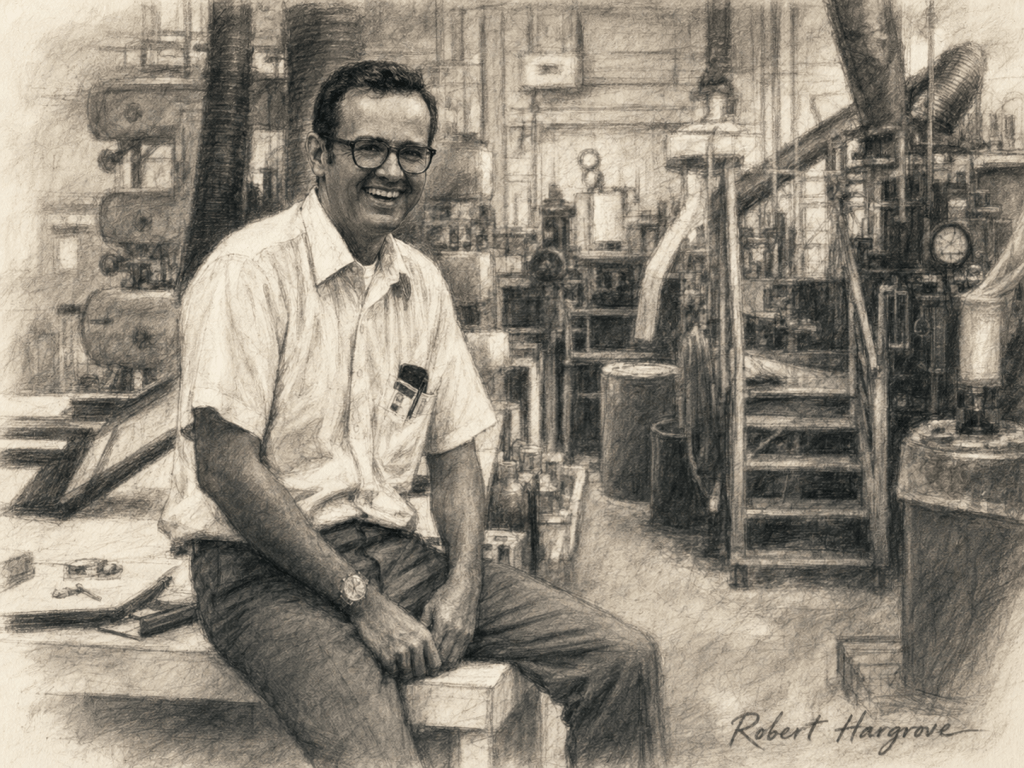
Robert Edwin Hargrove was a man of action, not words.
He was born in Buna, Texas, in 1927. He lived in Buna his whole life. He raised his family there. He was a fixture in the community — a man other men counted on and did not have to be told twice by. When something needed doing, he did it. When someone needed help, he helped. He did not narrate the help. He performed it.
The camp on the Neches River was his. Not his alone — the river had been in the family since before his own father was born — but the camp itself, the physical structure of it, was Robert’s work. He built it. He maintained it. He hosted at it. When his sons and later his grandchildren came into the world, they came into a world that already had a camp on the Neches waiting for them.
He was a man who marked ground.
His hands are still on the ceiling of the cabin, in the oil and grime of the plywood he and his brother George nailed up in 1988ish. Those handprints are among the most literal expressions of who Robert was: a man whose hands were on the wood, whose feet were on the land, whose body was present in the places he built for his family.
II. The Boy Who Grew Up There
Joshua Blake Hargrove was one of the grandchildren Robert built the camp for, though neither of them knew that at the time.
Joshua came to the camp as a child. He came again as a boy. He came in May of 1998 with his father and two dogs, and he drove the boat on the river his grandfather knew, and he slept under the ceiling his grandfather’s hands had marked. He came in April of 2000 as a young man about to be baptized in the river his grandfather had navigated always.
Robert was there for the baptism.
He was there because the baptism was at his camp — the river he had held for the family for decades, the water he had known his whole life. About forty family and friends gathered on the sandbar that April day, and Robert was among them, watching his grandson walk into the Neches.
After Joshua came up from the water, Robert hugged him.
That is the thing to hold. Robert was not a man who said much. He was a man who hugged. The hug was the sentence. The hug was what he had come to give.
III. The Day at the River
Three generations of Hargrove men stood in the frame of that April day in 2000.
Robert on the sandbar. John on the sandbar. Joshua in the river. The camp behind them. The Neches around them. The pines above.
It was Robert’s ground. Robert’s water. Robert’s roof over his grandson’s head those nights. And it was Robert who had done what most grandfathers do not get to do — he had been the one to make the space where his own grandson chose to be publicly claimed by Christ.
He did not preach that day. He was not the one who lowered Joshua under the water. He may not have spoken more than a sentence at the whole gathering.
But the ground was his. And on it, his grandson was named.
That is a kind of ministry too. It is the kind that men of action perform without ever calling it ministry.
IV. The Eleven Years After
Joshua died on June 22, 2002.
Robert lived another eleven years.
Those eleven years held a change in the camp that no one named out loud. Robert continued to go. He continued to bring his sons — Hardy and Wylie — and the grandchildren who were still coming and going through those years: Kendra, Cassie, Brennan. He did what he had always done. He kept the ground held. He kept the camp alive. He continued the pattern of gathering.
His son John stopped.
John had been slowly becoming less of a river boy since college — the pull of work, of the family he was raising in his own house, of the years of adulthood that draw a man away from the water he grew up on. After Joshua died, John went to the camp one more time. August of 2002. Two months after his son was in the ground. He went with his father Robert, his brothers Hardy and Wylie, and the cousins Kendra and Cassie and Brennan.
That was John’s last trip.
Robert kept going.
For most of the next decade Robert continued to arrive at the camp on the Neches, get out of the truck, greet whoever had come with him, and make the place work. Fish were caught. Meals were eaten. Nights were spent under the ceiling with his own handprints. He did all of it without his grandson. He did most of it without his son John.
He kept the camp.
Until about a year before his death, when his body finally would not carry him back to it anymore.
V. What He Carried Without Saying
Robert would sometimes speak of Joshua.
Not often.
Some men grieve by talking. Some men grieve by going. Robert grieved by going back to the water. Every trip he made to the camp in those eleven years was a trip to the water where his grandson had been baptized, along the sandbar where his grandson had played with the dogs at fourteen, under the ceiling that had held them both when Joshua had slept in that room in 1998.
The not-speaking was not the not-carrying.
A man of action carries his dead in a way that is not always visible from the outside. He carries them in the truck ride. He carries them in the meal cooked at the camp. He carries them in the arm around a younger grandchild who reminds him just enough of the older one who is gone. He carries them in the ordinary continuation of the ordinary things.
Robert continued. That was his grief. That was his witness. That was his love for his grandson expressed in the only register a man like Robert had.
He would sometimes say Joshua’s name.
Not often.
But every step across the sandbar was a saying of it too.
VI. The Two Names on the Same Ground
Robert died in 2013.
He is buried in Buna. Joshua is buried in Magnolia Springs. They are on the same ground.
The camp on the Neches still stands. The plywood ceiling still has Robert’s handprints. The river still moves.
Two Hargrove men in the Buna cemetery. One who lived his full length of days. One who did not. Both marked the same ground — the ground of the family, the camp, the water, the town. And both left the ground marked back. Robert left it marked with a cabin his hands had built. Joshua left it marked with a baptism the ground had witnessed.
The line between them is not broken. It is just that both are now on the other side of it.
Robert did not speak of Joshua often.
He did not have to.
He walked back to the same water, year after year, and let his footprints keep saying what his mouth would not.
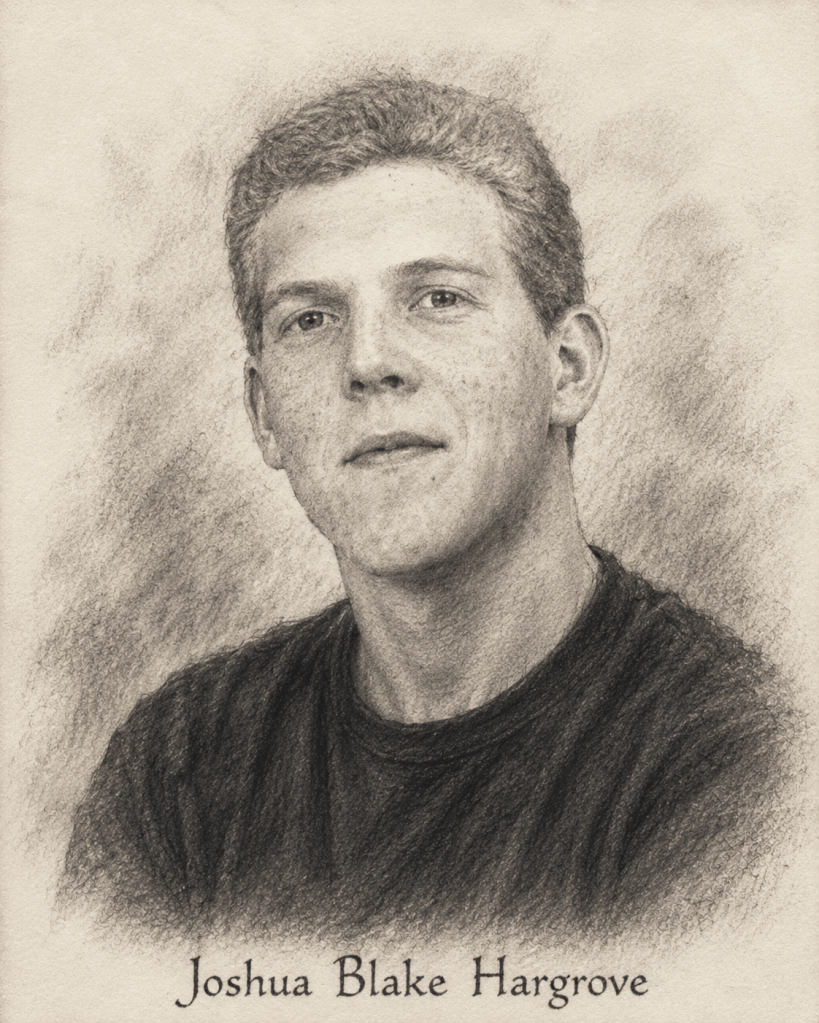
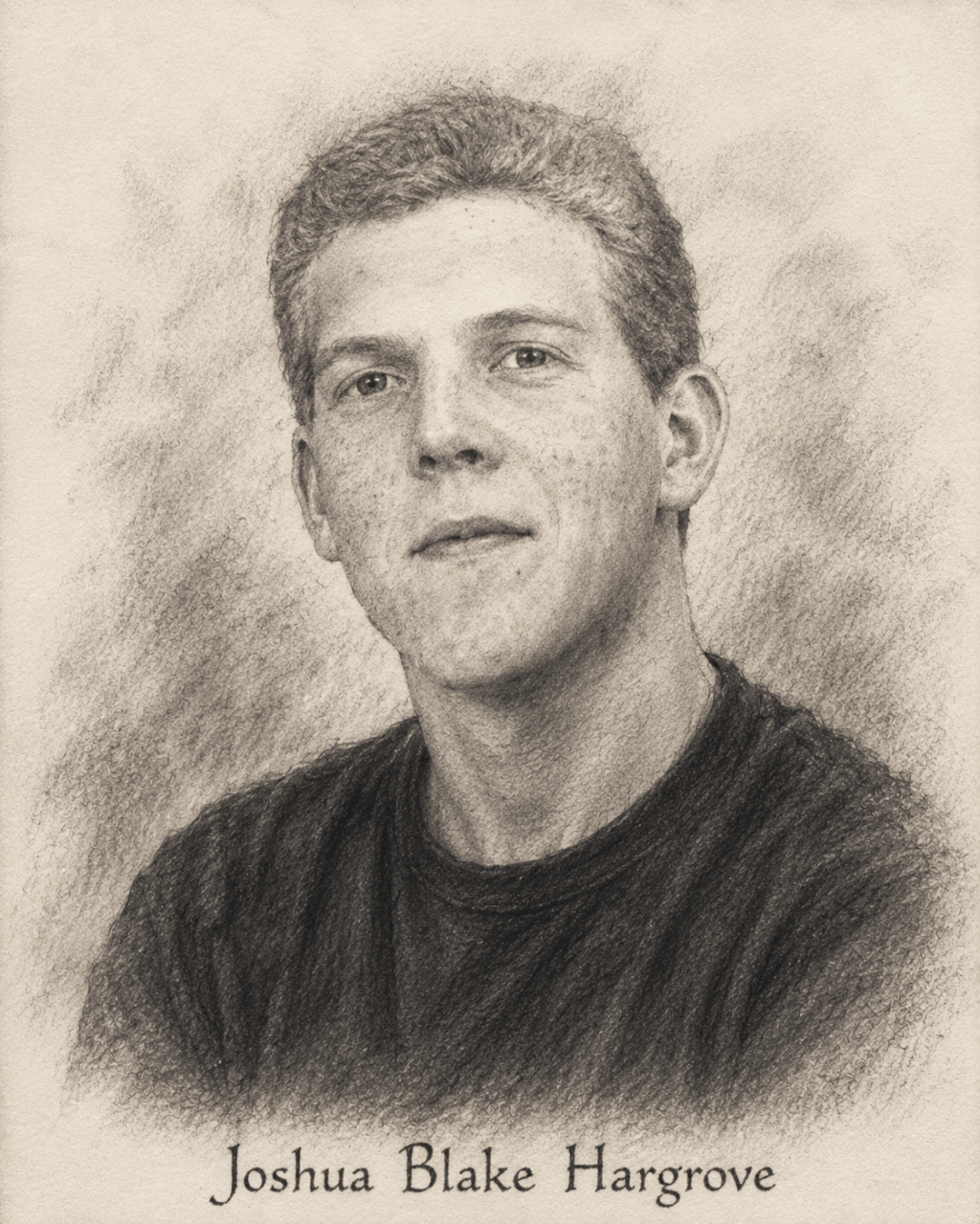
Joshua Blake Hargrove
April 9, 1984 — June 22, 2002
Poet. Warrior. Son of Light.