
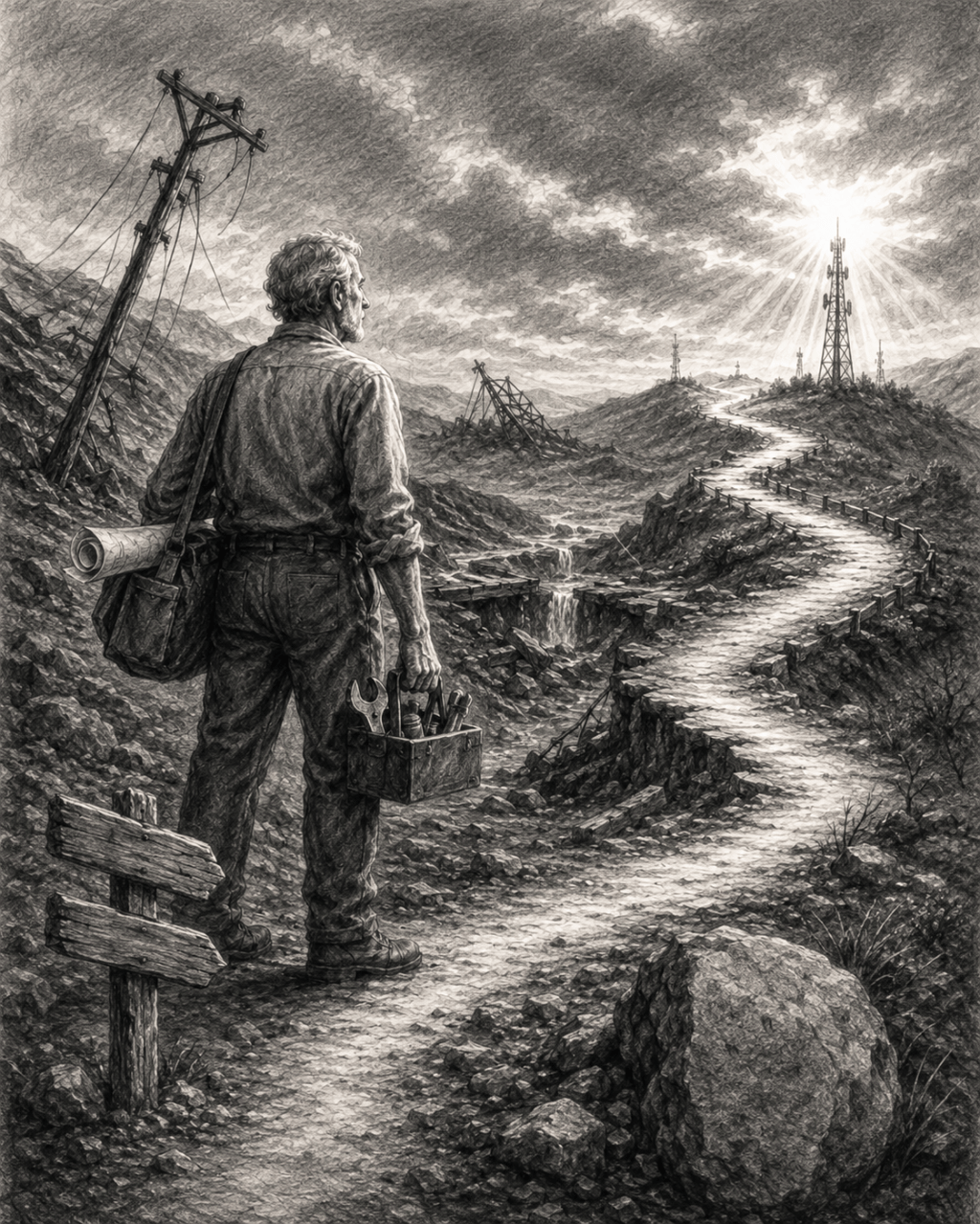
There was not one decision that brought me here, nor was there one person, one mistake, one bad month, or one unexpected event that explains where I find myself today. It was a long road, and looking backward, I can see that many different roads eventually converged in the same place.
For most of my life, I have been someone who believed problems could be solved. Give me a communications problem, an engineering problem, a failing network, a difficult project, or something nobody else quite understands, and my instinct has always been to study it, work harder, stay longer, and find a way through. That trait served me well for decades. It built a career and allowed me to help communities, utilities, churches, businesses, and people.
Somewhere along the way, though, that strength became part of the weakness. I began carrying things longer than I should have carried them.
In 2023, I stepped away from the relative security of being a senior engineer with a major consulting firm and helped build what I believed could become something meaningful in East Texas. We were going to provide broadband where people needed broadband. Then the vision expanded. Internet service became technology services, and technology services grew to include phones, networks, managed services, cameras, cybersecurity, engineering, consulting, and whatever else our customers needed.
For a while, it looked as though it might work. We had employees, customers, infrastructure spread across several communities, towers, radios, fiber connections, equipment, projects, and recurring services. From the outside, it could look like a growing rural technology company.
But growth and health are not the same thing, and underneath the activity were problems I did not confront soon enough. Some employees were not performing as they should have. Some responsibilities were not being carried by the people who were supposed to carry them. Billing was not always right. Systems were not sufficiently controlled. Projects consumed money before they produced enough revenue, and some services simply did not generate enough margin to support the infrastructure behind them.
There were warning signs, and I saw many of them. Sometimes I dealt with them. Sometimes I hoped they would improve. Sometimes I believed another contract, another customer, another project, or another month would give us room to fix what was wrong. Sometimes I was simply too tired to deal with another problem. That is difficult for me to admit.
I can identify failures in other people, and some of those failures were real and consequential. Work was left undone, responsibilities were neglected, technical and administrative problems accumulated, money was lost, and opportunities were missed. But that is not the entire story.
I was the chief operating officer. I was an owner. I was an engineer who understood that systems fail when warning alarms are repeatedly acknowledged without correcting the underlying condition. Yet in my own company, I sometimes did exactly that.
I delayed decisions about people because I did not want confrontation. I allowed weak processes to remain because there was always something more urgent. I financed deficits because I believed the next opportunity might turn things around, and I kept putting more of my own money into the company.
Eventually, the business was not simply consuming its own resources. It was consuming mine.
Hundreds of thousands of dollars that represented years of work became entangled with a company struggling to survive. Taxes accumulated. Vendors accumulated. Loans accumulated. Legal threats began appearing. Recurring expenses continued whether revenue arrived or not, and still I kept trying to solve it because that is what I do.
Meanwhile, the rest of life did not stop. My consulting work weakened, and contracts I had once expected to provide stability became uncertain. Community responsibilities continued. Church responsibilities increased. People still called when something did not work. Customers still needed their phones, networks still failed, bills still came, my family had needs, the church had wounds, and friends had illnesses. There were people to pray for, people to counsel, systems to repair, invoices to send, creditors to answer, equipment to replace, and decisions waiting every morning when I opened my eyes.
Then came another blow. The technology underlying much of the rural broadband network became uncertain. Cambium’s problems were not something I created, but they exposed how fragile the ISP operation had become. Suddenly I was no longer merely trying to improve an unprofitable network. I was trying to determine how to protect customers while dismantling something I had spent years and enormous amounts of money building.
That hurt in a way a spreadsheet cannot describe. Those towers were not just steel, and those radios were not just equipment. They represented an idea: that we could bring reliable broadband into rural East Texas, build something of lasting value, and make a difference.
Now I have found myself helping customers move to Starlink, helping communities find replacement providers, donating infrastructure, returning stranded equipment, closing accounts, explaining transitions, and trying to make sure people are not harmed by the collapse of something I once believed would grow. There is humility in that, and there is grief in it too.
Underneath all of this is something deeper. I have known loss before. I know what it is to discover that life can change without asking permission, and I know what it is to pray and still bury something precious. Those experiences teach faith, but they can also leave places in the heart where fear quietly lives. If enough new disappointments accumulate, old grief sometimes finds its way back into the room.
So when I say that bitterness and despair have become familiar companions, they did not arrive from nowhere. Bitterness came from seeing people fail responsibilities that mattered, from feeling abandoned with burdens that were supposed to be shared, and from looking at debts, losses, broken systems, and years of work while wondering why so much had gone wrong.
But some of the bitterness has also been directed at myself. I ask why I did not act sooner, why I lent more money, why I tolerated things I knew were wrong, why I believed I could keep carrying everything, and why I did not see sooner where this was going. Those questions can become merciless.
Then despair walks in behind them. Despair takes legitimate regret and turns it into prophecy. It says, “You ruined it, and nothing good comes after this.”
That is where I must be careful. There are things for which I need to repent. There are decisions I would change if I could. There are governance failures, financial decisions, personnel decisions, and moments of avoidance for which I bear responsibility. I do not want to excuse those things, but neither do I want to tell a false story in which everything that happened was mine to control.
Markets changed. People failed. Technology failed. Customers changed. Contracts disappeared. Events occurred that I could not have predicted. Through it all, I was operating as one human being with finite strength, finite wisdom, finite resources, and far too many responsibilities.
Perhaps the truest explanation of where I am is that I tried to carry too much for too long. Some of it was responsibility, some loyalty, some hope, some pride, and some fear of disappointing people. Some of it came from the belief that if I worked hard enough, prayed hard enough, invested enough money, and solved enough problems, eventually everything would stabilize.
It did not, and now I stand in the aftermath. The business is smaller. The debts are large. The financial consequences may follow me for years. My professional future is less certain than it once was. Some relationships have changed, some dreams have ended, and I am tired in a way that sleep does not completely repair.
Yet this is not actually the end of the story, because something else has been happening. Things I once depended upon for security have been stripped away one by one: income, business plans, people, technology, contracts, and even my confidence that I could engineer a solution to almost anything.
Eventually a man can reach a place where there is nothing left to say except, “Lord, I cannot fix this.”
That sentence once sounded like failure to me. Now I am beginning to wonder whether it might be the beginning of surrender.
For years I said that my hope was in God. Now circumstances are forcing me to discover whether I meant it. The question is no longer whether God will restore everything I lost, whether every creditor disappears, whether another business opportunity suddenly rescues me, or whether the next chapter looks anything like the one I planned. The deeper question is whether Christ is enough if none of those things happen the way I want.
That is a harder faith, but perhaps it is also a truer one.
So this is where I am: a man with regrets, but not only my regrets; a man who has been hurt, but not only what others have done to me; a man facing consequences, while knowing that consequences are not the same thing as condemnation; a man whose plans have broken apart, while God’s sovereignty has not.
I do not know what the next few years will look like, what survives, what must still be surrendered, or what God may build from the pieces. But I know that I have finally reached the place where I cannot pretend my strength is enough. Perhaps that is why this season feels so frightening, and perhaps somewhere inside that same truth is the beginning of hope.
If my life depended entirely upon my ability to repair everything I have broken, replace everything I have lost, and overcome everything standing against me, then despair might have the final word. But it does not. Jesus Christ does.
And so the story of how I got here cannot end with, “I failed.” It has to continue with something more complete: I failed in some things. Others failed me. Circumstances changed. Things were lost. I became exhausted, bitter, and afraid.
And God was still there.
I may not yet know what comes after that sentence, but for now, it is enough to begin there.

