The Keeper and the Unfinished Bridge
There once lived a keeper among the pine forests of the eastern lands.
He was taught by his father to build, by his mother to love, by his teachers to question, and by his Lord to serve.
Throughout his life, mentors appeared along his path, often at precisely the moment he needed them. Each left something of themselves within him, though many would never know the significance of their contributions.
The teachers at the successive gates.
He stretched wires across the wilderness and raised towers above the trees. He brought distant voices into isolated villages and carried knowledge into places where opportunity had seldom traveled.
He believed that separation was a condition to be overcome.
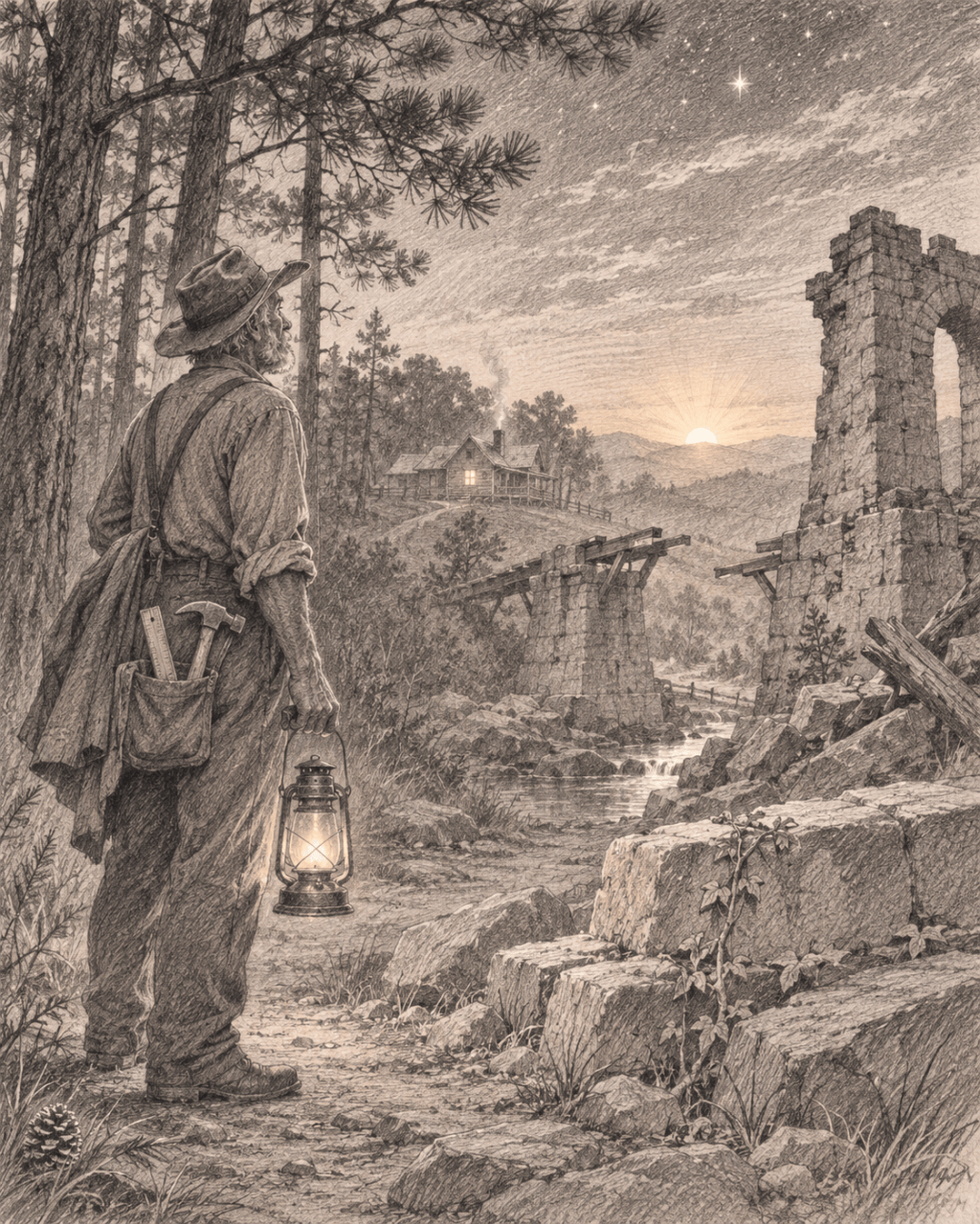
The keeper, his lantern above the trees.
Beside him walked a woman who guarded his heart. Together they built a shelter, welcomed a son and dreamed of years yet to come.
She witnessed the victories others celebrated and the defeats they never saw. She knew the doubts behind his confident voice and the weariness behind his determination.
Leisa, her shield before his heart.
Then came the day of the silent heavens.
Their son journeyed beyond the evening horizon, and the keeper discovered that there were distances no earthly instrument could measure and chasms no earthly bridge could cross.
He searched the heavens for answers that did not come. Yet he continued to believe that the horizon visible to him was not the boundary of existence.
Joshua, beyond the evening horizon.
The keeper continued building.
He served the villages. He taught the travelers. He comforted the grieving. He opened the ancient Scriptures and spoke of a kingdom beyond the visible world.
Along the road to Emmaus, he encountered companions whose hearts burned with the same eternal hope. Together they broke bread, shared their burdens and discovered again the presence of their Lord.
The travelers, their hearts burning.
Yet there was a contradiction within the keeper.
Though he had stood before multitudes, taught ancient truths, led communities and accomplished difficult things, somewhere within him remained the young man who questioned whether he had anything worth saying.
He could recognize the gifts of others while struggling to recognize his own.
He stood before the gathering while inwardly remaining at the back of the hall.
The man beneath the shadowed arch.
The years passed. Storms came. Towers fell. Companions departed. The treasury emptied, and the keeper stood among the scattered stones of his unfinished work.
He had given much of himself to the things he believed would endure. Now he watched some of those things crumble before him.
Shaka, when the towers fell.
He wondered whether his perseverance had always been wisdom, or whether sometimes it had become an unwillingness to relinquish what could no longer be sustained.
He struggled to distinguish generosity from overextension, loyalty from enabling, perseverance from attachment, and responsibility from the belief that everything depended upon him.
He looked toward heaven and asked whether all that he had done had been in vain.
In the silence, he remembered the ancient words he had read and taught so many times: that neither death nor life, nor things present nor things to come, could separate him from the love of God in Christ Jesus.
He remembered that the treasure was never the vessel, and that the strength of the vessel was never the source of the treasure.
The clay jar, its treasure revealed.
He looked again at the fallen stones.
They were no longer the measure of his existence.
He began to understand that not every broken bridge was his to repair. Not every neglected village was his to rescue. Not every invitation was a calling, and not every burden was his to carry.
He had spent much of his life teaching others about grace.
Now he was learning to receive it himself.
Sokath, his eyes uncovered.
He looked toward his home, where his heartshield waited.
He looked toward the heavens, where his hope remained.
He remembered the son who had journeyed beyond the horizon, the companions who had walked beside him, the teachers who had prepared him, and the Lord who had sustained him through seasons of both abundance and loss.
He gathered the tools that were still useful and laid aside those that had become too heavy.
And he continued along the road.
Not because every bridge had to be completed.
Not because every failure had to be reversed.
Not because every wound had to be healed in this lifetime.
Not because every person had to understand him.
But because the road itself still held purpose, and the One who had called him had not abandoned him.
He was more than the towers he had built.
More than the bridges he had constructed.
More than the victories he had celebrated or the failures he had endured.
He was a husband, a father, a teacher, a servant, and a man loved by God.
His story was not finished.
The keeper and his Lord upon the road.
The unfinished bridge beneath the morning sun.
The keeper, his hands empty, yet his heart full.
The road before him, the morning breaking.
Inspired by “Darmok,” an episode of Star Trek: The Next Generation, in which shared stories and metaphor convey the deeper meaning of life’s experiences, relationships, struggles, and enduring truths.

