Preparation and Response—Seeing the Lamb and Following Him

I. THEOLOGICAL FRAMEWORK & CORE CONCEPTS
A. The Witness (Martyria) – More Than Testimony

Theological Definition: The Greek word martyria (μαρτυρία) means “testimony” or “witness,” but carries weight beyond simple reporting. In John’s Gospel, witness is not passive observation but active participation in revealing truth. A martyr (martyrs) is literally “one who testifies”—someone who stakes their credibility, reputation, and sometimes life on the truth they proclaim.
Key Theological Significance:
- Witness is relational: it always requires both a testifier and an audience
- Witness is costly: authentic witness demands alignment between message and life
- Witness is eschatological: it participates in God’s work of revealing His Kingdom
- Witness points beyond itself: true witness always directs attention away from the witness toward the one witnessed to

In John the Baptist’s case, his entire mission is framed as witness to the light (John 1:7-8). He is not the light; he testifies to the light. This distinction is theologically crucial—it establishes the pattern for all Christian witness.
Theological Principle: Authority in witness comes not from institutional power, but from the integrity between proclamation and practice.
B. The Forerunner (Prodromos) – Preparing the Way
Theological Definition: A forerunner (Greek: prodromos, προδρόμος) was an advance scout or herald who would prepare the path for a royal procession. In the Old Testament, this role was prophesied for Elijah (Malachi 4:5-6); in the New Testament, John fulfills this calling as the forerunner to Jesus.

Layers of Meaning:
- Literal/Historical: John prepares people through baptism and the proclamation of repentance, creating space for Jesus’ arrival
- Spiritual: John’s ministry addresses the fundamental human condition of spiritual disorientation. Israel had been spiritually “lost in the wilderness” for four centuries (the “intertestamental period”). John calls people out of this confusion toward clarity.
- Mystical/Personal: For individual believers, the forerunner function invites us to examine how we prepare our hearts for encounter with Christ. What obstacles block our recognition of Him?
Theological Principle: Preparation is not about becoming worthy, but about removing obstacles to encountering God’s grace.
C. Repentance (Metanoia) – Transformation of Mind

Theological Definition: The Greek word metanoia (μετάνοια) means far more than “regret” or “turning around.” It literally means “change of mind” (meta=after/beyond, noia=mind/perception). This is a fundamental reorientation of consciousness—a new way of seeing reality.
Distinguishing from “Penance”: Many English translations blur the line between metanoia (Greek) and penance (Latin). This is a critical error. Repentance is not:
- Self-flagellation or punishment
- Earning forgiveness through suffering
- Shame-driven self-rejection
- A one-time event that “fixes” a person
Rather, repentance is:
- A sustained reorientation toward God
- Cognitive + emotional + volitional transformation
- The recognition that current patterns are misaligned with reality (God’s kingdom)
- The acceptance of a new identity and orientation
Biblical Precedent: Isaiah 1:18 presents repentance not as punishment but as a new way of seeing: “Come now, let us reason together… though your sins are like scarlet, they shall be like snow.” The invitation is to reconsider, to see oneself and God differently.

Recovery Parallel: This aligns with how modern recovery frameworks understand transformation—not shame-based, but identity-based. “I am no longer defining myself by my addiction” is a form of metanoia.
Theological Principle: True repentance is a gift from God that restores sight, not a price we pay for forgiveness.
D. The Lamb of God (Arnos/Pascha)
Theological Definition: John the Baptist’s declaration—”Behold the Lamb of God who takes away the sin of the world” (John 1:29)—draws on multiple layers of symbolism:

- Sacrificial Lamb (Levitical):
- In the Jewish temple system, a lamb was the primary sacrifice for sin atonement (Leviticus 4-5)
- The lamb was typically young, spotless, unblemished—perfect
- Its death effected atonement for the community
- Passover Lamb (Exodus):
- The lamb’s blood marked doorframes, protecting the firstborn of Israel
- It provided both protection (salvation) and community identity (you are the redeemed people)
- This was the most profound liberation narrative in Jewish memory
- Suffering Servant (Isaiah):
- Isaiah 53:7 describes the servant “like a lamb led to slaughter”
- This servant’s suffering is vicarious—for others, not for himself
- His self-offering transforms death into redemption
- Cosmic Lamb (Revelation):
- Revelation portrays the Lamb (arnion, the diminutive form suggesting tenderness/intimacy) as central to all cosmic worship and redemption
- The Lamb who was slain is simultaneously the Lamb enthroned in power (Revelation 5)
Critical Theological Insight: The Lamb is vulnerable who redeems. In a world of power and domination, the Lamb offers a radically different path—the power of self-giving love. This is why in Revelation, the most powerful cosmic being is depicted as a Lamb.
Theological Principle: God’s redemptive power works through self-giving vulnerability, not coercive might.
E. Baptism (Baptizo) – Symbolic Drowning and Rising
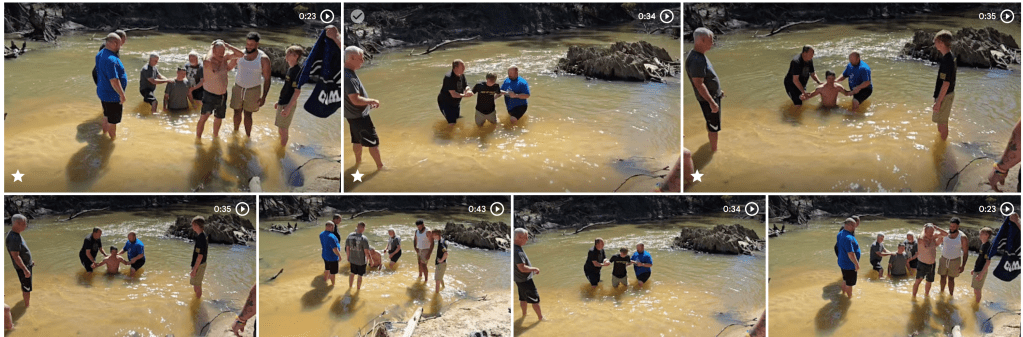
Theological Definition: The Greek word baptizo (βαπτίζω) literally means “to immerse” or “to plunge.” It’s not sprinkling or pouring, but total submersion. This is symbolically significant.
What Baptism Signifies:
- Death of the Old Self (Romans 6:3-4):
- Going under the water = entering the grave, the end of old patterns
- Rising from water = resurrection into new life
- Paul uses baptism as the primary metaphor for identification with Christ’s death and resurrection
- Washing/Cleansing (Acts 22:16):
- Baptism signifies the removal of shame and guilt
- In the ancient world, baptism was about ritual purity—entering the presence of the holy
- For those in recovery, this symbolizes the possibility of being cleansed, not stained by past
- Incorporation into Community (1 Corinthians 12:13):
- Baptism marks entry into the Body of Christ
- You are no longer alone in your identity; you are grafted into a people
- In recovery language: you move from isolation to belonging
- Public Identification (Matthew 28:19):
- Baptism is explicitly public and trinitarian—done in the name of the Father, Son, and Spirit
- It’s a declaration to heaven and earth: you belong to God
Recovery Significance: In recovery frameworks, baptism can represent the moment of public commitment—the willingness to be vulnerable, to identify with a community, to declare that your old way of life is over.
Theological Principle: Baptism is both death to self and birth into new identity; both washing and incorporation.
F. The Spirit Descending – God’s Empowerment
Theological Definition: In all four Gospel accounts of Jesus’ baptism, the Spirit descends upon Him “like a dove” (Matthew 3:16, Mark 1:10, Luke 3:22, John 1:32-33). This imagery is profound.
Why a Dove?

- Gentleness, not violence: Doves represent peace, purity, and innocence. This contrasts sharply with other biblical symbols of the Spirit’s power (like wind or fire). Here, power comes gently.
- Connection to Creation: In Genesis 1:2, the Spirit “broods” over the waters at creation. The dove echoes this creative, generative presence.
- Innocence: Doves were the sacrifice of the poor (Mary’s offering in Luke 2:24). The Spirit descends with identification with the marginal, not the powerful.
- Universality: The dove became a symbol of peace across cultures. John’s Gospel uses it to suggest the Spirit’s work transcends ethnic and cultural boundaries.
The Voice of Affirmation: At Jesus’ baptism, a voice from heaven declares: “This is my beloved Son, in whom I am well pleased” (Matthew 3:17). This is not about achievement or earning approval. It’s an affirmation of identity before any work is done. Jesus hasn’t begun his ministry yet—He’s simply received the Spirit and heard His Father’s voice.
Recovery Parallel: In recovery, participants often struggle with shame and the belief that they must “earn” their worth. The baptism narrative offers a different model: affirmation precedes achievement. God declares you beloved before you prove yourself.
Theological Principle: The Spirit’s work is characterized by gentleness, empowerment, and identification with the vulnerable.
II. HISTORICAL & CULTURAL CONTEXT
A. First-Century Political Landscape
The Wilderness as Counter-Site: John the Baptist operated in the Judean wilderness—a deliberate choice with political significance. The wilderness was:
- Liminal space: neither civilized nor truly wild; a place of transition
- Prophetic space: where Israel encountered God (Moses, Elijah, Amos)
- Anti-imperial space: removed from Roman administrative control and Jerusalem’s temple-based authority
By preaching in the wilderness, John was making a statement: an authentic encounter with God happens outside the power structures of Rome and the Jerusalem establishment.
Rome’s Religious Strategy: The Roman Empire was pragmatic about local religions. It allowed client kingdoms to maintain religious practices as long as they didn’t threaten the political order. However, John’s preaching of repentance—calling people to radical reorientation—was inherently destabilizing. You cannot preach genuine metanoia without implicitly critiquing the status quo.
This is why John was arrested. Herod Antipas (the tetrarch of Galilee/Perea) saw John as a political threat (Mark 6:17-18). John was preaching repentance, which threatened the entire social order that Herod benefited from.
The Jewish Establishment’s Complexity: The Pharisees and Sadducees represented different responses to Roman occupation:
- Pharisees: Believed in maintaining Jewish practice and purity despite Roman rule; focused on Torah observance as resistance
- Sadducees: More accommodationist; collaborated with Rome; controlled the temple system
John’s baptism was radical because it bypassed the temple entirely. You didn’t need to go to Jerusalem, pay a priest, or engage in the sacrificial system. Repentance was available to anyone, anywhere, through water and a change of mind. This was democratizing and therefore destabilizing.
B. Jewish Renewal Movements
John didn’t emerge in a vacuum. First-century Judaism experienced multiple “renewal” movements, each offering different responses to Roman occupation and spiritual disorientation:
- Apocalyptic Movements: Believed God would soon intervene violently to overthrow Rome
- Qumran Community (the Essenes): Withdrew to the desert to maintain ritual purity; saw baptism as a daily practice of repentance
- Zealot Movements: Advocated armed rebellion
- John the Baptist’s Movement: Offered spiritual reformation through repentance and baptism
John was part of a broader Jewish renewal conversation, but with a distinct emphasis: repentance, not revolution; baptism, not armed struggle; humility, not political power-grabbing.
III. CULTURAL RELEVANCE FOR 2025
A. Authenticity in an Age of Performativity
The Crisis of Credibility: John’s credibility came from the alignment between his message and his life. Today, we live in an age of unprecedented performative capacity. Consider:
- Social media allows anyone to curate a perfect image
- Influencer culture separates the public persona from private reality
- Religious institutions have experienced successive waves of scandals where leaders’ private lives contradicted their public messaging
- Deepfakes make it possible to simulate authenticity entirely
The Result: Younger generations are deeply skeptical of institutional religion and religious authority. Pew Research consistently shows that one primary reason young people leave faith communities is perceived hypocrisy—the failure of religious leaders to live out their stated values.
Where John’s Witness Speaks: John offers a model of radical transparency. He lived simply; he had no institutional power base to protect; he explicitly denied his own importance. In an age of performativity, genuine humility and integrity are increasingly rare—and therefore increasingly powerful.
The question for 2025 Christianity: Can we recover a witness that is willing to be small, to refuse institutional protection, and to point away from ourselves toward Christ?
B. Counter-Cultural Witness in Polarized Times
The Polarization Problem: In 2025, we live in unprecedented ideological fragmentation. Every issue is tribal: politics, economics, sexuality, technology, spirituality. The default posture is adversarial—you’re either with us or against us.
Religious communities are not immune to this. Many churches have become effectively political organizations, blessing one partisan vision or another. The boundary between Christian witness and political ideology has dissolved.
Where John’s Witness Speaks: John stood outside the power structures of his day. He didn’t ally with Rome, the Pharisees, the Sadducees, or the Zealots. His allegiance was singular and undivided: to the God who was coming.
This suggests a prophetic posture for 2025 Christianity: the willingness to critique all human power structures from the perspective of God’s kingdom, rather than investing in any earthly power system.
This is countercultural in every direction:
- To progressive Christians, it suggests you cannot simply sacralize left-wing political movements
- To conservative Christians, it suggests that you cannot baptize right-wing nationalism
- To political moderates, it suggests the kingdom of God is not a middle-ground compromise
John’s witness invites believers to a different kind of politics—one rooted in repentance, humility, and reorientation toward Christ, rather than securing earthly power.
C. The Hunger for Authenticity in Spirituality
The Spiritual-But-Not-Religious Movement: Over the past 20 years, the “spiritual but not religious” category has exploded. In 2025, many younger people are:
- Rejecting institutional religion
- Exploring mysticism, meditation, Eastern spirituality
- Seeking authentic spiritual experience rather than doctrinal correctness
- Valuing experiential knowledge over inherited tradition
The Gap: Many spiritual-seeking people are not actually anti-Christian; they’re anti-institutional-Christianity. They want an encounter with transcendence, community, and transformation, but without the perceived baggage of hypocrisy and control.
Where John’s Witness Speaks: John offers Christianity at its most reduced and most powerful: a call to repentance, baptism, and encounter with the living God in the wilderness. No institution, no priesthood, no complex theology. Just: change your mind, be immersed, meet the one who is coming.
This suggests that authentic Christian witness in 2025 may look less like defending institutions and more like inviting people into a genuine encounter with God. Not as a defensive posture, but as an offensive proclamation: There is a reality larger than your current perception. Come, and your mind will be changed.
D. The Wilderness as Metaphor for Digital Disorientation
The Information Wilderness: In 2025, we live in a kind of wilderness—not a geographical one, but an informational one. The digital landscape is:
- Unstructured and overwhelming
- Full of competing voices claiming authority
- Algorithmically designed to fragment consensus
- Increasingly difficult to navigate with integrity
Social media creates what we might call “spiritual disorientation”—the sense that you don’t know what’s true, who to trust, or which way is forward. Conspiracy theories flourish. Expert knowledge is distrusted. Everyone has a platform.
Where John’s Witness Speaks: John preached clarity in a time of confusion. He stood in one place, spoke one message, and pointed in one direction. His witness was singular and undivided. In an age of infinite choice and information overload, this is spiritually compelling.
The question for 2025 believers: Can we offer a witness that is clear, coherent, and courageous amid digital chaos? Can we help people navigate the wilderness?
E. Recovery and the Language of Rebirth
The Recovery Movement’s Growth: In 2025, awareness of addiction—not just substance abuse, but behavioral addiction, digital addiction, relational trauma—is widespread. More people than ever before have some connection to recovery frameworks (12-step programs, therapy, spiritual direction).
Recovery language emphasizes:
- Admission of powerlessness and need
- Spiritual reorientation (the “higher power”)
- Community accountability
- The possibility of transformation despite past failure
Where John’s Witness Speaks: John’s entire proclamation is oriented toward people who recognize they are spiritually lost and need reorientation. He doesn’t shame; he invites. He doesn’t demand perfection; he offers change.
For people in recovery, John’s witness says: Your past does not determine your future. Repentance is real. You can be baptized into a new identity. The Lamb of God takes away the sin of the world—including yours.
This is not judgment; it’s liberation. This is not shame; it’s hope.
F. Leadership Without Institutional Power
The Crisis of Authority: In 2025, institutional authority is fundamentally compromised:
- Religious institutions have credibility crises around abuse and misconduct
- Political institutions are deeply distrusted
- Corporate institutions are seen as serving shareholders, not communities
- Even educational institutions face questions about their true purposes
Young people are skeptical of anyone claiming authority based on position, credentials, or institution.
Where John’s Witness Speaks: John had no institutional authority. He had no credentials, no ordination, no official status. His authority came entirely from the integrity of his witness. He pointed away from himself to One greater. He refused to capitalize on his own influence—when people tried to follow him, he redirected them to Jesus.
This offers a model for 2025 leadership: Authority grounded not in position but in integrity; power exercised through humility; influence wielded by pointing away from oneself.
This is radical in every context. It suggests:
- Pastors should be willing to be small, unknown, humble
- Religious leaders should critique their own institutions when necessary
- Spiritual authority is not something you claim but something others recognize in your witness
- The goal is never to build your own platform but to redirect people toward Christ
IV. THEOLOGICAL QUESTIONS FOR DEEPER EXPLORATION
For Individual Reflection:
- On Witness: Where am I most tempted to let my actions contradict my proclaimed values? What would it look like to align more fully?
- On Preparation: What obstacles in my life prevent me from seeing and following Christ clearly? What would removing them cost?
- On Repentance: Where do I need a fundamental reorientation of my thinking? Where has my “mind” become captured by cultural narratives rather than divine truth?
- On the Lamb: How do I tend to seek power—through dominance, manipulation, accumulation? How might the Lamb’s way of vulnerability change my approach?
- On Baptism: Have I truly “died” to my old identity, or am I still trying to resurrect aspects of my former self? What would a wholehearted commitment to a new life require?
- On the Spirit: Where in my life do I need the Spirit’s gentle empowerment rather than my own striving?
- On Counter-Cultural Witness: Where am I tempted to align Christianity with a particular political or cultural system? How might I recover a witness that transcends such alignments?
For Community Dialogue:
- How do we foster authentic, humble witness in contexts where the default is performance and self-promotion?
- What does it look like to invite people into genuine repentance without shaming or coercion?
- How can we recover baptism as genuinely transformative rather than merely ceremonial?
- What would it mean for our community to offer genuine spiritual sanctuary—a “wilderness” space where people can encounter God outside consumer and entertainment logic?
- How do we cultivate leadership that points away from itself toward Christ?
V. PASTORAL INTEGRATION: FROM THEOLOGY TO LIVED TRANSFORMATION
A. Preaching Theology to Those in Recovery
The theological themes here are not abstract—they speak directly to the experience of addiction, relapse, and recovery.
Witness & Integrity: Many in recovery have had their trust shattered by people who claimed to have their interests at heart but didn’t. John’s integrity—his willingness to be small and to point away from himself—offers a model of trustworthiness that wounds can begin to heal around.
Repentance, Not Shame: The distinction between metanoia and penance is critical. Many people in recovery have internalized profound shame about their addiction and failures. Repentance (change of mind) offers transformation; shame offers only degradation. The proclamation must be: You don’t have to be ashamed of who you were to be transformed into who you’re becoming.
Baptism as New Identity: For someone who has been labeled “addict” or “failure,” baptism offers an alternative narrative. You are not your history. You are beloved. You are being reborn.
The Lamb’s Vulnerability: People in recovery understand vulnerability. They’ve experienced rock bottom. John’s Lamb—powerful through self-giving, not domination—speaks to the paradoxical strength found in admission and surrender.
B. Liturgical & Spiritual Practices
Ritual Recommitment: Consider a baptismal renewal practice in which people publicly reaffirm their commitment to a new life. This is not a requirement but an invitation—a moment to declare before the community that they are identifying with Christ’s death and resurrection.
Wilderness Pilgrimage: Create intentional “wilderness” space—whether literal (a retreat in nature) or metaphorical (a period of prayer and silence). This is not an escape from community but deeper entry into it, via encounter with God.
Witness Sharing: Create safe containers where people can share their witness—how they’ve seen God work, where their integrity has been tested and held, how their minds have been changed by encountering Christ.
Contemplative Prayer on John 1: Lead people through extended meditation on John’s first chapter, using different senses: What do you see? What do you hear? What invitation are you sensing?
VI. CULTURAL COMMENTARY: THE PROPHETIC TASK
For 2025, a word about the prophetic role of John the Baptist witness:
The prophetic stance is not:
- Being right about politics
- Defending Christian civilization
- Gaining cultural influence
- Building institutional power
- Making Christianity palatable to the dominant culture
The prophetic stance is:
- Calling all people—including ourselves—to repentance
- Pointing away from human power toward God’s kingdom
- Offering hope grounded in reality, not wishful thinking
- Maintaining integrity at the cost of comfort
- Standing in solidarity with the vulnerable and marginalized
- Speaking truth even when it threatens our own interests
John the Baptist was executed for his witness. Not because he directly attacked Rome or the religious establishment, but because his call to repentance was fundamentally destabilizing to all existing power structures.
For Christians in 2025, this raises a question: Are we willing to be small, to lose influence, to be misunderstood, to be marginalized—in order to maintain integrity in our witness?
The culture war posture says: Gain power so you can impose your values.
The John the Baptist posture says: Lose power so you can witness to a different kingdom entirely.
FINAL REFLECTION
John the Baptist is not the hero of his own story. He is the forerunner, the witness, the voice crying in the wilderness. His greatness consists entirely in his humility—his willingness to be small so that Another might be great.
In 2025, as we navigate polarization, performativity, institutional crisis, and spiritual seeking, John’s witness remains timely. It is prophetic. It invites us to:
- Trade authenticity for performance
- Trade political power for spiritual authority
- Trade the pretense of perfection for the reality of transformation
- Trade the comfort of belonging to worldly systems for the cost and joy of following the Lamb
The one who testifies to the Light is not the light. But by pointing clearly and humbly away from himself, he becomes a clear channel through whom others can see.
This is the calling. This is the invitation. This is the way forward in 2025.
SCRIPTURE REFERENCES & FURTHER STUDY
Primary Texts:
- John 1:1-34 (John’s Prologue and John the Baptist’s testimony)
- Mark 1:1-11 (Gospel opening and baptism)
- Matthew 3:1-17 (John’s preaching and Jesus’ baptism)
- Luke 3:1-22 (John’s prophetic witness and baptism)
- Isaiah 53:1-12 (Suffering Servant passage)
- Revelation 5:6-10 (The Lamb in cosmic worship)
Key Theological Texts:
- Romans 6:1-14 (Paul on baptism and dying to self)
- 1 Peter 1:18-21 (Redemption through the spotless Lamb)
- 2 Corinthians 5:17 (New creation in Christ)
- Ephesians 5:25-27 (The Church as spotless Bride)
Secondary Sources for Further Study:
- N.T. Wright, Simply Christian (on witness and kingdom)
- Richard Rohr, The Universal Christ (on Christ’s cosmic redemption)
- Barbara Brown Taylor, Learning Church (on baptismal theology)
- James Dunn, Baptism in the Holy Spirit (technical theology of baptism)
- John Dominic Crossan, The Historical Jesus (context of John the Baptist)

 John Hargrove Seeking Truth and Reality