John 14 Deeper Dive — Part 2
Love That Moves, Peace That Walks
Source of Old Faith Church — Sunday, July 5, 2026
Wednesday Night – Matthew presented Part 1 stood on John 14:1–14 and answered who Jesus is — the way, the truth, the life, the perfect revelation of the Father, the only door to the Father’s house.
Part 2 walks through the rest of the chapter and answers a different question: what kind of people does Jesus form in disciples who have received that truth?
John 14 is not only a chapter of comfort. It is a chapter of preparation. Jesus is not merely calming His disciples’ emotions. He is forming them for continued mission, obedient love, discernment, and courage after He is no longer visibly present. The chapter that begins with “Let not your heart be troubled” ends with “Rise, let us go from here.” Comfort becomes movement.
The main question for this study:
What does love for Jesus look like after Jesus leaves the room?
John 14:12–31 gives six answers.
1. The Mission Continues Through His People (John 14:12–14)
Jesus says:
“Truly, truly I say to you, the one who believes in Me, the works that I do, he will do also; and greater works than these he will do; because I am going to the Father.” — John 14:12
This is one of the most misread verses in the chapter. Jesus is not saying that believers will surpass Him in divine power, work greater miracles than He worked, or somehow outstrip the Son of God. The governing phrase is at the end: “because I am going to the Father.”
The “greater works” are greater in scope, not greater in divine worth.
Jesus healed the sick, raised the dead, taught with authority, and revealed the Father. His public ministry was largely confined to Galilee and Judea, to a specific people, in a specific window of time. After the cross, resurrection, ascension, and Pentecost, His mission goes outward through His people. Peter preaches at Pentecost and thousands are converted. Philip carries the gospel into Samaria. Paul goes to the Roman world. Ordinary believers scatter under persecution and take the name of Jesus with them. The finished gospel is proclaimed to Jews and Gentiles across the earth.
The work is greater in reach because Jesus has finished the work of the cross and sent the Spirit.
This has direct pastoral weight for a small church. The greatness of kingdom work is not measured first by budget, size, platform, or visibility. It is measured by whether Christ is obeyed, proclaimed, trusted, and glorified through His people. A rural congregation with limited resources can do real kingdom work. The verse does not license spectacle. It commissions witness.
The promise about prayer that follows — “whatever you ask in My name, this I will do” — belongs to this same missional frame. Praying “in Jesus’ name” is not a verbal formula that obligates God to hand over whatever we want. It is prayer offered under Christ’s authority, in agreement with His character, in submission to His purposes, for the Father’s glory through the Son. Jesus states the governing purpose Himself: “so that the Father may be glorified in the Son” (14:13).
2. Love Made Visible: Obedience and the Indwelling of God (John 14:15–24)
Jesus joins love and obedience three times in this section:
“If you love Me, you will keep My commandments.” — 14:15 “He who has My commandments and keeps them is the one who loves Me…” — 14:21 “If anyone loves Me, he will keep My word…” — 14:23
He then names the opposite plainly:
“He who does not love Me does not keep My words.” — 14:24
Jesus does not leave love undefined. Love for Christ is not reduced to emotion, music, spiritual excitement, or religious talk. Love takes the shape of obedience.
This is not legalism. Obedience does not purchase salvation. But obedience is how love becomes visible. A person can use spiritual language — worship, prayer, faith, Bible study — as a substitute for the actual commands of Christ. Jesus refuses that trade. Love for Him and disregard for His words cannot occupy the same life.
Between these statements about love and obedience, Jesus places one of the most staggering promises in the New Testament. To disciples who love and obey, He says:
“I will ask the Father, and He will give you another Helper, so that He may be with you forever.” — 14:16
“We will come to him and make Our dwelling with him.” — 14:23
The two promises describe the same reality. The Spirit’s coming and the Father and Son making their home with the disciple are one indwelling seen from two angles. God does not send the Spirit as a substitute for His presence. The Spirit is God’s presence in the believer.
The word translated Helper — Paraklētos — describes one called alongside to help, defend, strengthen, and speak on behalf of another. Jesus calls the Spirit another Helper, meaning another of the same kind. The Spirit continues Christ’s ministry with the disciples, now from within rather than beside.
The Spirit is also called “the Spirit of truth” (14:17). The world, Jesus says, cannot receive Him — not because information is withheld, but because the world lacks the capacity to receive Him apart from Christ.
What Judas asked, and why it matters
The disciple Judas (not Iscariot) then asks a very honest question:
“Lord, what has happened that You are going to reveal Yourself to us and not to the world?” — 14:22
The question assumes that if Jesus is Messiah, He ought to reveal Himself publicly, politically, undeniably, on the world’s terms. Why not overwhelm the opposition? Why not settle everything at once?
Jesus answers by returning to love, obedience, and indwelling (14:23). He does not reveal Himself savingly on rebellious terms. The world wants power without surrender, evidence without repentance, glory without a cross. Jesus refuses to be known that way. He is not hidden because He is weak. He refuses to be received in a manner that leaves the receiver’s rebellion intact.
This has been John’s argument all along. Many saw Jesus’ signs and did not believe. Some followed for bread. Some admired the teaching. Some wanted political deliverance. The issue is not information. It is the condition of the heart.
The witness of the Church follows the same pattern. We proclaim Christ clearly, reasonably, publicly. We do not manipulate people into faith. We cannot make the world receive Jesus by dressing Him up in the world’s values or removing the offense of the cross. Our task is faithfulness. God opens eyes.
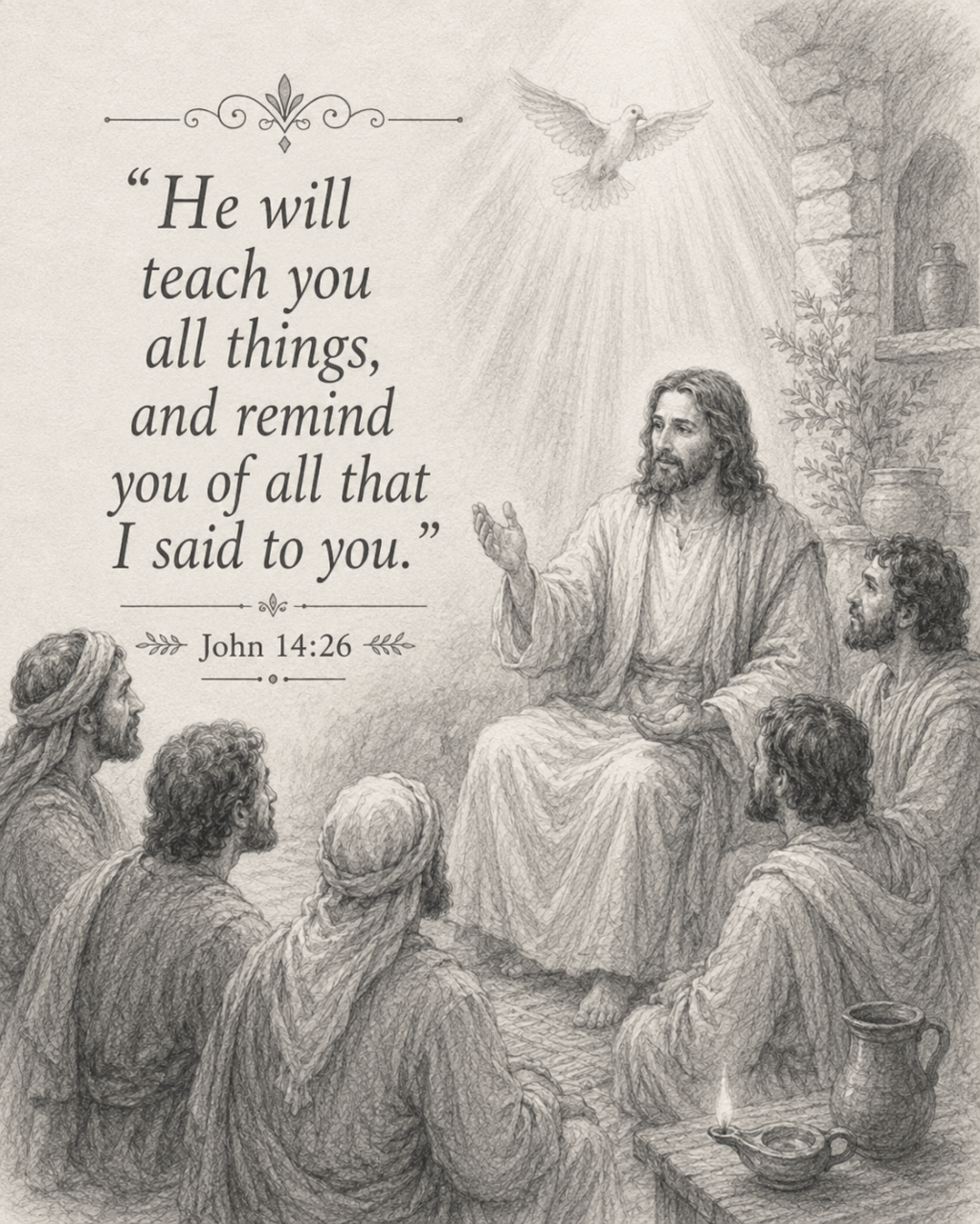
3. The Spirit as Teacher — Christ Kept at the Center (John 14:25–26)
Jesus says of the Helper:
“He will teach you all things, and remind you of all that I said to you.” — 14:26
Two functions stand together: teaching and reminding.
For the apostles, this had immediate weight. Under the Spirit’s guidance, they would understand, preserve, and proclaim what Jesus taught. The New Testament did not arise from religious creativity. It arose from Spirit-taught, Spirit-reminded apostolic witness.
The enduring principle for the Church is equally clear: the Spirit does not lead believers away from the words of Jesus. He brings the words of Jesus back to the center.
This is one of the clearest tests for discerning spiritual claims. Someone may claim to be led by the Spirit while ignoring Scripture, contradicting Christ, exalting themselves, excusing sin, or spreading confusion. That is not the work of the Holy Spirit John 14 describes. The Spirit is not the Spirit of novelty. He is the Spirit of truth. He may freshly apply the Word — He does not replace it. He may convict personally — He does not contradict Scripture. He may empower the Church — He does not glorify human personality above Christ.
This matters for a church that takes the Spirit’s ongoing work seriously. We should not quench the Spirit. We should desire His teaching, conviction, courage, and gifts for witness. But every claimed movement of the Spirit is tested by whether it drives people back to Jesus and His words. The Spirit-filled church is not less biblical. It is more deeply governed by Scripture.
4. Peace That Walks Into the Storm (John 14:27)
“Peace I leave with you; My peace I give to you; not as the world gives do I give to you. Do not let your heart be troubled, nor let it be fearful.” — 14:27
The chapter opened with the command “Let not your heart be troubled” (14:1). It repeats the command here. The peace Jesus gives is directly tied to the trouble the disciples are in.
The world’s peace is circumstantial. When circumstances hold, the world calls it peace. When circumstances break, that peace is gone. Christ’s peace does not depend on circumstances holding. It rests on His communion with the Father, His finished work, His resurrection, the Spirit’s abiding presence, and His promised return.
That is why the disciples can be commanded not to be troubled even as Jesus walks toward the cross. Their circumstances will get worse before they get better. Their peace does not.
Christian peace is not denial, emotional numbness, or optimism. It is confidence in Christ while the storm continues.
5. “The Father Is Greater Than I” (John 14:28)
“You have heard that I said to you, ‘I go away, and I will come to you.’ If you loved Me, you would have rejoiced because I go to the Father, for the Father is greater than I.”
This sentence has been misused often — historically by the Arians, currently online in various forms — to argue that Jesus is not truly God, is a lesser being, or is a subordinate deity. That reading fails on two counts.
First, it contradicts what Jesus has already said in this same chapter: “I am in the Father and the Father is in Me” (14:10–11); “Whoever has seen Me has seen the Father” (14:9). A merely created being cannot make such claims.
Second, the historic Christian reading — held from the earliest Fathers onward — understands “greater” in the context of Christ’s incarnate mission. The Son, in becoming man, voluntarily took on human limitation, obedience, and death. The Father sent Him. He came. Within that ordered relationship of sending and being sent, and within the humility of the incarnation, the Father holds a position the incarnate Son voluntarily entered beneath. This is not a difference of divine essence. It is a difference of role within the mission of redemption.
Jesus tells the disciples they should rejoice that He is going to the Father, because the Father’s welcome of the Son is the vindication of the Son’s mission and the guarantee of everything He has promised them.
Scripture must be allowed to interpret Scripture. Isolating this sentence to overturn what John has otherwise written throughout his Gospel is not a faithful reading.
6. The Ruler of This World, and the Command to Rise (John 14:29–31)
“I will not speak much more with you, for the ruler of the world is coming, and he has nothing in Me; but so that the world may know that I love the Father, I do exactly as the Father commanded Me. Get up, let us go from here.”
Jesus does not pretend that the next hours will be easy. Satan is real, active, and moving through the betrayal, the arrest, the injustice, and the cross. But Jesus makes two things clear.
First, “he has nothing in Me.” There is no sin in Jesus for Satan to accuse, no rebellion to exploit, no disobedience to claim. The cross is not Satan’s victory. It is Jesus’ obedient victory over sin, death, and the powers of darkness. He is not trapped. He is not surprised. He is not defeated.
Second, His obedience is the demonstration of His love for the Father: “so that the world may know that I love the Father, I do exactly as the Father commanded Me.” Love and obedience are joined at the top of the chapter in the disciples (14:15) and joined at the bottom of the chapter in Jesus Himself (14:31). What He asks of them, He is about to demonstrate perfectly.
This gives the Church a sober balance for thinking about spiritual conflict. We do not ignore the enemy. We do not obsess over him either. Jesus names him. Jesus does not center him. The Father’s will is central. The Son’s obedience is central. The victory is central.
Then the chapter ends with a command:
“Get up, let us go from here.”
Jesus does not give comfort so the disciples can stay in the room. He gives comfort so they can walk the road. He does not teach them so the teaching can end in discussion. He teaches them so they can follow Him faithfully when He is no longer visibly present.
There is a pattern here for how Jesus discipled His people:
First, He tells the truth. Second, He gives promises. Third, He gives peace. Fourth, He calls His people to rise and walk.
For our church, this is a timely word. Comfort is not the same as inactivity. Bible study is not meant to end in discussion only. The Word of God strengthens the people of God so they can obey God — in loving one another, forgiving, serving, telling the truth, bearing witness, making disciples, and facing the hard thing with Christ’s peace rather than with fear.
The Chapter in One Sentence
The peace of Christ is not given so that troubled disciples can stand still in fear. It is given so that loved and obedient disciples can walk forward, indwelt by the Spirit, kept centered on Jesus’ words, unafraid of the ruler of this world, into whatever the Father is calling them to do next.
Emphasis for Sunday, July 5
Part 1 answered who Jesus is. Part 2 answers what love for Jesus looks like when the room ends. The pivot for Sunday is the joining of three things Jesus refuses to let the disciples separate:
- Love that stays inward and never becomes obedience.
- Obedience that has no love in it and becomes cold rule-keeping.
- Comfort that stops at consolation and never rises to walk.
The central question for the class is not, “Do we believe in the Holy Spirit?”
It is:
After hearing Jesus in John 14, what is He telling us to get up and do?
Observation and Reflection Questions
1. John 14:12 — the “greater works”
Look at what Jesus places right after the promise of “greater works.” What reason does He give? What kind of work does that reason describe — and what kind of work does it not describe?
(The reason — “because I am going to the Father” — points to witness carried outward after the cross, resurrection, and Pentecost, not to spectacle, prosperity, or scale. A small, hurting congregation is not disqualified from the promise; a spectacle-hungry one is redirected by it.)
2. John 14:15, 21, 23, 24 — love and obedience
Read the four verses together. How does Jesus describe what love for Him looks like? What does He not use to describe it?
(He does not say, “If you love Me, you will feel Me strongly,” or “If you love Me, you will always be warm toward Me.” He says obedience. For a person whose faith has gone dry, whose family is fighting, whose body hurts — this is news. Love is not measured today by what you feel. It is measured by what you do next.)
3. John 14:22–23 — Judas’ question
Judas asks why Jesus will show Himself to the disciples and not to the world. Look carefully at verse 23. What answer does Jesus give? What does that answer say about how a person comes to know Him?
(The answer is love and obedience, not secret information. This quietly removes the ground out from under any “hidden-knowledge” framework — online or otherwise — without naming one.)
4. John 14:26 — teach and remind
Jesus says the Helper will “teach you all things” and “remind you of all that I said to you.” Both. Together. If someone today claims the Spirit is teaching them something Jesus never said, what does verse 26 offer for testing that claim?
(Discernment question. Text-anchored. Doesn’t attack any teacher. Hands the class a practical test they can use for the rest of their lives.)
5. John 14:1 and 14:27 — the same command, twice
The chapter opens with “Let not your heart be troubled” and returns to the same command in verse 27. Between those two verses, what specific things does Jesus give the disciples that make it possible for them to obey the command?
6. John 14:31 — peace, and then movement
The chapter ends with Jesus rising from the table and walking toward the cross. He gives peace, and then He moves. What does it change about His peace to see it followed immediately by walking into the hardest hours of His life?
Patristic (Church fathers) Voices Referenced
Origen of Alexandria (c. 185–253) — early biblical interpreter; treated Christ’s titles (“way, truth, life”) as distinct saving realities in his Commentary on John.
Tertullian (c. 155–240) — early Latin theologian; used John 14 to defend both the unity and the personal distinction of Father, Son, and Spirit against modalism.
Athanasius of Alexandria (c. 296–373) — leading defender of Nicene orthodoxy against Arianism; in his Letters to Serapion extended the Nicene argument to the full divinity of the Holy Spirit, and consistently insisted that verses like “the Father is greater than I” be read in light of the whole of John.
John Chrysostom (c. 347–407) — preached the Homilies on John to his Constantinople congregation; treated Christ’s peace as the anchor that holds while the storm continues above.
Augustine of Hippo (354–430) — the Tractates on the Gospel of John remain one of the most influential expositions of John in Christian history; carefully distinguished what Christ says according to His divine nature from what He says according to His incarnate mission.
Cyril of Alexandria (c. 376–444) — his Commentary on John emphasized the Spirit’s role in uniting the believer to Christ and making the believer a true dwelling place of God.
Irenaeus of Lyons (c. 130–202) — used the “many dwelling places” of 14:2 to defend the real, embodied hope of resurrection against Gnostic escapism.
 John Hargrove Seeking Truth and Reality