Text: 1 John 2:3–6
Proposition: A man can walk near Jesus a long time and still not be in Him. The tell is not how close he stood. The tell is not how much he knew. The tell is whether his life walks the way Jesus walked.
Church, we come this morning back to John.
For a while now we have been walking through the Gospel of John together. We watched Jesus turn water into wine at Cana. We stood at the well in Samaria. We saw Him feed the five thousand and open the eyes of a man born blind. We heard Him say, “I am the bread of life.” “I am the light of the world.” “I am the resurrection and the life.” “I am the true vine.”
We spent a Sunday not long ago in John 15. Some of you will remember. Jesus told His disciples that He is the true Vine, and we are the branches. He said, “Abide in Me, and I in you.” He said, “Apart from Me you can do nothing.” We saw that the Father is the vinedresser. We saw that pruning is care. We saw that Jesus does not use us like tools — He calls us friends.
That was the invitation.
This morning we are going to sit with the question that comes right after the invitation.
Because if Jesus says, “Abide in Me,” the honest question in every faithful heart is this. How do I know I am actually in Him?
We are going to ask that question this morning by turning to the first letter of John. This is the same disciple. The same John who was there in the upper room. The same John who leaned on Jesus at supper. The same John who stood at the cross when nearly everyone else ran. But he is older now. He is writing to a church that is fighting a hard fight — a fight against people who have knowledge without life. Correct doctrine without obedience. Confidence in Christ without a walk that looks anything like Him.
And John, who heard Jesus say “abide” with his own ears, sits down and tells that church how to know.
Listen.
1 John 2:3–6 (Parallel Reading)
NASB: “By this we know that we have come to know Him, if we keep His commandments. The one who says, ‘I have come to know Him,’ and does not keep His commandments, is a liar, and the truth is not in him; but whoever keeps His word, in him the love of God has truly been perfected. By this we know that we are in Him: the one who says he abides in Him ought himself to walk in the same manner as He walked.”
ESV: “And by this we know that we have come to know him, if we keep his commandments. Whoever says ‘I know him’ but does not keep his commandments is a liar, and the truth is not in him, but whoever keeps his word, in him truly the love of God is perfected. By this we may know that we are in him: whoever says he abides in him ought to walk in the same way in which he walked.”
BSB: “By this we can be sure that we have come to know Him: if we keep His commandments. If anyone says, ‘I know Him,’ but does not keep His commandments, he is a liar, and the truth is not in him. But if anyone keeps His word, the love of God has been truly perfected in him. By this we know that we are in Him: Whoever claims to abide in Him must walk as Jesus walked.”
Church, hear this before we go any further. This sermon is not a corrective sermon. It is not a sermon designed to make anybody sit up straight or shrink down small. It is a mirror sermon. And I am going to stand in front of the mirror first. You are welcome to stand beside me.
Because here is what we are going to see this morning.
The obeying is not what puts us in the Vine. The obeying is what shows the Vine is in us.
Say it with me if you can. The obeying is not what puts us in the Vine. The obeying is what shows the Vine is in us.
Now hold that.
Because we are going to look at three men this morning. Three men who were near Jesus. Two of them lost Him. One of them was restored. And the difference will preach.
I. Proximity is not possession. (Judas.)
John 13:21–30
Turn with me to John chapter 13. This is the upper room. This is the same night Jesus said, “I am the true vine.” This is the same table where He washed their feet.
“Jesus then answered, ‘That is the one for whom I shall dip the morsel and give it to him.’ So when He had dipped the morsel, He took and gave it to Judas, the son of Simon Iscariot. After the morsel, Satan then entered into him. Therefore Jesus said to him, ‘What you do, do quickly.’ . . . So after receiving the morsel he went out immediately; and it was night.” — John 13:26–27, 30
Church, look at this man.
Judas walked with Jesus for three years.
Not three days. Not three months. Three years. He was there when the water became wine. He was there when the five thousand were fed. He was there when Lazarus walked out of the tomb. He heard the Sermon on the Mount. He heard “blessed are the poor in spirit.” He heard “I am the bread of life.” He heard every “I am” statement in this Gospel with his own ears.
He held the money bag. He was trusted with the finances of the ministry.
He sat at the Last Supper.
He let Jesus wash his feet.
Jesus reached across that table and handed him a piece of bread, dipped in the dish, out of His own hand.
And then John says this. He went out immediately. And it was night.
Three years of proximity. And it was night.
Church, this is the hardest sentence in the Gospel of John, and I want us to sit with it. A man can be that close to Jesus and go out into the night.
Now hear me. I am not standing up here this morning to point at anybody in this room and say, “Watch out — you might be Judas.” That is not the point of this text. That is not why John wrote it. Judas is not a stone we throw. Judas is a warning we receive.
And the warning is for me first.
Because I have been a pastor for years. I have preached a lot of sermons. I have baptized folks. I have buried folks. I have prayed at hospital beds and at gravesides. I have taught this Bible and I have been taught by it.
And the question John puts in front of me this morning is this. Have I mistaken proximity for possession?
Have I confused doing church for being in Christ?
That is not a comfortable question. But it is a mercy question. Because it is better to ask it now than to hear the answer later.
And it is not a question just for the pulpit. It is a question for all of us. A man can sit in these pews for thirty years. A woman can teach the children’s class for a generation. A family can have their name on the roll and their pew where it has always been. All of that can be true, and none of it settles the question.
You can be close to Jesus without being in Jesus.
Judas is the proof.
So we look at the mirror this morning and we ask the honest question. Am I near Him, or am I in Him?
We are going to hold that question open. We are not going to answer it yet. Because the text is going to answer it for us in a minute.
But first, we have one more figure to look at.
II. Knowledge is not trust. (Satan knows the Bible.)
Matthew 4:1–11
Turn with me to Matthew chapter 4.
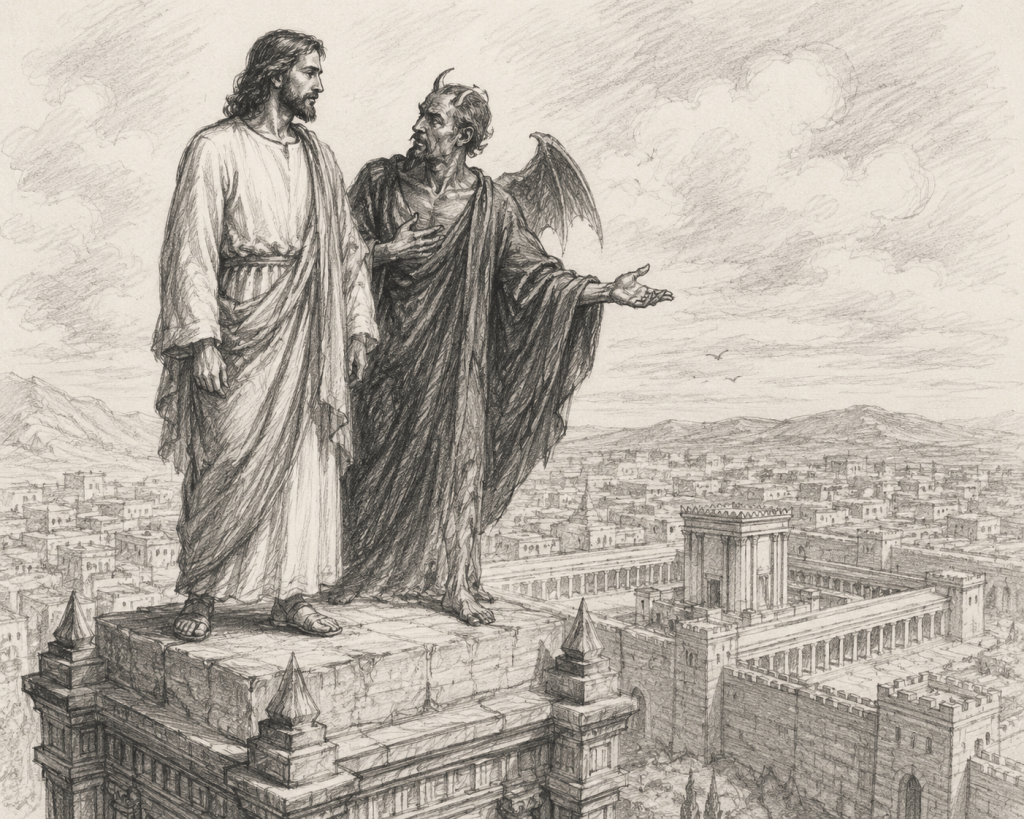
This is the wilderness. Jesus has just been baptized. The heavens opened. The Father spoke. The Spirit descended. And the Spirit — the same Spirit — led Him out into the wilderness to be tempted by the devil.
You know the story. Forty days. No food. Weakness. And the tempter comes.
But look at what the tempter uses.
“Then the devil took Him into the holy city and had Him stand on the pinnacle of the temple, and said to Him, ‘If You are the Son of God, throw Yourself down; for it is written, “He will command His angels concerning You”; and “On their hands they will bear You up, so that You will not strike Your foot against a stone.”’” — Matthew 4:5–6
Church, look at what the devil quoted.
He quoted Psalm 91.
He quoted it accurately.
“He shall give His angels charge over you, to keep you in all your ways; in their hands they shall bear you up, lest you dash your foot against a stone.” That is Psalm 91, verses 11 and 12. The tempter got the chapter right. He got the verses right. He got the wording close enough that any Bible teacher in this county would nod his head.
The devil knows the Bible.
He is not a theological illiterate. He is not confused about the text. He can cite chapter and verse. He can quote it under pressure. He has read it a lot longer than any of us have.
And it does not save him.
Now hear me, church. This is not a small thing. Because we live in a moment in the American church where knowing the Bible is treated as though it were the same thing as knowing the Lord.
They are not the same thing.
“You believe that God is one. You do well. The demons also believe — and shudder.” — James 2:19
The demons have better theology than most of us. They know Jesus is the Son of God. They knew it before the disciples knew it. In the Gospels, when Jesus walks into a synagogue, the demons cry out, “We know who You are — the Holy One of God.” They have their doctrine straight.
And it does them no good at all.
Because knowing about Jesus is not the same thing as trusting Jesus.
Knowing the Bible is not the same thing as bending your life to the Bible.
Paul said it plain in 1 Corinthians 8. “Knowledge puffs up, but love builds up.” A man can have his Bible half memorized and his heart half hardened at the same time. The knowledge does not soften the heart. Only the Spirit does that. And a man can go to seminary, and know Greek, and preach every Sunday, and still not know the Lord.
I have to ask the mirror question again, church, because I am the preacher and the mirror is in front of me too.
Do I have knowledge, or do I have trust?
Do I know a lot of things about God, or do I know God?
Do I believe correct doctrine, or do I believe Him?
Because those are not the same question.
The demons pass the doctrine test. And Judas passed the proximity test. And neither one was saved.
So how do we know?
That is where John takes us.
III. Obedience is the tell. (1 John 2:3–6.)
1 John 2:3–6
Come back with me to 1 John chapter 2.
The apostle does not leave the church guessing.
Look at verse 3.
“By this we know that we have come to know Him, if we keep His commandments.” — 1 John 2:3
Church, John does not soften that.
By this we know.
He does not say, “By our feelings we know.” He does not say, “By our doctrine we know.” He does not say, “By our church attendance we know.” He does not say, “By how sincere we are we know.”
He says, by this we know — if we keep His commandments.
Verse 4 is harder still.
“The one who says, ‘I have come to know Him,’ and does not keep His commandments, is a liar, and the truth is not in him.” — 1 John 2:4
That is strong language. John does not use language like that lightly. He uses it here because the stakes could not be higher. A confession without a life is a lie. Not because the confession failed. Because the confession was never true to begin with.
Verse 5.
“But whoever keeps His word, in him the love of God has truly been perfected.” — 1 John 2:5
Now hear that. The obedient life is not a striving life that hopes to be perfected someday. It is the place where the love of God has already been perfected. The love of God is not just felt in the obedient heart. It is completed there. It comes to rest.
Verse 6.
“The one who says he abides in Him ought himself to walk in the same manner as He walked.” — 1 John 2:6
There is our word, church. Abides. Same word Jesus used in John 15. Same word we sat with a few weeks ago. Same word the same John used both times.
To abide in Him is to walk the way He walked.
Now hear me carefully. This is not a sermon telling us to be sinless.
Jesus did not fall. We do.
John is not saying that the mark of the true disciple is that he never stumbles. If that were true, none of us would qualify. John himself, a few verses earlier in chapter 1, said, “If we say that we have no sin, we deceive ourselves.” So he is not asking for sinlessness.
He is asking about the direction of the walk.
A man in the Vine falls and gets up. He confesses. He returns. He walks on. His whole life is bending, over time, in the direction of the One who is inside him.
A man outside the Vine falls, and stays down, and calls the falling his identity. He does not confess. He does not return. His life is not bending toward Christ. It is running from Christ, or running around Christ, or running past Christ — but not with Him.
The tell is the direction of the walk.
And this is what we said in Abide, church. This is not new material. This is the same truth from another angle. When we sat with John 15 we said abiding is not a mood. It is not a Sunday feeling. It is not a poster on the fellowship hall wall.
Now the beloved apostle tells us what abiding looks like in shoe leather.
It looks like a walk.
Not a perfect walk. A walk in the same direction as His.
Hear the truth of the sermon one more time, and then we are going to turn the corner.
The obeying is not what puts us in the Vine. The obeying is what shows the Vine is in us.
If we are in Him, the walk will come. Not all at once. Not without stumbles. Not without seasons. But it will come. Because His life is in us, and His life produces a walk that looks like His.
That is the diagnostic John gives.
By this we know.
Landing
Church, before we close, we need to look at one more man.
We have looked at Judas, who walked near Jesus for three years and went out into the night.
We have looked at the tempter, who quotes Scripture and cannot be saved by it.
Now we need to look at Peter.
Because there is a man in the Gospel of John who failed the Lord in the same week Judas did. And what happened to him is the reason this sermon is not a threat but a mercy.
You remember what Peter did.
He said in the upper room, “I will lay down my life for You.” And Jesus said, “Peter, before the rooster crows, you will deny Me three times.”
And Peter did.
He warmed his hands at a charcoal fire in the courtyard of the high priest. And three times he was asked, and three times he said, “I do not know Him.”
Two men who walked with Jesus. Two men who failed Him in the same week. One kissed Him in the garden and betrayed Him. One warmed his hands at a fire and denied Him.
What separated them was not the failure. Both failed. Peter’s failure was public. Judas’s failure was hidden. But both failed.
What separated them was what they did with the failure.
Judas went out to a field.
Peter went back to the fire.
Turn with me to John chapter 21.
It is after the resurrection. The disciples have gone back to Galilee. They have been fishing all night and caught nothing. Jesus stands on the shore in the morning and calls out to them. They do not know it is Him at first. But John does. John says, “It is the Lord.” And Peter — the same Peter who denied Him three times — jumps into the water and swims to shore.
And when they get to the beach, Jesus has a fire going.
“So when they got out on the land, they saw a charcoal fire already laid and fish placed on it, and bread.” — John 21:9
Church, hear that. It is a charcoal fire.
Peter denied Jesus at a charcoal fire.
And Jesus makes another charcoal fire on the beach, and He calls Peter over to it.
He is not there to convict Peter. He is not there to shame him. He is there to feed him.
And then, at that fire — the fire that must have smelled to Peter like the worst night of his life — Jesus asks the question three times. Once for each denial.
Simon, son of John — do you love Me?
Simon, son of John — do you love Me?
Simon, son of John — do you love Me?
And three times, Peter says yes.
And three times, Jesus says, feed My sheep.
Church, hear this. This is where the sermon lands.
There is a charcoal fire waiting for every one of us.
If you have been near Him without being in Him — He is not done with you.
If you have known the Bible without knowing Him — He is not done with you.
If you have failed Him this week, or this year, or for most of a lifetime — He is not done with you.
There is a fire on the beach.
He is not there to convict you.
He is there to feed you.
And the question He is going to ask you at that fire is not, “How much do you know about Me?” It is not, “How close have you been to Me?” It is one question, three times.
Do you love Me?
That is the whole examination.
Not proximity. Not knowledge.
Love that walks the way He walked.
Come sit down.
Amen.

