
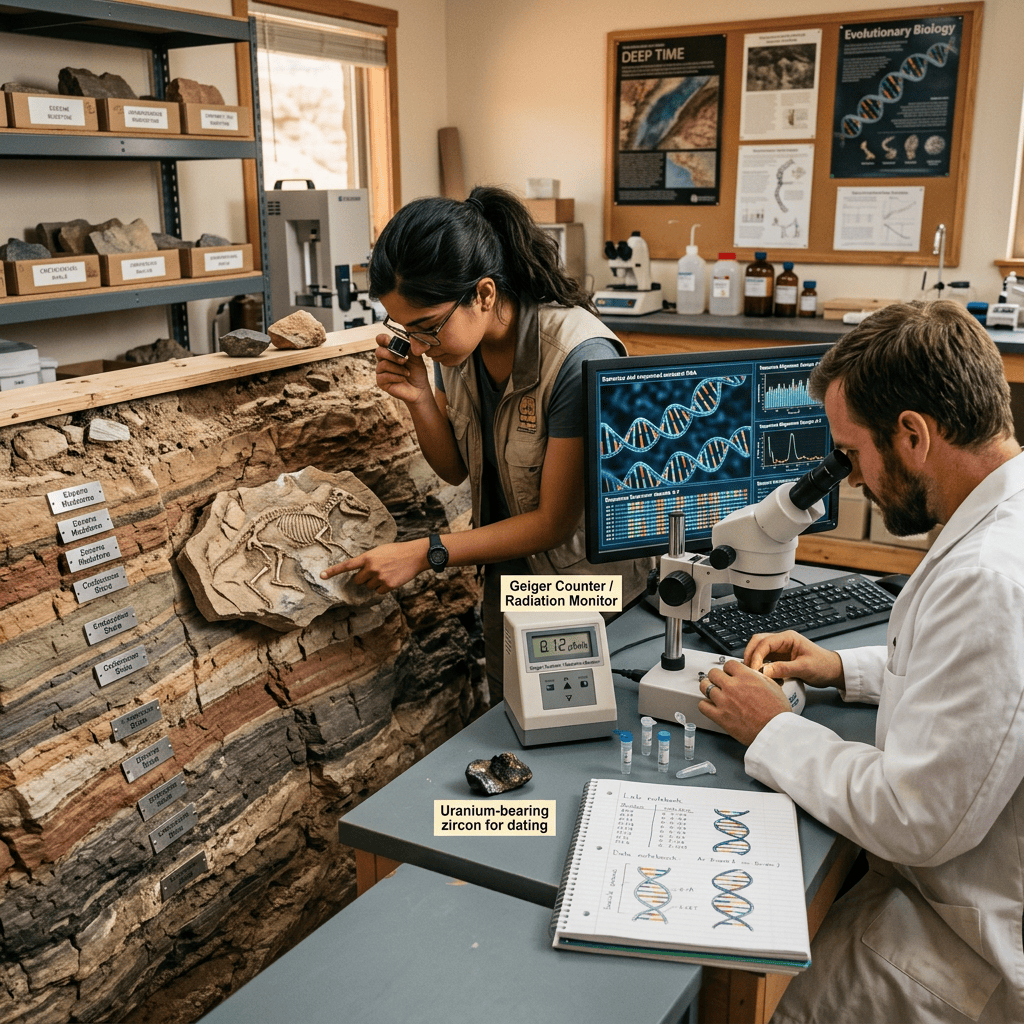
Almost every argument you will encounter about origins — from a preacher, a science documentary, a YouTube video, a textbook, a Facebook post — is a stack of four different kinds of claims mixed together into one confident sentence. If you cannot separate the four, you cannot think clearly about any of it. If you can, most of the loudest debates suddenly become manageable.
Here are the four.
Observation. What can be directly seen or measured. A rock layer. A fossil in a particular position. A DNA sequence. Preserved proteins in a dinosaur bone. Cosmic background radiation. Observations are the ground floor. They do not, by themselves, tell you what they mean.
Interpretive model. How the observation is explained. Plate tectonics. Radiometric chronology. Common ancestry. A global flood. Catastrophic plate tectonics. Intelligent design. A model is a proposal about what produced the observation.
Philosophical assumption. What kinds of explanations are permitted before the evidence is even examined. Methodological naturalism, which restricts scientific explanation to natural causes. Uniformity of natural law. Causal adequacy. Inference to the best explanation. These are not conclusions of science. They are commitments about how science is to be done.
Biblical interpretation. What Scripture is understood to teach. Six ordinary creation days. Literary or analogical days. Historical Adam. Entrance of death. Global or regional Flood. These are readings of the text, which — like all readings — are the work of readers.
Now watch what happens when you learn to separate these.
Someone shows you a slide with preserved soft tissue in a dinosaur bone and says, “Therefore the dinosaur is only a few thousand years old.” Level one is the observation: preserved soft tissue exists in this fossil. That is real, and it is genuinely interesting. Level two is the model being proposed: the tissue is recent, therefore the fossil is recent. That is a conclusion, not an observation. And it requires additional assumptions — including that we already understand the full chemistry of long-term preservation, which we may not. Someone else can look at the same observation and propose a different model, including preservation mechanisms that were not previously understood. The tissue is real. The conclusion is an inference.
The same discipline applies in the other direction. Someone shows you the fact that certain DNA sequences are shared between humans and other primates and says, “Therefore intelligent design is impossible.” Level one is the observation: DNA is shared. Level two is a model: common ancestry. Level three is a philosophical assumption: only undirected natural processes count as explanations. And level four is a theological conclusion that has been imported into what was presented as a purely scientific argument.
Neither of these examples proves the person is wrong. That is not the point. The point is that they are not making one claim. They are making four, stacked. If you agree only with the observation, you are not obligated to agree with the model. If you agree with the model, you are not obligated to agree with the philosophical assumption. And the theological conclusion — whichever direction it goes — was not doing the work anyone thought it was doing.
This is not skepticism about science, and it is not skepticism about Scripture. It is the discipline required to think clearly about either one. Scripture itself is careful to distinguish between what God has said and what people have concluded from what God has said. Job’s counselors reason a great deal from observations that turn out to be true, to conclusions that turn out to be false. Their observations are not the problem. Their inferences are the problem. And when God finally speaks, He does not condemn them for observing. He condemns them for not knowing where their observations stopped and their inferences began.
If you take away only one thing from this series, take this. When a claim is being pressed on you — Christian, scientific, or otherwise — pause long enough to ask which of the four levels is doing the work. It changes everything.

