
Trump, Institutional Resistance, and the Constitutional Problem of Informal Power
A Constitutional White Paper
September 2026
Executive Summary
The political conflict surrounding Donald Trump since 2015 presents a constitutional problem larger than whether Trump himself is good or bad for the United States.
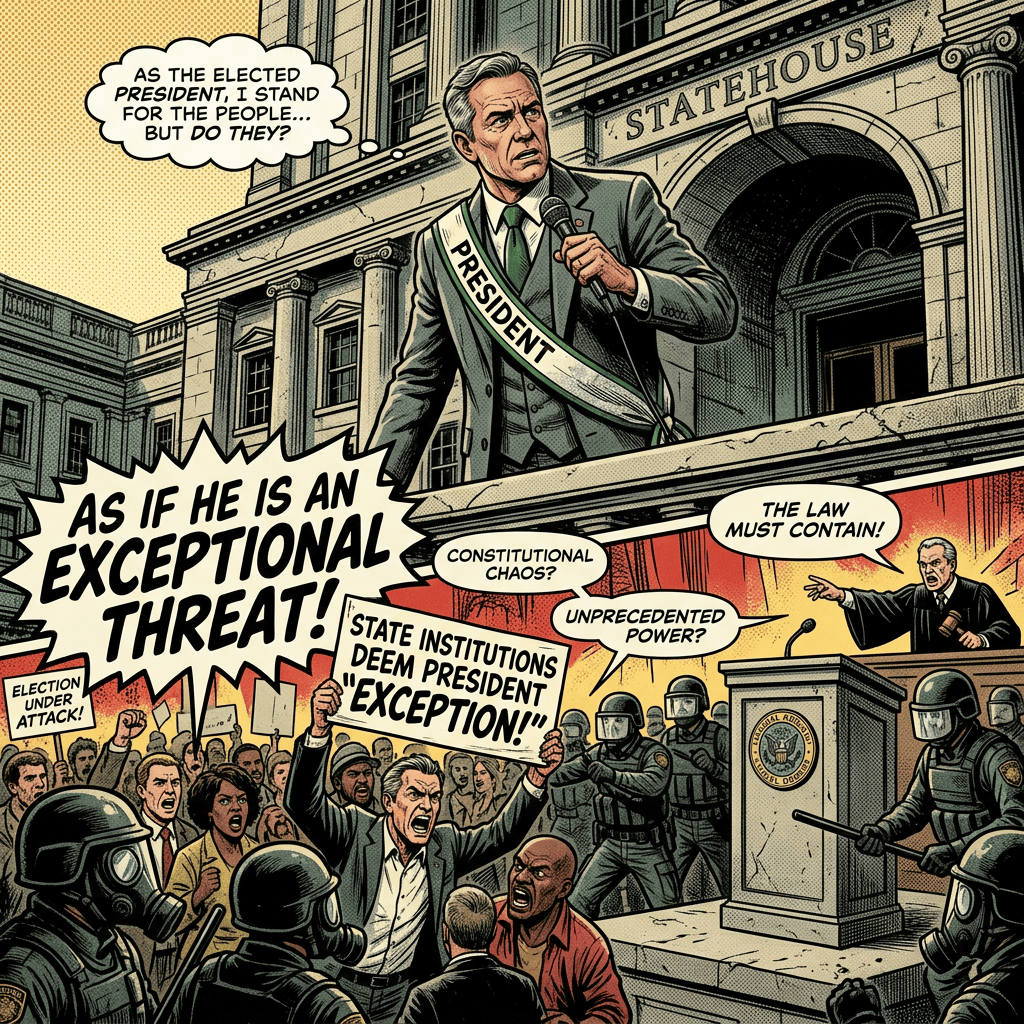
The more important question is what happens to a constitutional republic when substantial numbers of influential people across government, law enforcement, intelligence, Congress, media, corporations, technology companies, advocacy organizations, academia, and other institutions become convinced that an elected political leader represents an exceptional threat—and consequently conclude that extraordinary resistance is justified.
This paper examines a hypothesis rather than asserting a proven conspiracy:
Beginning with Donald Trump’s emergence as a serious presidential candidate, many influential actors independently concluded that Trump threatened important political, institutional, cultural, or international arrangements. Over time, some of those actors communicated, cooperated, exchanged information, coordinated strategies, or simply responded similarly because they shared assumptions about the danger Trump represented. The resulting institutional convergence sometimes operated without centralized direction yet could produce effects resembling coordinated opposition.
Documentary evidence shows particular instances of cross-institutional coordination. Evidence also shows serious institutional mistakes and disputed exercises of governmental power during the Trump era. But the available evidence does not establish a single organization directing the entire twelve-year resistance to Trump.
The distinction is critical.
A centralized conspiracy is not necessary for a constitutional problem to exist.
The more plausible danger is distributed institutional coordination reinforced by ideological consensus and emergency justification.
Under such circumstances, people acting in subjective good faith can collectively weaken constitutional norms because each believes extraordinary circumstances justify actions that would otherwise be unacceptable.
The United States may consequently be entering a period in which the central constitutional struggle is no longer simply Republican versus Democrat or Trump versus his opponents.
It is increasingly a struggle over the meaning of institutional legitimacy itself.
That raises profound questions about prosecutorial discretion, intelligence activities, presidential authority, the administrative state, congressional oversight, federalism, the judiciary, elections, freedom of expression, civil-service independence, executive control, and ultimately the sovereignty of the electorate.
The greatest constitutional danger may not be domination by either faction.
It may be the normalization of the principle:
“Because the other side represents an extraordinary threat, ordinary constitutional restraint is no longer sufficient.”
Once one political coalition accepts that principle, the other can use it.
The resulting cycle can transform constitutional government from a system of competing institutions restrained by law into a continuing struggle for institutional control.
I. The Constitutional Question
The American Constitution does not assume political harmony.
It assumes conflict.
James Madison’s famous observation that “ambition must be made to counteract ambition” captures the Framers’ expectation that people in power would defend their interests and institutional authority. The constitutional structure therefore distributes power among Congress, the President, courts, states, and ultimately the electorate rather than trusting any particular faction with permanent control. The Congressional Research Service’s Constitution Annotated describes separation of powers precisely in these terms: institutional friction is a safeguard against arbitrary concentration of authority.
Resistance to a president is therefore not evidence of constitutional malfunction.
It is often evidence that the Constitution is functioning.
Congress should resist presidential usurpation of legislative authority.
Courts should invalidate unconstitutional executive actions.
State governments should defend their constitutional powers.
Journalists should investigate presidents.
Prosecutors should prosecute crimes when the evidence and law justify prosecution.
Career officials should refuse unlawful orders.
Citizens should organize politically against policies they oppose.
The constitutional problem begins somewhere else.
It begins when institutional actors stop asking:
“What does my constitutional or legal responsibility require?”
and begin asking:
“What must I do to stop this particular political actor?”
Those questions sometimes produce the same answer.
But they are not constitutionally equivalent.
The first places law above political necessity.
The second risks placing perceived political necessity above law.
II. The Trump Disruption
Trump’s political significance cannot adequately be understood merely as another change in presidential administration.
Beginning in 2015, he challenged important assumptions held not only by Democrats but by substantial elements of the Republican establishment and many institutions outside electoral politics.
His challenges included immigration enforcement, trade with China, globalization, NATO burden-sharing, military intervention, climate and energy policy, international institutions, the administrative state, intelligence agencies, federal law enforcement, elite universities, major media institutions, and later diversity and identity-based governmental policies.
Trump simultaneously challenged the authority of institutions that normally disagreed with one another.
That distinction matters.
A conventional political leader may threaten another party’s policies.
A disruptive political leader can threaten the institutional equilibrium through which policy is produced.
If influential people throughout that equilibrium concluded that Trump threatened not merely particular policies but the integrity of the system itself, unusually intense resistance becomes understandable without requiring a centrally managed conspiracy.
III. The Institutional-Convergence Hypothesis
The hypothesis examined here can be stated more precisely.
Suppose that people occupying important positions throughout American society independently reached a similar conclusion:
Donald Trump represented an exceptional threat to democratic government, established institutions, international relationships, or the political order itself.
Different people could reach that conclusion for different reasons.
An intelligence official might fear national-security consequences.
A prosecutor might fear criminal misconduct.
A career civil servant might fear destruction of an agency’s mission.
A journalist might fear authoritarianism.
A technology executive might fear disinformation.
An environmental organization might fear deregulation.
A European policymaker might fear American abandonment of existing alliances.
A Republican internationalist might fear isolationism.
An immigration advocate might fear mass deportation.
A corporate executive might fear instability.
None needs to participate in a conspiracy.
Each possesses an independent reason for opposition.
But something important happens when these people communicate.
Professional networks connect government officials, journalists, congressional staff, academics, lawyers, former officials, corporations, nonprofit organizations, political consultants and technology companies.
People move between these institutions.
They share sources.
They attend conferences.
They exchange information.
They recommend personnel.
They appear together on panels.
They leak information.
They develop professional consensus.
They reinforce one another’s assessments.
Eventually a decentralized network can acquire considerable coherence.
This is institutional convergence.
IV. Coordination Without Central Command
Modern network theory provides a better conceptual model for this possibility than the traditional idea of conspiracy.
A conspiracy normally implies hierarchy:
A directs B.
B instructs C.
C executes the plan.
But decentralized systems operate differently.
Imagine hundreds of interconnected nodes.
Government officials communicate with journalists.
Journalists communicate with advocacy organizations.
Advocacy organizations communicate with lawyers.
Lawyers communicate with congressional staff.
Congressional staff communicate with former government officials.
Former officials communicate with technology companies.
Technology executives communicate with academics and nonprofit organizations.
None controls the network.
Yet information, assumptions and priorities propagate through it.
Once enough important nodes accept the proposition that Trump constitutes an extraordinary threat, coordinated behavior can emerge without centralized control.
Participants may sincerely believe they are independently fulfilling their professional responsibilities.
From outside the network, however, the aggregate effect can resemble orchestration.
This distinction provides a possible middle ground between two simplistic explanations:
“Everything was a conspiracy.”
and
“Nothing was coordinated.”
Reality can occupy the substantial territory between those propositions.
V. The 2020 Election Provides an Important Case Study
One unusually transparent example appeared after the 2020 election.
TIME subsequently documented what it described as a loosely organized, cross-institutional effort involving progressive organizations, labor, business interests, election organizations, technology companies and some Republicans. Participants coordinated election-related legal strategies, messaging, information-sharing and preparations for possible post-election disruption.
The article describes regular meetings bringing together hundreds of participants and says the network had “no name, no leaders and no hierarchy” while nevertheless keeping disparate organizations aligned. It also describes efforts involving Congress, Silicon Valley, state governments, business organizations, labor organizations and election advocacy groups.
The participants described their objective not as defeating Trump through election manipulation but as protecting the integrity of the election against what they regarded as foreseeable attempts to undermine it.
Those distinctions should be respected.
But constitutionally the episode demonstrates something important:
Large numbers of powerful organizations can coordinate informally around a common perception of political danger without a centralized command structure.
That does not establish that the same network controlled investigations, prosecutions, media coverage or other actions involving Trump.
It establishes the plausibility of the mechanism.
VI. Crossfire Hurricane and the Problem of Institutional Judgment
The investigation of the Trump campaign’s possible connections with Russia provides another useful example, although a considerably more complicated one.
The controversy produced years of investigation into both Trump associates and the investigators themselves.
The important constitutional lesson is not that one side’s complete narrative was proven.
It is that enormously consequential governmental decisions depended upon human judgment exercised within institutions operating under extreme political conditions.
Questions arose concerning investigative predication, confidential sources, surveillance applications, verification of allegations, information supplied through politically connected channels and the conduct of individual officials.
Those circumstances demonstrate why constitutional government cannot depend exclusively upon the good intentions of officials.
People sincerely convinced that they are protecting the country can still exercise poor judgment.
They can experience confirmation bias.
They can discount contradictory evidence.
They can trust sources they should distrust.
They can interpret ambiguity according to expectations.
They can regard procedural safeguards as obstacles rather than protections.
That is precisely why constitutional government relies upon procedures rather than virtue alone.
VII. The Constitutional Problem of Lawfare
The word “lawfare” is frequently used too casually.
Not every prosecution of a political figure constitutes lawfare.
Political office cannot create immunity from ordinary criminal law.
Conversely, the existence of probable cause or a legally available charging theory does not automatically establish that prosecutorial power has been exercised neutrally.
The constitutional concern lies principally in discretion.
Modern government contains enormous discretionary authority.
Investigators decide whom to investigate.
Prosecutors decide whom to charge.
Agencies decide whom to audit.
Regulators decide where enforcement resources should be concentrated.
Congress decides whom to investigate.
State attorneys general exercise similar discretion.
Most of those decisions are unavoidable.
The danger arises when political consensus influences the exercise of discretion.
The constitutional question therefore should not simply be:
“Was there a legal theory supporting the action?”
A better inquiry is:
“Would similarly situated individuals ordinarily have been investigated, charged, sued, sanctioned or subjected to the same governmental resources?”
That is a substantially more difficult question.
It requires comparative evidence rather than partisan intuition.
VIII. Trump v. United States and the Constitutional Reaction
The Supreme Court’s 2024 decision in Trump v. United States should be understood partly against this background.
The Court confronted the unprecedented federal criminal prosecution of a former president for conduct allegedly involving actions taken while president.
It held that a former president possesses absolute immunity from criminal prosecution for conduct within the President’s exclusive constitutional authority and at least presumptive immunity for other official acts. Unofficial conduct receives no presidential immunity.
The Court explained that the protection exists partly because the possibility of later prosecution could distort presidential decision-making. A president must be able to exercise constitutional authority without constantly calculating whether a future administration might criminally prosecute those decisions.
Whatever one thinks of the specific litigation, the underlying constitutional problem is real.
If administrations routinely prosecute predecessors for disputed exercises of presidential authority, peaceful transfers of power become much more dangerous.
Presidents acquire incentives to remain in power.
Successors acquire incentives to punish predecessors.
Future presidents become reluctant to exercise legitimate authority.
The criminal-justice system becomes intertwined with political succession.
The Constitution contains impeachment precisely because presidential misconduct sometimes requires political judgment by political institutions.
That does not place presidents above criminal law.
But it demonstrates why criminalizing disputes over presidential authority presents unusually serious separation-of-powers concerns.
IX. The Administrative State and the Problem of Democratic Control
The Trump conflict also exposes a longstanding constitutional tension surrounding the administrative state.
The President is elected.
Most federal employees are not.
That is intentional.
Professional civil-service protections help prevent every presidential transition from turning the federal government into a patronage system.
But career independence creates another problem.
What happens when career officials disagree profoundly with the policies of the elected president?
The President has the constitutional responsibility to “take Care that the Laws be faithfully executed.”
Yet implementation depends upon millions of executive-branch employees.
Trump’s second administration has explicitly attempted to resolve part of this problem by expanding presidential control over policy-influencing career positions. Its Schedule Policy/Career framework states that officials exercising policy influence must remain accountable to elected executive leadership while retaining merit-based career status.
Supporters can characterize this as democratic accountability.
Critics can characterize it as politicization of the professional civil service.
Both concerns have constitutional substance.
A bureaucracy completely independent of elected authority risks becoming an unelected fourth branch.
A bureaucracy completely dependent upon presidential favor risks becoming an instrument of personal presidential power.
The Constitution does not provide an effortless solution to that tension.
X. The Presidency and the Unitary Executive Question
The controversy therefore reaches one of the deepest unresolved questions in modern constitutional law:
Who controls the executive branch?
Article II states that “the executive Power shall be vested in a President.”
One interpretation emphasizes presidential authority over executive officials.
Another emphasizes Congress’s ability to establish independent agencies and protect certain officials from direct presidential control.
The Supreme Court has increasingly confronted that boundary.
In June 2026, for example, the Court reversed and remanded litigation concerning presidential removal of an FTC commissioner after specifically considering whether statutory removal protections violate separation-of-powers principles.
These disputes are not merely about Trump.
They concern the architecture of the American government.
Trump has simply forced questions that had accumulated for decades into the foreground.
XI. Media Power and the Constitution’s Informal Institutions
The Constitution regulates government.
It does not regulate political influence generally.
That creates another complication.
A newspaper, television network, university, nonprofit organization or technology platform is normally free to oppose a president.
Indeed, freedom to do so is fundamental to the First Amendment.
The press is supposed to scrutinize government.
Private citizens are supposed to organize politically.
Corporations and organizations possess their own lawful political interests.
The constitutional problem changes when governmental authority becomes intertwined with private information systems.
Government pressure on private platforms can raise First Amendment concerns.
Private organizations coordinating among themselves generally present different constitutional questions.
This distinction is essential.
A media consensus against Trump might be biased, mistaken or culturally homogeneous without being unconstitutional.
Government coercion of media organizations would present a fundamentally different issue.
Therefore:
bias is not censorship;
coordination is not necessarily conspiracy;
private persuasion is not governmental coercion;
and
governmental coercion cannot be excused merely because officials believe the information being suppressed is dangerous.
XII. Congress and the Transformation of Oversight
Congress possesses broad constitutional authority to investigate the executive branch.
Impeachment is explicitly constitutional.
Oversight is necessary.
But the same problem of emergency justification applies.
If congressional investigation becomes primarily a mechanism for destroying political opponents rather than supervising government, constitutional oversight can become partisan warfare.
The danger is symmetrical.
A Democratic Congress can abuse investigative power against a Republican president.
A Republican Congress can abuse investigative power against Democratic officials.
The constitutional question is not which party is conducting the investigation.
It is whether Congress is exercising legitimate legislative and constitutional authority according to principles it would accept when political control reverses.
XIII. Federalism as a Second Battlefield
State governments add another dimension.
American federalism intentionally creates competing centers of governmental power.
States can challenge federal policy.
State attorneys general can sue presidential administrations.
State prosecutors possess authority independent of the federal government.
That independence protects liberty.
But it also creates opportunities for political escalation.
Imagine successive cycles in which Republican prosecutors investigate prominent Democrats while Democratic prosecutors investigate prominent Republicans.
Every prosecution may possess an arguable legal foundation.
Yet the cumulative result could still transform criminal law into another battlefield of national politics.
The Fifth Amendment’s protections of due process and criminal procedure exist precisely because criminal prosecution represents one of government’s most coercive powers.
The constitutional norm therefore must be stronger than:
“Can prosecutors legally bring this case?”
It must include:
“Would we accept this standard if political control were reversed?”
XIV. Emergency Constitutionalism
This may be the most important concept arising from the Trump era.
Call it emergency constitutionalism.
Its premise is simple:
The normal rules are inadequate because the present threat is extraordinary.
History repeatedly demonstrates the attraction of this reasoning.
People rarely believe they are destroying constitutional government.
They usually believe extraordinary actions are necessary to save something important.
Applied to Trump, the reasoning can become:
Trump threatens democracy.
Therefore extraordinary investigation is justified.
Extraordinary surveillance is justified.
Extraordinary prosecution is justified.
Extraordinary information controls are justified.
Extraordinary bureaucratic resistance is justified.
Extraordinary political coordination is justified.
But the same logic can reverse:
The administrative state attempted to destroy Trump.
Therefore extraordinary presidential control is justified.
Extraordinary investigations of former officials are justified.
Extraordinary removal authority is justified.
Extraordinary action against hostile institutions is justified.
Extraordinary executive power is justified.
The danger becomes obvious.
Each side’s exceptional conduct becomes the other side’s justification for further exceptional conduct.
XV. The Constitutional Escalation Spiral
The process can be represented as a sequence:
1. Trump challenges established institutions.
2. Institutional actors perceive an extraordinary threat.
3. They exercise institutional power unusually aggressively.
4. Trump and his supporters interpret that resistance as evidence of institutional corruption.
5. They seek stronger presidential control over those institutions.
6. Opponents interpret stronger presidential control as confirmation of authoritarian intentions.
7. Resistance intensifies.
8. Presidential countermeasures intensify.
The cycle becomes self-validating.
Each faction can point to genuine actions by the other as evidence supporting its fears.
At that point identifying who “started it” becomes less constitutionally important than stopping the escalation.
XVI. The Sovereignty of the Electorate
The deepest issue may concern democratic sovereignty.
Suppose voters elect a president specifically because they want substantial institutional change.
What happens if institutions prevent that president from implementing the program?
Some resistance is constitutionally required.
A president cannot override statutes merely because he won an election.
He cannot disregard constitutional rights.
He cannot command courts.
He cannot eliminate Congress.
He cannot exercise powers the Constitution does not provide.
But there is an opposite danger.
If unelected institutions can systematically prevent an elected president from exercising lawful constitutional authority simply because institutional actors consider his policies dangerous, elections lose part of their meaning.
The constitutional system therefore requires two propositions to coexist:
Winning an election does not give a president unlimited power.
And:
Unelected institutions do not possess unlimited authority to nullify the consequences of elections.
Maintaining both propositions simultaneously is increasingly difficult.
XVII. What the Next Three Years May Represent
The remainder of Trump’s presidency may therefore be constitutionally more consequential than the preceding controversies.
The first Trump administration largely involved Trump attempting to operate institutions whose personnel and culture often predated him.
The second administration has placed considerably greater emphasis on changing those institutions themselves.
The administration explicitly argues that policy-influencing executive officials must be accountable to elected presidential authority. Its 2026 personnel order describes executive-branch accountability as essential to democratic self-government.
Consequently, the conflict has changed.
It is no longer simply:
Trump versus the administrative state.
Increasingly it is:
Trump’s attempt to reconstruct executive authority versus institutions seeking to preserve legal or institutional independence.
Some of those changes may survive Trump.
Others may be reversed.
The decisive constitutional question is whether durable rules emerge or whether each administration increasingly restructures institutions to defeat the opposing coalition.
XVIII. The 2028 Question
Trump himself is constitutionally temporary.
The institutional conflict is not.
The Twenty-Second Amendment prevents another elected Trump presidency after the present term.
The critical question therefore becomes whether the political realignment associated with Trump survives him.
If it does, the United States may be experiencing a durable transformation of the constitutional order comparable not necessarily in substance but in institutional significance to other major political realignments.
If it does not, future administrations may attempt to restore much of the pre-Trump institutional structure.
Thus the struggle between now and January 2029 is partly a struggle over institutional permanence.
Trump’s supporters have incentives to make changes difficult to reverse.
Trump’s opponents have incentives to prevent those changes from becoming embedded.
That creates enormous pressure on courts, Congress, agencies and the 2026 and 2028 elections.
XIX. The Most Dangerous Constitutional Development
The most dangerous outcome would not necessarily be Trump’s victory over the institutions.
Nor would it necessarily be the institutions’ victory over Trump.
The deeper danger would be establishing a precedent under which constitutional rules depend upon who controls government.
Consider the implications.
One administration prosecutes its predecessor.
The next prosecutes those prosecutors.
One administration pressures information platforms.
The next pressures hostile media organizations.
One administration expands administrative independence.
The next removes career officials.
One Congress aggressively investigates a president.
The next Congress investigates the investigators.
Each action supplies precedent for the next.
Eventually the question becomes not:
“What powers does the Constitution permit?”
but:
“What can our side get away with before the other side returns to power?”
That would represent a profound deterioration in constitutional culture.
XX. A Better Standard: The Reversibility Test
One of the most useful constitutional tests is remarkably simple.
Before supporting an exercise of governmental power, ask:
Would I want my political opponents to possess this same power?
If the answer is no, extreme caution is warranted.
Would conservatives want Democratic prosecutors possessing the precedent being created?
Would progressives want a Republican president possessing the executive authority being defended?
Would Republicans want Democratic intelligence officials exercising the same surveillance authority?
Would Democrats want Republican administrations exercising the same removal authority?
Would either side want hostile administrations controlling information according to their own definitions of misinformation?
This is not perfect constitutional doctrine.
But it captures something close to the Framers’ insight.
The Constitution was not designed on the assumption that virtuous people would always govern.
It was designed so that Americans could survive being governed by people they profoundly distrust.
XXI. What Would Demonstrate a Genuine Coordinated Network?
The institutional-convergence hypothesis should remain falsifiable.
Evidence strengthening it would include:
- documented communications among supposedly independent actors coordinating objectives or tactics;
- recurring personnel connections across government, advocacy organizations, media and political organizations;
- common funding networks tied directly to coordinated activity;
- evidence that governmental investigative information moved improperly into political or media channels;
- documented pressure on institutions to take actions against Trump or his supporters;
- substantial departures from ordinary investigative, prosecutorial or administrative procedures;
- differential treatment of similarly situated political actors;
- coordinated timing that cannot reasonably be explained independently;
- contemporaneous documents showing participants regarded normal institutional constraints as inadequate because Trump constituted an exceptional threat.
Conversely, the hypothesis would weaken where actions can be adequately explained by ordinary institutional responsibilities, independent evidence of misconduct, longstanding legal standards or actors who reached similar conclusions without meaningful communication.
This distinction prevents legitimate inquiry from becoming conspiracy theory.
XXII. What the Evidence Does Not Yet Establish
Even granting many of the factual premises advanced by Trump’s defenders, several propositions remain substantially more difficult to prove.
The existing record does not establish that a single organization directed the institutional opposition to Trump.
It does not establish that every Trump prosecution was politically motivated.
It does not establish that every adverse media story resulted from coordination.
It does not establish that every career official resisting Trump acted politically.
It does not establish that international organizations, intelligence agencies, technology companies, media organizations and Democratic politicians functioned as components of a single command structure.
Those propositions require evidence considerably stronger than ideological similarity or simultaneous behavior.
But neither should the absence of a central command structure end the inquiry.
Distributed networks can exercise enormous political power.
Indeed, modern institutions increasingly operate precisely through networks rather than hierarchies.
XXIII. The Madisonian Problem Reconsidered
Madison expected ambition to counteract ambition.
But the constitutional architecture assumes that ambition will largely remain attached to constitutional institutions.
Congress protects congressional authority.
The President protects executive authority.
Courts protect judicial authority.
States protect state authority.
Something different occurs when ideological or class alignment crosses institutional boundaries.
Suppose executive officials, legislators, journalists, corporations, academics, advocacy organizations and technology companies identify more strongly with one another’s worldview than with the constitutional independence of their respective institutions.
Then Madisonian competition can weaken.
Instead of:
Institution versus institution
the political structure can become:
Network versus network.
The Constitution was designed explicitly to divide governmental power.
It was not designed to prevent private and governmental elites from developing shared ideological assumptions.
That may be one of the most significant constitutional vulnerabilities exposed during the Trump era.
XXIV. Constitutional Implications
If the institutional-convergence hypothesis is substantially correct, several implications follow.
First, constitutional liberty depends upon procedural neutrality, not merely good intentions.
Second, prosecutorial discretion requires stronger safeguards when political candidates or former presidents are involved.
Third, intelligence and law-enforcement institutions require extraordinary transparency and oversight when investigating political campaigns.
Fourth, presidential authority over the executive branch requires clearer constitutional boundaries.
Fifth, civil-service independence must be balanced against democratic accountability.
Sixth, government interaction with private information platforms requires clear First Amendment limits.
Seventh, congressional investigations should operate according to standards capable of surviving partisan reversal.
Eighth, federalism must not become an unrestricted mechanism for partisan prosecution.
Ninth, presidents must not use governmental power to retaliate against critics merely because earlier administrations may have abused power against them.
And finally, political actors must reject the principle that perceived existential danger suspends ordinary constitutional restraint.
XXV. The Central Warning
The Trump era may ultimately be remembered less for Donald Trump himself than for something he exposed.
American institutions depend upon norms that are difficult to encode completely into law.
Prosecutors possess discretion.
Judges exercise judgment.
Journalists select stories.
Intelligence officials assess uncertain information.
Presidents determine priorities.
Congress chooses what to investigate.
Bureaucrats interpret directives.
Technology companies moderate information.
The system works only when participants accept restraints even when violating those restraints might benefit causes they sincerely believe are righteous.
That is why institutional good faith is indispensable.
But good faith alone is insufficient.
A person can sincerely believe that democracy is endangered and still damage constitutional government while attempting to save it.
The opposite is equally true.
A president can sincerely believe institutions have become corrupt and still exceed constitutional authority while attempting to reform them.
Conclusion
Assume, for purposes of analysis, that a significant portion of the criticism advanced by Trump and his defenders is substantially correct.
Assume that influential people throughout government, media, law, business, academia and advocacy organizations concluded that Trump represented an extraordinary threat.
Assume further that some communicated, cooperated and occasionally coordinated, while many others independently acted from similar assumptions.
No central conspiracy would be necessary.
The resulting institutional convergence could explain much of the unusual intensity and persistence of the opposition surrounding Trump while leaving room for legitimate investigations, legitimate journalism, legitimate judicial review and legitimate political opposition.
That distinction is essential.
The constitutional problem is not opposition to Trump.
Opposition to presidents is constitutionally normal.
The problem would arise if institutional actors concluded that the perceived danger posed by Trump justified abandoning neutral rules or exercising governmental authority differently because of his identity.
The same warning now applies to Trump and his administration.
If previous institutional abuses occurred, correcting them through constitutional mechanisms strengthens the republic.
Using those abuses to justify reciprocal abuses would deepen the constitutional crisis.
The question confronting the United States between now and 2029 is therefore larger than whether Trump succeeds.
It is whether Americans can restore a constitutional principle capable of surviving changes in political power:
The rules must protect us when our opponents govern as faithfully as they protect us when our allies govern.
The Framers intentionally created governmental friction because concentrated power was more dangerous than inefficient government. Madison’s system expected ambition to counteract ambition, while separating legislative, executive and judicial authority so no single center of power could dominate the republic.
The emerging problem is that twenty-first-century political power does not reside exclusively within those constitutional boxes.
Power also exists in networks connecting government, information, finance, technology, advocacy, academia and culture.
Those networks can protect constitutional government.
They can also circumvent its restraints.
The constitutional challenge of the Trump era may therefore be discovering how a government designed to restrain concentrated institutional power operates in a society increasingly characterized by distributed network power.
That question will remain after Donald Trump leaves office.
And it may prove considerably more important than Donald Trump himself.

