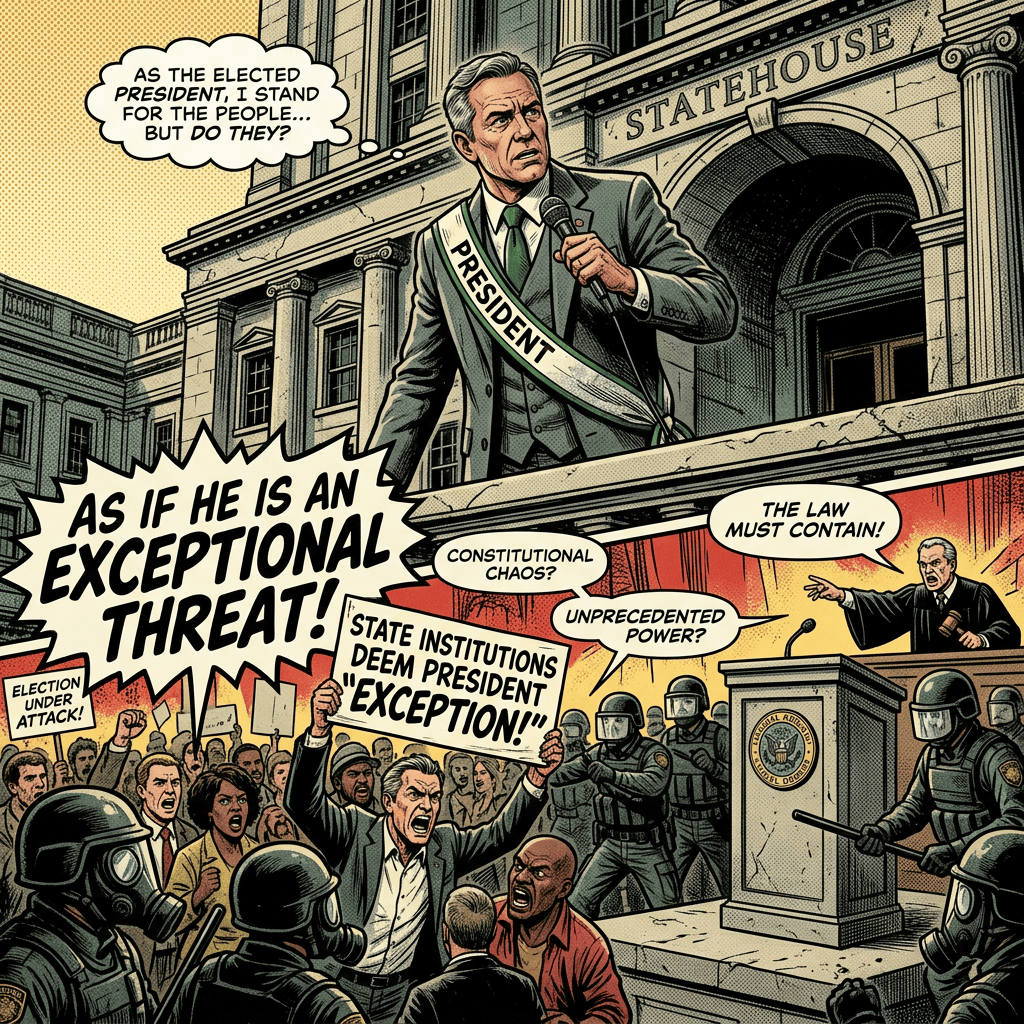
A THOUGHT EXPERIMENT FOR EVERY AMERICAN, REGARDLESS OF PARTY


The Founders called this republic an experiment. Madison said so explicitly. Hamilton opened the Federalist Papers asking whether societies of men are capable of governing themselves by “reflection and choice” — or whether they are forever destined to be governed by “accident and force.”

That question has never been permanently answered. It gets re-answered by each generation’s behavior.

Here is the experiment. Four variables. Be honest with yourself about all four.


Variable 1: The Constitution was built to change — but HOW you change it matters.

Article V provides two deliberate pathways for amendment. The Founders used them immediately — the Bill of Rights was ratified within three years of the Constitution itself. They were not building a frozen monument. They were building a process. Madison wrote that the greatness of the American people is that they “have not suffered a blind veneration for the past.”

The experiment: When you want the Constitution to mean something different, do you use the process — or do you use power to bypass the process? One is self-government. The other is the thing self-government was designed to prevent.


Variable 2: The Founders themselves were never unanimous — and they knew it.

Three delegates refused to sign the Constitution. Rhode Island boycotted the convention entirely. Ratification was close and contentious in nearly every state. Loyalists — perhaps a third of the colonial population — were never part of the founding consensus at all. Hamilton acknowledged in Federalist 1 that “wise and good men” would be found on both sides of the ratifying debate, and that honest opposition would “spring from sources blameless at least, if not respectable.”

The experiment: If the Founders — who had fought a war together, knew each other personally, and shared enormous common ground — could not achieve unanimity, why do we treat the other side’s disagreement as evidence of bad faith rather than honest difference?


Variable 3: Facts versus narrative — the one problem the Founders did not solve.

Madison’s great structural cure for faction was the extended republic — the idea that geographic distance and diversity would prevent any single passion from simultaneously inflaming the entire country. A pamphlet in Virginia took weeks to reach Massachusetts. The friction of distance cooled factional contagion.

That friction is gone. Every citizen now receives the same emotional signal simultaneously, curated for maximum reaction. Madison in Federalist 63 wrote that the Senate’s purpose was to protect the people “against their own temporary errors and delusions” until “reason, justice, and truth can regain their authority over the public mind.” He assumed truth would regain authority, given time and space.

The experiment: What happens to a republic designed around deliberation when the information environment is specifically engineered to prevent deliberation — and when “news” and “fact” have become functionally indistinguishable to millions of citizens? This is the one variable the Founders anticipated but could not design around. It is ours to solve or to fail.


Variable 4: The permanent political class — the pig at the trough problem.

Hamilton in Federalist 1 identified the most dangerous class of men in any republic: those who “aggrandize themselves by the confusions of their country” — men whose personal interest is permanently tied to the perpetuation of conflict rather than its resolution. He was describing the career politician before the career politician existed as a recognizable type.

The Constitution sets no term limits on Congress. The Founders debated this and chose not to impose them, trusting the election mechanism to rotate citizens in and out. What they did not anticipate was a professional class for whom holding office is the vocation — not a temporary sacrifice of a productive citizen, but a permanent extraction from the republic’s resources.

Madison in Federalist 47 called the accumulation of all power in the same hands “the very definition of tyranny.” A legislator who has held office for thirty years, whose personal wealth has multiplied through that tenure, who has converted public power into private benefit through earmarks and special interests — is not serving the republic. By Madison’s own definition, they are the faction.

The experiment: Does this apply only to the career politicians on the other side — or does it apply equally to the ones you keep re-electing?


The control variable — the one that determines whether the experiment succeeds or fails:

Orwell noticed, in Animal Farm, that the pigs did not become what they replaced by dramatic revolution. They became it gradually, by the slow logic of occupying power long enough that the distinction between serving the farm and owning the farm disappeared.

Hamilton’s question — reflection and choice, or accident and force — is not asked once at the founding and answered forever. It is asked again every time a citizen decides whether to apply their principles consistently or only when convenient.

The republic is not a partisan inheritance. It was built by people who disagreed profoundly, on a framework designed to contain disagreement without destroying the disagreers.

It will be kept — or lost — by whether we can still do the same.


Sources: Federalist No. 1 (Hamilton), Federalist No. 10, 47, 51, 63 (Madison) · Article V, United States Constitution · Madison, Federalist 14 on constitutional change · Hamilton, Federalist 1 on the permanent political class

Critical Perspectives on Governance, Media, and Policy: A 2025 Briefing”

1. Current Political Landscape and Criticism

  • “As Joe & Co. Leave”: President Biden’s administration is criticized for actions in its closing days, including drilling bans, clemency orders, and high expenditures such as student loan relief and funding under the CHIPS Act. The piece portrays the administration as prioritizing political gains over national interests​.
  • “Biden Senior Moments in Review”: Highlights media skepticism and public concerns about Biden’s cognitive abilities, showcasing incidents as part of a broader critique of his leadership​.

2. Law Enforcement and Criminal Justice

  • “Broken Windows Policing”: Advocates for the continued use of Broken Windows theory, arguing that maintaining order reduces crime. Critics suggest it heightens tensions in minority communities, but proponents highlight its historical effectiveness in NYC​.
  • “Trump Sentencing Update”: Judge Juan Merchan scheduled Trump’s sentencing on the “hush money” case, asserting legal grounds despite political implications. The sentencing underscores tensions in judicial processes involving prominent figures​.

3. Media Trust and Accountability

  • “New Year Offers Media Redemption”: Calls for legacy media to address its role in downplaying President Biden’s alleged cognitive decline and other issues. The commentary urges transparency and accountability to restore public trust​.

4. Cultural and Ideological Dynamics

  • “Say Goodbye to the ‘Islamophobia’ Hoax”: Argues against dismissing threats tied to extremist ideologies under the guise of Islamophobia, citing global and domestic incidents as examples. The piece calls for a more critical examination of related policies and narratives​.
  • “How Group Quotas Transformed the CIA”: Discusses how diversity initiatives within the CIA impacted its operational focus and efficiency. The critique questions whether such policies compromise effectiveness in national security

Contrast: Rule of Law and Legal Pursuit of Trump vs. Biden Family

Donald Trump

  • Legal Pursuit: Trump faces a high-profile legal case involving “hush money” payments. Judge Merchan’s sentencing, though politically charged, emphasizes adherence to judicial protocols. Despite criticisms of judicial bias, the legal process has been transparent, with detailed court proceedings and public awareness​.
  • Implications: Trump’s legal challenges underscore tensions between the judiciary’s independence and perceptions of partisan motivations. Critics argue the cases reflect the weaponization of legal mechanisms for political purposes​.

Biden Family

  • Hunter Biden: Allegations of influence-peddling and financial improprieties involving Hunter Biden have raised questions about accountability. Despite evidence from whistleblowers and released documents, investigations have been marked by delays and claims of political interference​​.
  • Joe Biden’s Role: Photos and emails suggest Joe Biden’s involvement in Hunter’s business dealings, contradicting his public denials. A last-minute presidential pardon for Hunter added to perceptions of shielding family interests​​.
  • Judicial Process: Critics argue that investigations into the Biden family have lacked transparency and urgency, with media and institutional actors accused of suppressing evidence to protect political interests​​.

Key Contrasts

  1. Transparency:
    • Trump’s legal cases have been conducted publicly, with rulings and processes scrutinized by the media.
    • Biden family investigations have faced accusations of concealment, delayed releases of evidence, and lack of accountability.
  2. Judicial Independence:
    • Trump’s cases have highlighted the judiciary’s independence but also exposed vulnerabilities to perceptions of partisanship.
    • Biden-related cases reflect concerns over political influence undermining the rule of law.
  3. Media Coverage:
    • Trump: Extensive media focus has amplified the visibility of legal proceedings.
    • Biden: Media and institutional reluctance to investigate allegations fully has led to accusations of bias and selective reporting.
  4. Public Perception:
    • Trump’s legal battles reinforce narratives of a polarized judicial system, with supporters viewing him as a victim of political prosecution.
    • Biden family controversies fuel skepticism about equal application of the law, with critics highlighting double standards.

Conclusion

The contrasting legal approaches toward Trump and the Biden family reflect broader challenges in balancing the rule of law with political and institutional pressures. Transparency and consistent application of justice are essential to maintain public trust in the legal system.

Evidence suggests that the CIA, FBI, and DOJ have faced allegations of withholding or delaying evidence that, if applied to an average U.S. citizen, could have led to significant legal jeopardy. These allegations revolve primarily around high-profile cases such as those involving the Biden family, Hunter Biden’s laptop, and other politically sensitive matters. Here’s a breakdown of the issues:


Instances of Alleged Evidence Withholding or Delays

  1. Hunter Biden Laptop:
    • The FBI reportedly had possession of Hunter Biden’s laptop as early as 2019 but delayed acting on its contents, which included evidence of potential influence-peddling, tax evasion, and other crimes​​.
    • Whistleblowers from the IRS alleged that political interference obstructed investigations into Hunter Biden’s financial dealings​.
    • Evidence that could implicate Joe Biden in influence-peddling, such as emails and photos, was withheld until after the 2024 election, reducing its potential political impact​.
  2. Russian Disinformation Allegations:
    • The Hunter Biden laptop story was labeled as Russian disinformation by former intelligence officials during the 2020 presidential election, despite the absence of evidence to substantiate these claims. This move suppressed the story’s credibility and limited public scrutiny​​.
  3. Delay in Releasing Key Evidence:
    • The National Archives delayed the release of photos showing Joe Biden meeting with Hunter Biden’s foreign business partners, allegedly due to legal and bureaucratic delays orchestrated by Biden’s and Obama’s legal teams​.
  4. General Perception of Preferential Treatment:
    • Allegations persist that the FBI and DOJ acted cautiously to avoid legal jeopardy for politically powerful individuals, particularly in the Biden family case. For example, whistleblower testimonies suggest evidence that could have expedited charges was deliberately overlooked​.

Legal Jeopardy for Ordinary Citizens

If the same evidence of financial misconduct, influence-peddling, or tax evasion had been uncovered in cases involving ordinary U.S. citizens:

  • Immediate Legal Action: Agencies would likely have acted swiftly, leading to indictments, asset seizures, and potential incarceration.
  • Lack of Institutional Protection: Ordinary citizens lack the political influence, resources, and legal protections available to high-profile individuals, making them more vulnerable to aggressive legal enforcement.
  • Transparency and Accountability: Public pressure and media attention often result in different standards of accountability, where ordinary citizens face a more rigid application of the law.

Conclusion

The allegations that the CIA, FBI, and DOJ withheld or delayed evidence to shield politically influential individuals highlight a troubling disparity in the application of justice. If such evidence involved an ordinary citizen, it is likely that legal consequences would have been far swifter and harsher. These incidents raise concerns about institutional impartiality and the principle of equal justice under the law. Ensuring transparency and accountability in these institutions is critical to maintaining public trust.