
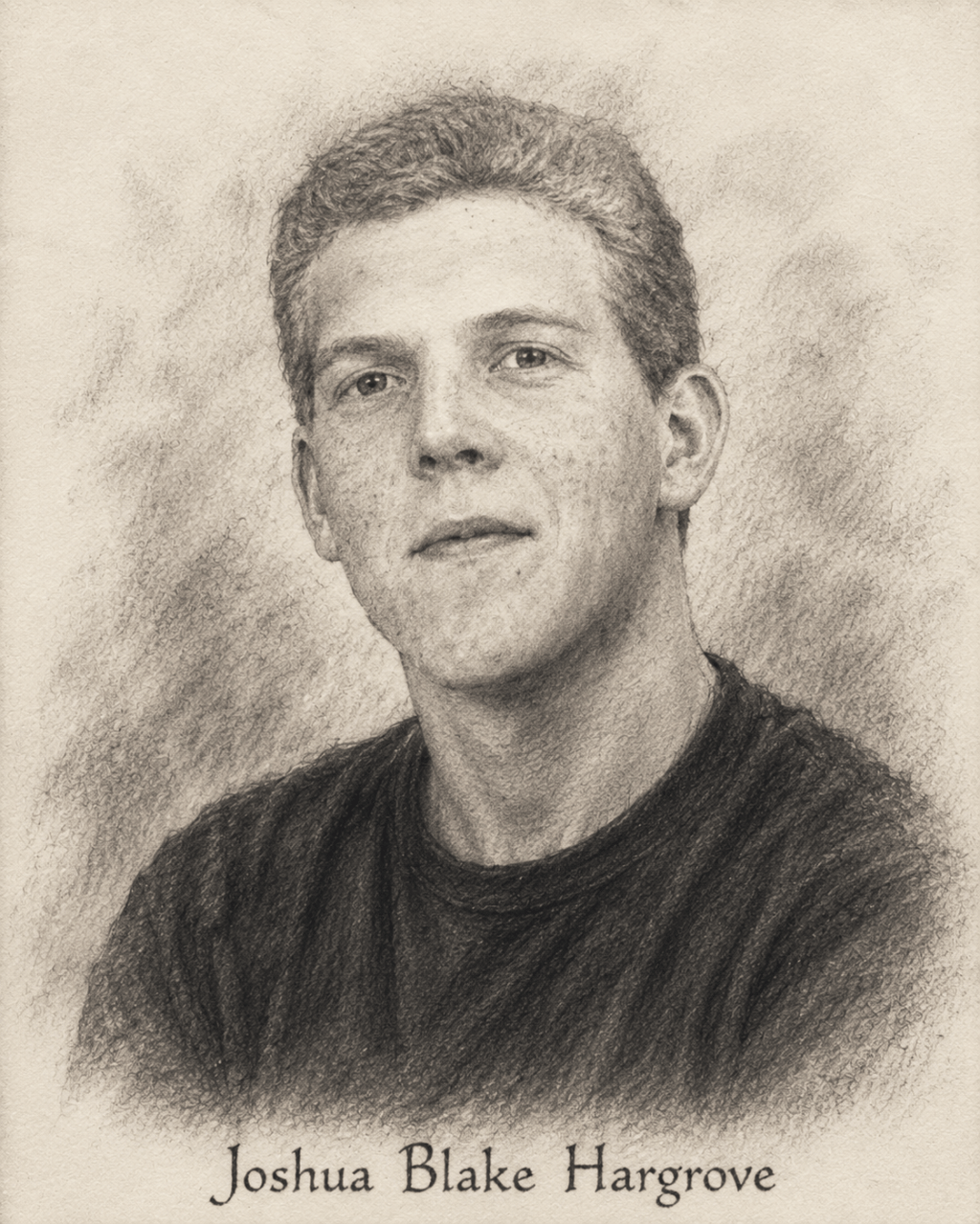
Joshua turned forty-two this past April. I let myself imagine him now, on the Saturday after Thanksgiving in 2026. I don’t claim to know. I only follow the lines he drew before he left.
The calling
I think he would be in ministry, though maybe not in a pulpit. At eighteen he invited four friends into his bedroom to open Scripture. Within a few weeks there were twenty-five, and they had outgrown the room. He didn’t do that because of a program or a title. He did it because people trusted him with their real questions. I can see him after college, maybe after some seminary, running something small that keeps growing: a house church, a youth ministry in a town like Buna, or a camp ministry on a river somewhere. He would want the back row and the late-night conversations more than the platform.
His letter-poem to Callie shows a young man already giving counsel. He told her to “choose the one that shares his fault.” He was already trying to guard someone else’s heart. That doesn’t fade with age. It turns into pastoring.
The man who knew the valley
He wrote “The Pain of Living” and “Is Nothing Something” in the same years he wrote “Alive in Christ” and “Can’t Wait to See Tomorrow.” The darkness and the faith sat side by side. At forty-two I believe he would have come through that valley and would speak about it openly. He would have no patience for a polished Christianity that pretends nobody hurts. He already disliked hypocrisy when he wrote about The Crucible in high school. He would be the pastor that young men call at 2 a.m., because they would sense he had been where they are and found the rope. His unfinished poem breaks off right there: “He is the rope He…” He would have spent his life finishing that line for other people.
The writer
He never stopped writing. By now I think he would have a book or two: devotional writing, maybe some poems, maybe something built on the knight-and-armor imagery he loved in Beowulf and the Arthurian legends. The tildes would have gone, though I wish he’d kept them. His spelling would have improved, mostly. His voice would be honest, a little fierce, and a little funny, like the boy who closed a breakup poem with “never never nuh-uh.”
The hands
He also had a practical side: keeping things running around the property and making sure the communication systems worked. He would know his way around a generator, a router, and a chainsaw after a hurricane. After Laura and Delta came through, I think he would have been out with a crew clearing driveways for widows before he ever got to his own yard. He might still be doing martial arts in some form, maybe teaching kids at a church gym. Discipline and gentleness together suited him. Six foot three, size thirteen feet, probably a little gray coming in at the temples by now.
The family
At seventeen he wrote a poem that imagined his own deathbed, with an eldest daughter and a little boy standing there and crying tears of joy because they knew where he was going. I don’t press too hard on a teenager’s poem. But I notice that when he pictured a full life, he pictured children. So I let myself imagine a wife who loves the Lord and can match his depth. I imagine a daughter about twelve, and a son who has inherited the big feet. I imagine them at our table this Thursday, with Joshua saying the blessing and taking too long, because he would mean every word of it.
The Neches
I think he would still go to the river. He would take his own boy out in the boat in May the way we went in 1998. He would yell into the wind for the joy of it and let the dogs run the sandbar. He might baptize people where he was baptized. He would stand in the same brown water and tell them what he believed at sixteen: death is a door, and what we do in life echoes in eternity.
What would not have changed
Whatever his job title turned out to be, the center of it would be the thing he told me on a night in early June 2002, when I was upset and he hugged me: “Let love guide you.”
At eighteen he said it. At forty-two I believe he would still be living it, more quietly and more deeply, and probably in a living room full of people nobody else knew how to reach.
In a sense he already is. The study he started in that bedroom ran for twenty years. Some of the young men who came through our door on Tuesday nights are now around the age Joshua would be. I can see the man he would have become in them.

