Central Truth
Jesus does not call His disciples to manufacture spiritual life, force visible results, or prove their worth to God. He calls them to remain in Him. As branches depend upon the vine, believers depend completely upon Christ for spiritual life, character, endurance, obedience, love, prayer, and faithful witness.
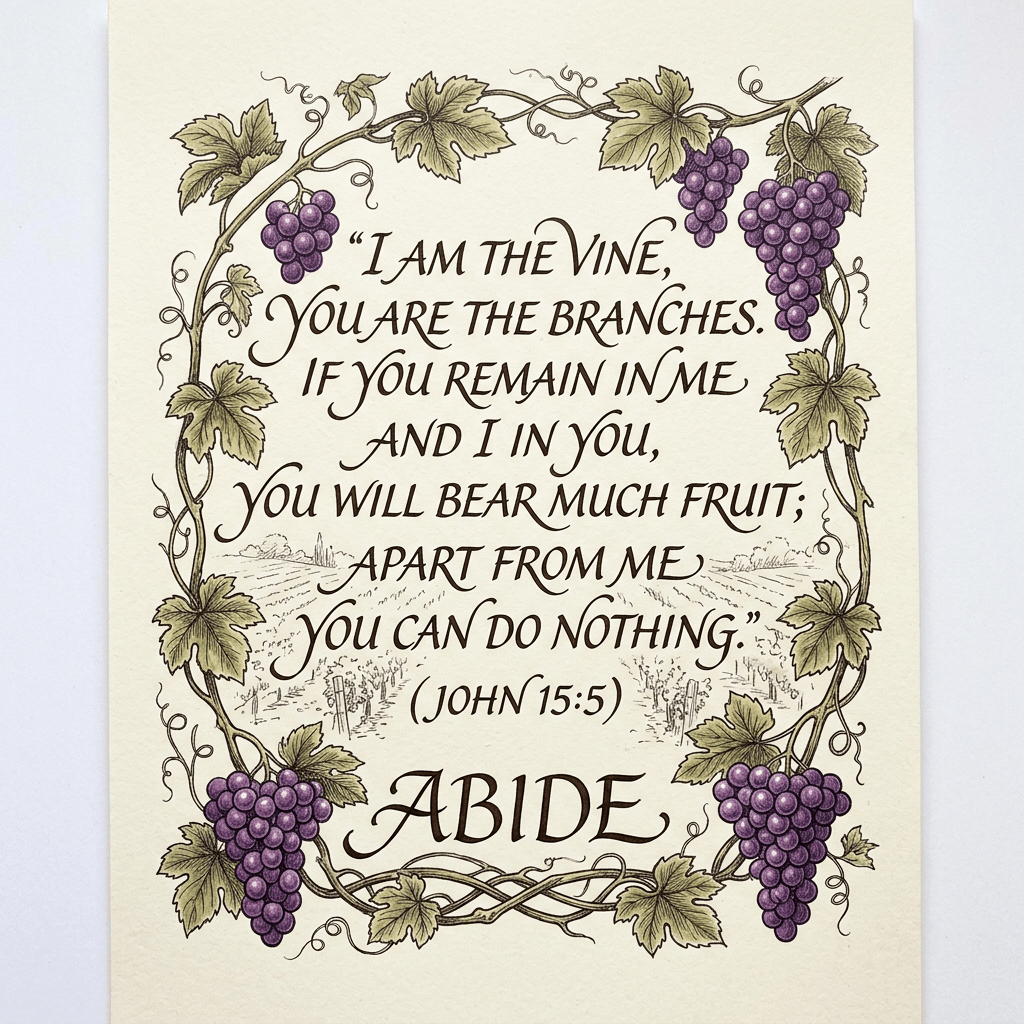
Biblical Text
John 15:1–27
1. Jesus Is the True Vine
“I am the true vine, and My Father is the vinedresser.”
John 15:1
Jesus’ description of Himself as the “true vine” carries important Old Testament background. Israel was frequently pictured as God’s vine or vineyard, but the nation repeatedly failed to produce the fruit of covenant faithfulness.
Relevant passages include:
- Psalm 80:8–16
- Isaiah 5:1–7
- Jeremiah 2:21
- Ezekiel 15:1–8
- Hosea 10:1
By calling Himself the “true vine,” Jesus identifies Himself as the faithful fulfillment of what Israel was called to be. God’s people now receive life, identity, and fruitfulness through union with Christ.
The Christian life therefore begins not with human effort, religious heritage, church participation, or moral determination, but with a living relationship with Jesus.
Theological Significance
Jesus is not merely a teacher who gives instructions from a distance. He is the source of spiritual life. Christianity is not simply imitation of Christ; it is participation in the life of Christ through faith.
2. Every Branch Is Examined by the Father
“Every branch in Me that does not bear fruit, He takes away; and every branch that bears fruit, He prunes it so that it may bear more fruit.”
John 15:2
The Father is the vinedresser. He carefully examines, tends, cleanses, and disciplines the branches.
Jesus describes two kinds of branches:
- Branches that do not bear fruit.
- Branches that bear fruit and are pruned so they may become more fruitful.
This passage contains both assurance and warning. Fruitfulness does not earn salvation, but an enduring absence of spiritual fruit raises serious questions about whether a person is truly remaining in Christ.
Major Interpretations of the Fruitless Branches
Some interpreters believe the fruitless branches represent people who appear outwardly connected to Christ but never truly possessed saving faith.
Others understand them as genuine believers who cease remaining in Christ and therefore face a real danger of apostasy.
The passage should not be reduced to a theological slogan. Jesus is addressing His disciples on the night before His crucifixion, after Judas has departed. His warning is meant to produce watchfulness, dependence, perseverance, and faithful obedience.
Within a Wesleyan-Arminian understanding, the warning should be taken seriously. Believers are secure as they remain in Christ, but they must not presume upon grace while continually rejecting Christ’s call to faith and obedience.
3. Pruning Is Not Rejection
Pruning can be painful because it involves cutting away what interferes with healthy growth. The Father may expose or remove:
- Sinful habits
- False beliefs
- Pride
- Self-reliance
- Unhealthy attachments
- Misplaced priorities
- Destructive relationships
- Activities that consume energy without producing spiritual good
- Expectations that God has never promised to fulfill
Pruning does not necessarily mean that God is displeased with a believer. Jesus says that fruitful branches are pruned because the Father intends them to become even more fruitful.
Pruning and Suffering
Not every hardship should automatically be labeled an act of divine pruning. Scripture identifies several possible causes of suffering:
- Life in a fallen world
- The consequences of personal choices
- The sinful actions of others
- Spiritual opposition
- Persecution for righteousness
- God’s discipline
- God’s providential preparation
- Circumstances whose purpose remains unknown
The believer should therefore avoid making careless declarations about why another person is suffering.
A better response is to ask:
- What is God revealing about my heart?
- Is there sin I need to confess?
- Is there something I must release?
- Is God teaching me endurance or dependence?
- How can I remain faithful even without understanding the reason?
The focus of John 15 is not discovering the explanation for every painful event. The focus is remaining connected to Christ through every season.
4. Remaining in Christ Is Essential
“Remain in Me, and I in you. Just as the branch cannot bear fruit of itself but must remain in the vine, so neither can you unless you remain in Me.”
John 15:4
The command “remain,” sometimes translated “abide,” means to stay, continue, dwell, or persist.
Remaining in Christ includes:
- Continuing to trust Him
- Receiving and obeying His Word
- Depending upon His grace
- Remaining in His love
- Continuing in prayer
- Participating faithfully in Christian community
- Refusing to abandon Him during hardship
- Turning back to Him through repentance when we sin
Abiding is not spiritual passivity. The branch does not create life, but it actively remains connected to the source of life.
Grace and Human Response
Jesus says:
“Apart from Me you can do nothing.”
John 15:5
This does not mean that people apart from Christ cannot accomplish ordinary human activities. It means that no one can produce the spiritual fruit that glorifies God apart from Christ’s life and grace.
Human effort is involved in discipleship, but human effort is never the source of spiritual life. Christians obey because grace is working in them, not because they have become spiritually self-sufficient.
5. What Is Spiritual Fruit?
Spiritual fruit is broader than numerical growth, public success, emotional experiences, or visible ministry activity.
Fruit includes the character and conduct produced by Christ’s life within believers.
The Fruit of the Spirit
Galatians 5:22–23 identifies:
- Love
- Joy
- Peace
- Patience
- Kindness
- Goodness
- Faithfulness
- Gentleness
- Self-control
This is not an unrelated list. It is a clear description of the character the Holy Spirit forms in those who belong to Christ.
Other Biblical Expressions of Fruit
Scripture also describes fruit as:
- Repentance — Matthew 3:8
- Righteous character — Philippians 1:11
- Holiness — Romans 6:22
- Good works — Colossians 1:10
- Praise and worship — Hebrews 13:15
- Generosity — Philippians 4:17
- Gospel witness — Romans 1:13
- Endurance during trials — James 1:2–4
- Love for other believers — John 15:12
- Obedience to Christ — John 15:10
Fruit is not perfection. Fruit is recognizable spiritual growth produced through continued dependence upon Christ.
A healthy question is not merely, “How much have I accomplished?” but, “What is Christ producing in my character, relationships, priorities, and obedience?”
6. Fruitfulness Glorifies the Father
“My Father is glorified by this, that you bear much fruit, and so prove to be My disciples.”
John 15:8
Fruit does not glorify the branch. It glorifies the vinedresser and reveals the life of the vine.
Spiritual fruit is not given so believers can appear superior to others. It reveals God’s grace, wisdom, patience, and transforming power.
The goal of Christian maturity is not self-promotion but the glory of God.
7. Love and Obedience Belong Together
“If you keep My commandments, you will remain in My love, just as I have kept My Father’s commandments and remain in His love.”
John 15:10
This statement can sound transactional when removed from its context. Jesus is not saying, “Obey so that you can convince Me to love you.”
He has already said:
“Just as the Father has loved Me, I also have loved you; remain in My love.”
John 15:9
Obedience is not the price paid to obtain Christ’s love. Obedience is the proper response to His love and the practical way disciples continue living within it.
God’s love is gracious, but it is not morally indifferent. Genuine love produces a desire to please the One who loves us.
Obedience Without Legalism
Legalism says:
“I obey so God will accept me.”
The gospel says:
“God has received me by grace through faith in Christ; therefore, I now desire to obey Him.”
Christian obedience is relational, grateful, and Spirit-enabled.
8. The Joy of Christ
“These things I have spoken to you so that My joy may be in you, and that your joy may be made full.”
John 15:11
Jesus speaks of joy on the night before His crucifixion. Biblical joy is therefore not dependent upon comfortable circumstances.
The joy of Christ comes from:
- Fellowship with the Father
- Confidence in God’s purpose
- Obedience to God’s will
- Love shared among believers
- Hope beyond suffering
- The assurance that evil will not have the final word
Christian joy does not deny grief. It is the presence of hope within grief because Christ remains faithful.
9. The Command to Love One Another
“This is My commandment, that you love one another, just as I have loved you.”
John 15:12
The standard of Christian love is not personal preference, cultural politeness, or emotional affection. The standard is the self-giving love of Jesus.
Jesus’ love is:
- Sacrificial
- Truthful
- Patient
- Holy
- Forgiving
- Courageous
- Servant-hearted
- Directed toward the good of others
“Greater love has no one than this, that a person will lay down his life for his friends.”
John 15:13
Jesus’ death is unique and atoning, but it also establishes the pattern of Christian love. Believers are called to lay down pride, convenience, personal agendas, and self-protection for the spiritual good of others.
This love does not require tolerating abuse, ignoring sin, or abandoning wise boundaries. Biblical love seeks another person’s genuine good under the authority of God’s truth.
10. Jesus Calls His Disciples Friends
“No longer do I call you slaves, for the slave does not know what his master is doing; but I have called you friends, because all things that I have heard from My Father I have made known to you.”
John 15:15
Jesus does not abolish His authority as Lord. The disciples continue to serve and obey Him. However, He brings them into a relationship of revealed purpose and covenant intimacy.
They are no longer merely servants carrying out unexplained commands. Jesus has disclosed the Father’s redemptive purpose to them.
Friendship with Christ includes:
- Access to His teaching
- Knowledge of God’s purposes
- Participation in His mission
- Loving obedience
- Trust
- Fellowship
- Sacrificial loyalty
Calling Jesus a friend must never reduce Him to a casual companion. He is the divine Lord who graciously welcomes His disciples into intimate fellowship.
11. Chosen and Appointed to Bear Fruit
“You did not choose Me but I chose you, and appointed you that you would go and bear fruit, and that your fruit would remain.”
John 15:16
Jesus is speaking directly to His apostles, whom He chose and commissioned for a particular mission. The verse has implications for all disciples, but its immediate setting concerns the apostolic calling.
The verse emphasizes divine initiative. The disciples did not invent their calling or appoint themselves. Jesus chose them, trained them, and sent them.
Their fruit would remain through:
- Their witness to Christ
- Their preaching of the gospel
- The establishment of the Church
- The apostolic teaching preserved in Scripture
- The lives transformed through their ministry
This verse should not be isolated as though it settles every later debate about election. Its primary emphasis is Christ’s initiative in choosing disciples for fruitful mission.
12. The World May Reject Christ’s Disciples
“If the world hates you, you know that it has hated Me before it hated you.”
John 15:18
In John’s Gospel, “the world” can refer to fallen humanity organized in resistance to God. Jesus is not teaching that every unbeliever will personally hate every Christian. He is warning that the values and authority of Christ will conflict with a world committed to sin and self-rule.
Christians should expect opposition when they faithfully represent Jesus.
However, believers must distinguish between:
- Rejection caused by faithfulness to Christ
- Rejection caused by harshness, pride, hypocrisy, foolishness, or misconduct
Not every criticism is persecution.
Peter later writes:
“Make sure that none of you suffers as a murderer, or thief, or evildoer, or a troublesome meddler; but if anyone suffers as a Christian, he is not to be ashamed.”
1 Peter 4:15–16
The believer’s responsibility is not to become deliberately offensive. It is to speak truth with love, display the character of Christ, and remain faithful when obedience brings opposition.
13. Christians Must Not Withdraw From the World
Jesus says His disciples are not “of the world,” but He does not command them to isolate themselves completely from unbelievers.
Believers are sent into the world as witnesses. They must guard against conformity without abandoning mission.
This is particularly important in environments shaped by anger, comparison, sexual temptation, misinformation, hostility, and constant distraction.
Digital media can become spiritually harmful when it cultivates:
- Envy
- Rage
- Fear
- Lust
- Pride
- Falsehood
- Addiction
- Careless speech
- Dehumanization of others
Wise Christian engagement requires discernment, restraint, truthfulness, and an awareness that every platform forms habits of attention and desire.
The question is not only, “Is this content permitted?” but also, “What kind of person is this forming me to become?”
14. The Holy Spirit Bears Witness to Christ
“When the Helper comes, whom I will send to you from the Father, namely, the Spirit of truth who comes from the Father, He will testify about Me.”
John 15:26
The Holy Spirit’s ministry is centered upon Jesus. He reveals, glorifies, and bears witness to Christ.
The Spirit was active throughout the Old Testament and during Jesus’ earthly ministry. Pentecost did not mark the first activity of the Holy Spirit. Acts 2 marked the promised new-covenant outpouring of the Spirit upon the Church for witness, holiness, fellowship, and mission.
The Spirit works through:
- The inspired Scriptures
- Conviction of sin
- Illumination of biblical truth
- Empowerment for witness
- Formation of Christlike character
- Spiritual gifts
- Prayer
- Guidance consistent with Scripture
- The wisdom of mature believers
- The worship and fellowship of the Church
The Spirit Is More Than an Inner Voice
The Holy Spirit may impress, prompt, guide, or convict, but He should not be reduced to personal intuition.
Internal impressions must be tested because human beings can confuse the Spirit’s leading with:
- Emotion
- Fear
- Desire
- Habit
- Imagination
- Pride
- Personal preference
A claimed leading should be evaluated by asking:
- Does it agree with Scripture?
- Does it exalt Jesus Christ?
- Does it promote holiness and love?
- Does it reflect the character of God?
- Can it withstand wise Christian counsel?
- Does it produce the fruit of the Spirit?
- Does it manipulate, flatter, frighten, or control others?
The Holy Spirit never contradicts the Word He inspired.
15. The Disciples Are Also Called to Testify
“And you are testifying as well, because you have been with Me from the beginning.”
John 15:27
This statement has a special application to the apostles. They were eyewitnesses of Jesus’ ministry, death, and resurrection. Their testimony became foundational to the Church.
All believers are also called to bear witness, although not with the unique eyewitness authority of the apostles.
Christian witness includes:
- Accurately proclaiming the gospel
- Speaking truth about Jesus
- Living consistently with the gospel
- Giving a reason for Christian hope
- Serving others in Christ’s name
- Refusing to deny Christ under pressure
The Spirit testifies to Christ, and the Church testifies in the Spirit’s power.
16. Abiding Shapes Prayer
“If you remain in Me, and My words remain in you, ask whatever you wish, and it will be done for you.”
John 15:7
This is not an unrestricted promise that believers can obtain anything they desire by using the correct words or achieving enough faith.
The promise contains two conditions:
- The believer remains in Christ.
- Christ’s words remain in the believer.
As a person remains in Christ, desires are progressively reshaped by His teaching, character, kingdom, and will. Abiding prayer increasingly seeks what honors God.
This does not mean believers will always pray perfectly. It means communion with Christ transforms what they want and how they pray.
Faithful prayer may include:
- Honest lament
- Requests for healing
- Provision
- Wisdom
- Deliverance
- Forgiveness
- Spiritual growth
- Strength to endure
- The salvation of others
- God’s kingdom and glory
Every request is ultimately submitted to God’s wisdom:
“Yet not My will, but Yours be done.”
Luke 22:42
17. When God Seems Silent
Believers sometimes experience seasons when God appears distant or silent. Scripture does not treat this experience lightly.
Examples include:
- Psalm 13
- Psalm 22
- Psalm 42
- Job 23
- Habakkuk 1
- Lamentations 3
A feeling of divine silence does not prove divine absence.
During such seasons, believers should continue to:
- Pray honestly
- Read Scripture
- Remember God’s past faithfulness
- Remain within Christian fellowship
- Reject known sin
- Continue ordinary obedience
- Seek wise counsel
- Wait without pretending that waiting is easy
God’s primary authoritative speech is preserved in Scripture. Even when a believer receives no special impression or immediate answer, God has not left His people without truth.
Faithfulness often means continuing to trust what God has already said while waiting for further clarity.
18. God’s Love and the Language of Hatred
Questions sometimes arise from passages such as:
“Jacob I have loved, but Esau I have hated.”
Malachi 1:2–3; Romans 9:13
In Malachi, Jacob and Esau represent not merely two individuals but two peoples: Israel and Edom. The language concerns covenant election, historical purpose, and divine judgment.
Biblical language can also use “hate” comparatively to describe choosing one over another. Jesus uses similar language in Luke 14:26, where devotion to Him must exceed every other loyalty.
This language should not be used to teach that God emotionally despises His children whenever they disobey.
Scripture teaches that God disciplines His children because He loves them:
“For whom the Lord loves He disciplines.”
Hebrews 12:6
God opposes sin, judges rebellion, and calls His people to holiness. At the same time, His fatherly discipline is not the same as personal hatred or abandonment.
19. A Practical Pattern for Remaining in Christ
Abiding is a lifelong relationship sustained by grace. A practical pattern may include the following.
Receive Christ’s Word
Read Scripture attentively and in context. Ask:
- What does this reveal about God?
- What does it reveal about the human heart?
- What command should be obeyed?
- What promise should be trusted?
- What sin should be confessed?
- How does this lead me toward Christ?
Respond in Prayer
Speak honestly to God about praise, gratitude, sin, fear, need, confusion, and desire.
Obey What Is Clear
Do not wait for extraordinary guidance before obeying what Scripture has already commanded.
Remain in Christian Fellowship
Branches do not grow in isolation. Christians need worship, teaching, communion, accountability, encouragement, correction, and shared service.
Practice Repentance
When sin is exposed, return to Christ rather than hiding in shame.
Accept the Father’s Pruning
Release what God reveals to be sinful, distracting, unhealthy, or spiritually unfruitful.
Love Other Believers
Abiding in Christ is demonstrated by patient, truthful, sacrificial love.
Bear Witness
Speak and live as someone who belongs to Jesus.
Persevere
Remain faithful during seasons when spiritual growth feels slow, circumstances are painful, or God appears silent.
Discussion Questions
- What does the vine-and-branches image teach about dependence upon Christ?
- What is the difference between producing fruit through human effort and bearing fruit through abiding?
- How can believers distinguish God’s pruning from the ordinary pain of living in a fallen world?
- What kinds of spiritual fruit are sometimes overlooked because they are not public or dramatic?
- Why are love and obedience inseparable in Jesus’ teaching?
- How can Christians know whether opposition is genuine persecution or a response to their own conduct?
- What are reliable ways to test an inward impression that may be attributed to the Holy Spirit?
- How does abiding in Christ reshape a person’s prayers?
- What should a believer do when God seems silent?
- What habit or attachment may currently be interfering with your attentiveness to Christ?
Pastoral Application
The central question of John 15 is not, “How can I become impressive?” It is, “Am I remaining in Christ?”
Some people are exhausted because they are trying to produce spiritual life through determination alone. Others are discouraged because they compare their fruit to someone else’s. Some interpret every hardship as divine anger. Others want Christ’s comfort without His commands.
Jesus calls every disciple back to the same place: remain in Him.
Remain when the Father prunes.
Remain when growth is slow.
Remain when prayers appear unanswered.
Remain when the world resists Christ’s truth.
Remain when obedience is costly.
Remain when personal strength fails.
The branch’s hope is not its own strength. Its hope is the life of the vine.
Conclusion
John 15 presents the Christian life as continual dependence upon Jesus Christ.
The Father tends the branches.
The Son supplies their life.
The Spirit testifies to Christ and empowers their witness.
The disciples remain, obey, love, pray, bear fruit, and persevere.
The call of Jesus is clear:
“Remain in Me.”
Everything necessary for lasting spiritual fruit flows from that relationship.

