July 19, 2026 | | Sunday Deeper Dive
TEACHING SEQUENCE
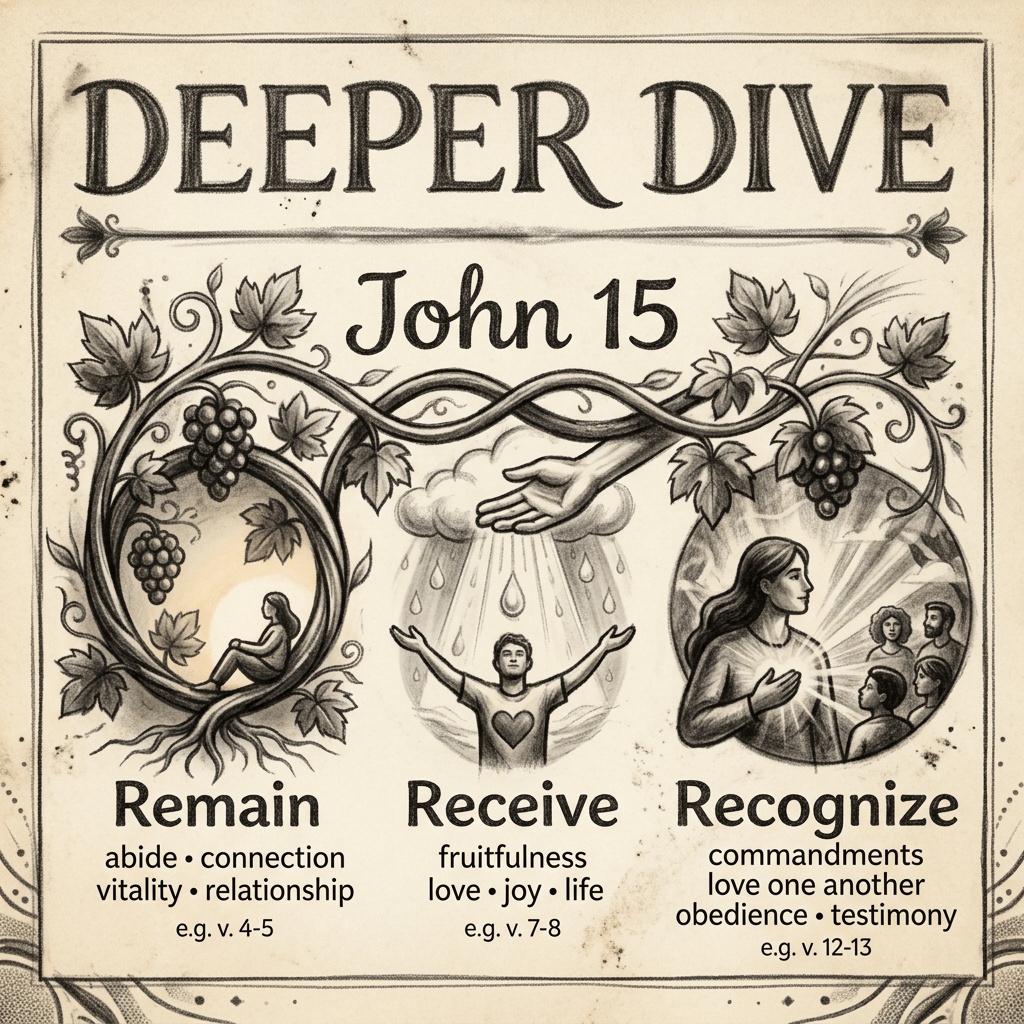
1. Remain in Christ (vv. 1–5) — The source of spiritual life and the necessity of dependent perseverance.
2. Receive the Father’s pruning (vv. 2, 6) — How to understand suffering, correction, change, and relationships.
3. Remain in Christ’s love (vv. 9–13) — Why obedience does not earn love and discipline does not mean hatred or abandonment.
4. Recognize the fruit (vv. 7–8, 16, 18–19, 26–27) — How Scripture tests character, prayer, spiritual impressions, and Christian witness.
Read John 15 aloud together before beginning. The first study walked the chapter verse by verse; this session slows down on four questions the room actually raised.
1. Remain in Christ
John 15:5 — “I am the vine, you are the branches; the one who remains in Me, and I in him, he bears much fruit, for apart from Me you can do nothing.”
WHAT THE TEXT SAYS
Jesus is the true vine. The Father is the vinedresser. Believers are branches. Israel was called God’s vine in the Old Testament and failed to bear covenant fruit; Jesus is what Israel could not be. The branch does not support the vine; the vine supports the branch. The branch does not create the life that flows through it; it receives it.
THE CLARIFICATION
“Apart from Me you can do nothing” does not mean an unbeliever cannot work, think, or act morally. It means no one produces the fruit that belongs to God’s kingdom apart from living union with Christ. Abiding is not passivity. Grace is opposed to earning, not to effort. The pattern is dependent perseverance — continuing in Christ, not visiting Him occasionally.
WHAT SURFACED IN OUR FIRST SESSION
The room named it honestly: the flesh wants to be in charge, even when we are convinced we are serving God. Substituting activity for dependence is one of the easiest religious errors to make and one of the hardest to see in ourselves.
DISCUSSION
1. Where are we most tempted to substitute activity for dependence on Christ — church, work, family?
2. What is the difference between working for Jesus and letting Jesus work through us? How would we know which one is happening?
2. Receive the Father’s Pruning
John 15:2 — “Every branch in Me that does not bear fruit, He takes away; and every branch that bears fruit, He prunes it so that it may bear more fruit.”
WHAT THE TEXT SAYS
Two branches, two actions. The fruitless branch is taken away. The fruitful branch is pruned. Both are the Father’s work, and both have purpose. The Greek words for “prunes” (kathairei) and “clean” (katharoi, v. 3) share a root: the Father’s pruning and Christ’s cleansing word are the same work.
SUFFERING, CORRECTION, CHANGE, RELATIONSHIPS
Not every painful season is God pruning. Pain can come from a fallen world, from other people’s sin, from our own poor choices, from spiritual opposition, or from causes we cannot identify. Job’s friends assumed suffering proved wrongdoing, and God rebuked them. The test is not whether something hurt; the test is whether God is using it to produce greater holiness, humility, love, and dependence on Christ.
On relationships: God does sometimes prune destructive relationships out of a believer’s life, and Anthony’s account of that was truthful. But John 15 must not become a permission slip for discarding people we find difficult. Sometimes God prunes the relationship. At other times, God prunes our pride, our resentment, or our impatience so we can remain in the relationship more faithfully.
DISCUSSION
1. What has God removed from our lives that once seemed necessary? What fruit came out of that removal?
2. How do we discern whether God is calling us to leave a relationship or to become more Christlike within it?
3. Remain in Christ’s Love
John 15:9–10 — “Just as the Father has loved Me, I also have loved you; remain in My love. If you keep My commandments, you will remain in My love.”
THE CONCERN NAMED IN THE FIRST SESSION
The wording can sound like Jesus is saying, “If you do what I tell you, then I will love you.” That is not what Jesus says. He begins with an accomplished reality: “I have loved you.” His love is the starting point, not the reward. Obedience is the response to His love, not the price paid to obtain it.
Legalism says, “I obey so God will accept me.” The gospel says, “God has already received me in Christ, so I now desire to obey Him.” “Remain in My love” describes continued fellowship — living inside the joy and communion of a love already given. A disobedient child is still loved by a faithful parent, but disobedience damages the fellowship and brings discipline. Grace does not remove consequences, and discipline is not hatred.
DISCIPLINE IS NOT HATRED — TWO RELATED QUESTIONS
Did God hate Esau? Malachi 1 and Romans 9 are not describing God’s emotional state toward two brothers. Jacob and Esau stand for Israel and Edom — two peoples. The language expresses covenantal preference and rejection, not uncontrolled emotion. It is not accurate to say God begins hating His children whenever they disobey. Hebrews 12:6 — “Whom the Lord loves He disciplines.”
Does God go silent when we resist Him? The felt experience of silence is real, and Scripture takes it seriously (Psalm 13; Psalm 42; Lamentations 3). But felt silence is not proof of divine abandonment. God continues to speak through His written Word, the conviction of the Spirit, wise counsel, and honest self-examination. Often what we call God’s silence is our refusal to accept what He has already said.
DISCUSSION
1. Where do we treat obedience as the price of God’s love rather than the response to it?
2. When God seems silent, what has He already made clear that we can walk in while we wait?
4. Recognize the Fruit
John 15:8 — “My Father is glorified by this, that you bear much fruit, and so prove to be My disciples.”
Scripture teaches us to recognize the Spirit’s work by its fruit. John 15 gives four tests. Each one is a place where the room can drift — mistaking success for character, wishlists for prayer, impressions for the Spirit, or reaction for persecution.
CHARACTER (GALATIANS 5:22–23)
Fruit is not visible success, large numbers, financial gain, or emotional excitement. Fruit is Christlike character produced by the Spirit — love, joy, peace, patience, kindness, goodness, faithfulness, gentleness, self-control. A believer may live a quiet, unnoticed life and bear deep and lasting fruit. A ministry may look successful and lack all of it.
PRAYER (VV. 7, 16)
“Ask whatever you wish” is not a blank check. Jesus states two conditions: that the believer remain in Him and that His words remain in the believer. Abiding reshapes desire. Prayer is not the power to bend God’s will toward ours; it is the grace by which our will is increasingly formed by His. God always hears — the answer may be yes, no, wait, or something different.
SPIRITUAL IMPRESSIONS (VV. 26–27)
The Spirit testifies about Christ, and He speaks to believers. But not every inner impression is the Holy Spirit. Impressions can also come from fear, personal desire, memory, anxiety, cultural conditioning, or temptation. Guidance must be tested: does it agree with Scripture, exalt Christ, produce holy and loving fruit, lead toward humility, and stand up to wise counsel? Conviction is specific and restorative — “this is sin; bring it to Christ.” Condemnation is vague and hopeless — “you are worthless; there is no way back.” The Spirit convicts to restore.
WITNESS (VV. 18–19)
The Greek word kosmos here does not mean every individual who disagrees with us. It means humanity organized in resistance to God. Not every criticism or lost friendship is persecution. Christians may face opposition for faithfully confessing Christ — or for speaking harshly, treating opinions as commands, spreading unverified claims, or failing to listen. Peter is plain: no honor in suffering for wrongdoing, blessing in suffering for Christ. Digital exposure belongs here. Abiding may require stepping away from the noise, or remaining online with truth, restraint, and self-control.
DISCUSSION
1. Which of these four tests — character, prayer, impressions, witness — do we most need to apply honestly right now?
2. Have we ever called ordinary disagreement “persecution”? What would honest self-examination look like before we use that word?
CLOSING
Christ supplies life.
The Father forms the branches.
Love produces obedience.
The Spirit produces recognizable fruit and faithful witness.
Anchor question. This week, in one sentence, what is one specific way you will remain in Christ that you have been trying to substitute activity for?

