

A Bible Study for Men Facing Spiritual Conflict in the Home
Purpose
This study is designed to help Christian men respond biblically when a wife, family member, or close friend is involved in witchcraft, Wicca, spell-casting, divination, occult spirituality, or another belief system opposed to the gospel of Jesus Christ.
The goal is not to create fear, encourage hostility, or turn spiritual conflict into a spectacle. The goal is to help men remain faithful to Christ, love their families, protect their children, pray with wisdom, establish biblical boundaries, and support other men facing similar situations.
Central Truth
A Christian man must neither compromise his allegiance to Christ nor abandon the people God has placed under his care.
He is called to stand firm in truth, walk in love, protect the vulnerable, refuse participation in darkness, and trust the authority of Jesus Christ.
Primary Scriptures
- 1 Corinthians 7:12–16
- Ephesians 5:21–33
- Ephesians 6:10–18
- 1 Peter 3:1–9
- Deuteronomy 18:9–14
- Acts 19:18–20
- Galatians 5:19–23
- 1 John 4:1–4
- 2 Timothy 2:24–26
- Galatians 6:1–2
- James 5:16
1. Begin With the Right Understanding of the Conflict
“For our struggle is not against flesh and blood, but against the rulers, against the authorities, against the powers of this world’s darkness, and against the spiritual forces of evil in the heavenly realms.”
—Ephesians 6:12
The first truth a Christian man must understand is that his wife, child, relative, or friend is not the enemy.
A person may believe false things, practice sinful things, resist the gospel, or become involved in spiritually dangerous activities. Those practices must be addressed truthfully. However, the person remains someone created in the image of God and someone for whom Christ died.
This distinction is essential.
The believer must oppose the practice without hating the person.
He must reject occult spirituality without becoming cruel, controlling, or self-righteous.
He must recognize spiritual danger without becoming obsessed with demons, spells, signs, or unexplained events.
The Christian man does not fight spiritual darkness with hatred, threats, manipulation, superstition, or retaliation. He stands in the truth of Christ.
Questions for Reflection
- Am I viewing this person as an enemy rather than someone who needs Christ?
- Has fear begun to control my thinking?
- Am I responding with anger, pride, or a desire to dominate?
- Do my words and actions reflect the character of Jesus?
2. Call Occult Practice What Scripture Calls It
“Let no one be found among you who practices divination or sorcery, interprets omens, engages in witchcraft, casts spells, consults a medium or spiritist, or inquires of the dead.”
—Deuteronomy 18:10–11
Scripture does not treat witchcraft, spell-casting, divination, spirit consultation, or magical practices as harmless entertainment.
Paul lists sorcery among the works of the flesh in Galatians 5:19–21. In Acts 19:18–20, those who came to faith in Christ openly renounced their magical practices.
A Christian man must not excuse occult activity because it is presented as:
- Wicca
- Nature spirituality
- Energy work
- Divination
- Tarot
- Astrology
- Spirit guidance
- Manifestation rituals
- Protection spells
- Healing magic
- Ancestral communication
- A harmless business
The name given to the practice does not determine its spiritual nature. Scripture does.
At the same time, biblical clarity must not become an excuse for insult or cruelty. The believer should speak honestly, calmly, and respectfully.
A biblical statement may sound like this:
“I love you, and I will treat you with dignity. Because I belong to Jesus Christ, I cannot participate in spell-casting, divination, spirit invocation, or any practice that seeks spiritual power apart from God.”
3. Do Not Abandon an Unbelieving Spouse Merely Because She Is an Unbeliever
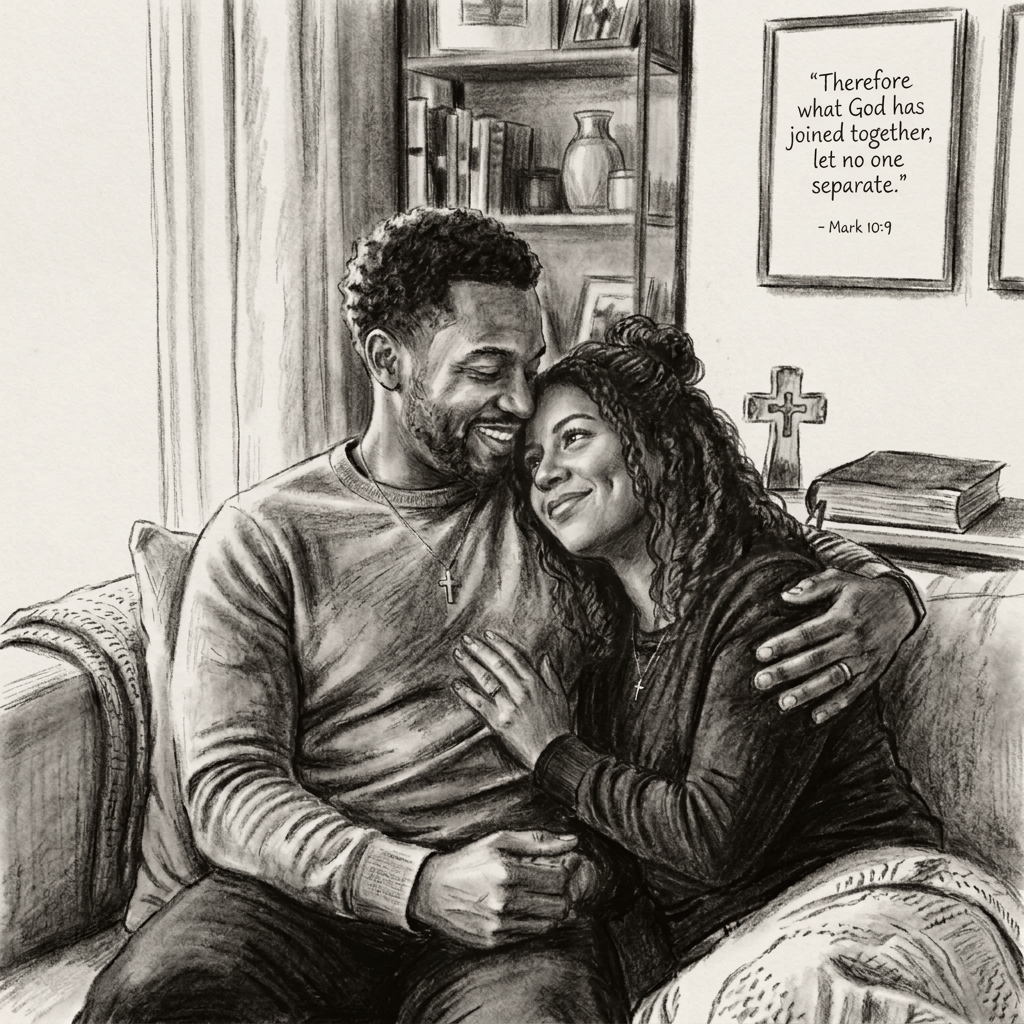
“If any brother has an unbelieving wife and she is willing to live with him, he must not divorce her.”
—1 Corinthians 7:12
Paul directly addressed believers who were married to unbelieving spouses.
His instruction was not to abandon the marriage simply because the spouse did not believe in Christ.
If the unbelieving spouse is willing to remain in the marriage, the Christian husband is ordinarily called to remain faithful.
This does not mean he must approve of her beliefs.
It does not mean he must participate in her practices.
It does not mean he should ignore danger to the children.
It means that spiritual disagreement alone is not an automatic biblical command to divorce.
The husband’s presence may provide a continuing Christian witness within the home.
“For the unbelieving wife is sanctified through her believing husband.”
—1 Corinthians 7:14
This does not mean she is automatically saved. It means the marriage and household are not spiritually defiled merely because one spouse is an unbeliever. The believing spouse brings the influence of prayer, Scripture, Christian character, and gospel witness into the home.
If the unbelieving spouse chooses to leave because she refuses to live with a faithful Christian, Paul says:
“But if the unbeliever leaves, let him leave. The believing brother or sister is not bound in such cases. God has called us to live in peace.”
—1 Corinthians 7:15
The believer should not provoke abandonment, but neither is he required to deny Christ to prevent it.
4. Love Does Not Mean Agreement
“Husbands, love your wives, just as Christ loved the church and gave Himself up for her.”
—Ephesians 5:25
A Christian husband is commanded to love his wife, including when she does not share his faith.
Biblical love is not sentimental approval.
Biblical love seeks the true good of another person.
A husband may love his wife while saying:
- “I cannot agree with this.”
- “I cannot participate in this.”
- “I cannot allow the children to be drawn into this.”
- “I will not mock or mistreat you.”
- “I will continue to care for you.”
- “I will pray for you.”
- “I will remain faithful to Christ.”
Christlike love is patient, truthful, sacrificial, and holy.
A husband fails in love when he becomes abusive, threatening, humiliating, or controlling.
He also fails in love when he remains silent because he fears conflict more than he loves truth.
“Speaking the truth in love, we will in all things grow up into Christ Himself.”
—Ephesians 4:15
Truth without love becomes harshness.
Love without truth becomes compromise.
Christian faithfulness requires both.
5. Establish Clear Spiritual Boundaries
“Have no fellowship with the fruitless deeds of darkness, but rather expose them.”
—Ephesians 5:11
A Christian man should not participate in occult activity to keep peace in the home.
He should not:
- Request spells
- Allow spells to be cast over him
- Participate in rituals
- Use tarot cards or divination
- Wear charms for spiritual protection
- Consult spirits or mediums
- Promote occult services
- Schedule customers for spell-casting
- Accept occult practices as compatible with Christianity
- Encourage children to participate
- Treat Christian prayer as a counter-spell
His boundary should be clear, calm, and consistent.
He should not destroy another person’s possessions, use physical force, threaten her, or attempt to control her conscience.
He may say:
“I will not interfere with you through violence or intimidation, but I cannot spiritually consent to these practices, participate in them, or allow them to be imposed upon me or the children.”
Boundaries should be communicated before moments of crisis whenever possible.
6. Protect the Children Without Teaching Them to Hate Their Mother
“Fathers, do not provoke your children to anger; instead, bring them up in the discipline and instruction of the Lord.”
—Ephesians 6:4
A Christian father has a responsibility to teach his children the truth.
He should not surrender their spiritual formation because he wants to avoid disagreement.
He should:
- Read Scripture with them
- Pray with them
- Teach them who Jesus is
- Explain why Christians reject occult practices
- Bring them into healthy church fellowship
- Answer questions honestly
- Provide stable Christian examples
- Teach them to respect their mother
- Protect them from manipulation and fear
- Avoid making them choose which parent to love
A father may say:
“Your mother is loved and must be treated respectfully. However, we believe Jesus Christ is Lord, and the Bible teaches us not to seek spiritual power through spells, divination, spirits, or magic.”
Children should not be used as spies.
They should not be interrogated after every visit or conversation.
They should not be told that their mother is beyond God’s mercy.
They should not be frightened with exaggerated stories of demons or curses.
They should be taught that Jesus Christ is greater than every power of darkness.
“You, little children, are from God and have overcome them, because greater is He who is in you than he who is in the world.”
—1 John 4:4
If a child is exposed to physical abuse, sexual misconduct, dangerous substances, blood rituals, animal cruelty, threats, severe psychological coercion, or forced spiritual practices, the matter must be treated as a safety issue rather than merely a religious disagreement.
Appropriate pastoral, professional, and legal help may be necessary.
7. Refuse Fear and Superstition
“God has not given us a spirit of fear, but of power, love, and self-control.”
—2 Timothy 1:7
A Christian man should take occult practice seriously, but he should not live in terror of it.
Fear may cause him to:
- Interpret every difficulty as a curse
- Blame every illness on a spell
- Search constantly for signs of attack
- Become suspicious of ordinary events
- Seek dramatic deliverance experiences
- Use objects as magical protection
- Become consumed with spiritual warfare
This is not biblical maturity.
The believer’s confidence is in Jesus Christ.
“He has rescued us from the dominion of darkness and brought us into the kingdom of His beloved Son.”
—Colossians 1:13
Christian prayer is not magic.
Prayer is not a formula used to control spiritual forces.
Prayer is communion with the living God through Jesus Christ.
The believer does not need a counter-spell.
He needs faith, obedience, truth, prayer, Christian fellowship, and the armor of God.
8. Put On the Armor of God
“Therefore take up the full armor of God, so that when the day of evil comes, you will be able to stand your ground.”
—Ephesians 6:13
Paul’s command is to stand.
The armor of God is not a collection of mystical objects. It describes a life rooted in Christ.
The Belt of Truth
The believer must reject lies, exaggerations, secrecy, and self-deception.
He should ask:
- Am I telling the truth about my situation?
- Am I exaggerating what is happening?
- Am I hiding my own sin?
- Am I using spiritual conflict to avoid marital responsibility?
The Breastplate of Righteousness
The husband must live obediently.
He cannot claim spiritual authority while practicing adultery, pornography, drunkenness, dishonesty, rage, or abuse.
Righteous living does not earn God’s protection, but habitual disobedience weakens the believer’s witness and damages the home.
The Gospel of Peace
The Christian man should be ready to bring peace without surrendering truth.
He should not create unnecessary confrontations.
He should not use spiritual language to justify aggression.
The Shield of Faith
Faith trusts Christ when fear rises.
Faith says:
- Christ is Lord.
- Christ has defeated sin and death.
- Christ is present with me.
- Christ can save my spouse.
- Christ can preserve my children.
- Christ will give wisdom.
- Christ is greater than darkness.
The Helmet of Salvation
The believer remembers who he is.
He belongs to Jesus Christ.
His identity is not determined by his wife’s beliefs, his family crisis, or his fears.
The Sword of the Spirit
The Word of God must govern his response.
Scripture must be used accurately, not as a weapon to humiliate someone.
Prayer
“Pray in the Spirit at all times, with every kind of prayer and petition.”
—Ephesians 6:18
Prayer is the atmosphere in which the armor is worn.
9. How a Man Should Pray
A man in this situation may feel overwhelmed and unsure what to say. Scripture teaches him to pray honestly, specifically, and submissively.
Pray First for His Own Heart
Before praying for God to change another person, he should ask God to examine him.
“Search me, O God, and know my heart; test me and know my concerns.”
—Psalm 139:23
He should pray:
“Lord, expose my pride, fear, anger, compromise, hypocrisy, and unbelief. Make me faithful before I ask You to change anyone else.”
Pray for His Wife’s Salvation
The greatest need is not merely that she stop practicing witchcraft. Her greatest need is reconciliation with God through Jesus Christ.
He should pray:
“Father, open her eyes to the truth of Jesus Christ. Convict her of sin, reveal Your grace, and draw her to repentance and faith.”
Pray Against Deception
“The god of this age has blinded the minds of unbelievers.”
—2 Corinthians 4:4
He should pray:
“Lord, expose every lie she has believed. Break the appeal of counterfeit spirituality. Let the truth of Christ become clear.”
Pray for Wisdom
“If any of you lacks wisdom, he should ask God, who gives generously to all.”
—James 1:5
He should pray:
“Show me when to speak, when to remain quiet, when to establish a boundary, and when to seek help.”
Pray for the Children
He should pray by name for each child.
He should ask God to:
- Guard their minds
- Give them discernment
- Protect them from fear
- Establish them in truth
- Provide Christian influences
- Preserve their relationship with both parents
- Lead them to personal faith in Christ
Pray for Peace in the Home
“If possible, so far as it depends on you, live peaceably with all.”
—Romans 12:18
He should pray:
“Lord, restrain anger and confusion. Teach us to speak truthfully without cruelty. Establish peace that does not depend upon compromise.”
Pray for Courage
He should pray:
“Give me courage to obey You even when obedience is costly. Keep me from silence when I must speak and from aggression when I must be gentle.”
Pray for Protection Without Obsession
He should pray:
“Protect this household from evil. Keep us from deception, fear, temptation, and spiritual harm. Fix my attention on Christ rather than darkness.”
Pray With Thanksgiving
He should remember God’s faithfulness.
“In everything, by prayer and petition, with thanksgiving, present your requests to God.”
—Philippians 4:6
Thanksgiving keeps prayer from becoming dominated by fear.
10. A Model Prayer for the Husband
Father, I come to You through Jesus Christ, my Lord and Savior.
You alone are God, and there is no power greater than Yours. Jesus Christ has conquered sin, death, and the powers of darkness.
Search my heart. Forgive my pride, anger, fear, compromise, and failure. Make me a faithful husband, father, and disciple.
I pray for my wife. Open her eyes to the truth. Let her see the beauty, authority, mercy, and lordship of Jesus Christ. Expose every deception and draw her to repentance and faith.
Teach me to love her without approving what is wrong. Give me courage to establish righteous boundaries without becoming cruel or controlling.
Protect our children. Guard their minds and hearts. Give them discernment. Lead them into a living faith in Christ. Help me teach them truth without turning them against their mother.
Give me wisdom in every conversation. Restrain my anger. Keep me from fear and superstition. Help me stand firmly in Your Word.
Bring mature believers around us. Give our church wisdom, humility, and courage. Let our home become a place where the light of Christ is clearly seen.
I trust You with what I cannot control. I ask for Your will to be done, Your truth to prevail, and Your mercy to be revealed.
In the name of Jesus Christ, amen.
11. How Church Friends Should Pray
Christian friends must pray for both the believing man and the unbelieving spouse.
They should not pray with arrogance, hostility, or sensational language.
They should not treat the wife as though she were beyond redemption.
They should pray:
- For the husband’s faithfulness
- For the wife’s salvation
- For the children’s protection
- For peace in the home
- For wisdom in setting boundaries
- For freedom from fear
- For practical provision
- For wise pastoral leadership
- For genuine repentance where needed
- For the gospel to be clearly demonstrated
A Model Prayer for Church Friends
Father, strengthen our brother in Christ.
Keep him faithful to You, faithful to his marriage vows, and faithful in caring for the children. Guard him from fear, anger, pride, compromise, and isolation.
Give him wisdom to speak truth with love. Help him establish boundaries that honor Christ without becoming harsh or controlling.
We pray for his wife. Open her heart to the gospel. Reveal Jesus Christ to her. Deliver her from deception and bring her into the freedom of repentance and faith.
Protect every child in the home. Give them stability, truth, love, and discernment.
Show us how to help without gossiping, interfering, or making the situation worse. Give us courage to bear burdens, provide practical help, and speak honestly when necessary.
Let our church become a place of truth, grace, accountability, and hope.
In Jesus’ name, amen.
12. How Men Should Support a Brother in This Situation
“Carry one another’s burdens, and in this way you will fulfill the law of Christ.”
—Galatians 6:2
Men in the church should not leave him to carry this burden alone.
They should:
- Pray with him regularly
- Maintain confidentiality
- Ask honest questions
- Encourage him to remain in worship
- Help him study Scripture
- Guard him from isolation
- Provide practical support
- Encourage appropriate counseling
- Help him think clearly about the children
- Correct him gently if he becomes harsh or compromising
- Remind him of Christ’s authority
- Involve mature church leadership
They should not:
- Spread rumors
- Call his wife degrading names
- Encourage immediate divorce without biblical examination
- Feed his fears
- Attempt dramatic confrontations
- Destroy occult objects without permission
- Tell him every problem is caused by witchcraft
- Encourage retaliation
- Treat him as spiritually contaminated
- Make promises that his wife will certainly convert
A faithful friend listens, prays, speaks truth, and remains present.
13. Questions Men Should Ask One Another
- Are you remaining faithful to Christ?
- Are you treating your wife with dignity?
- Are you participating in any occult activity?
- Are you helping promote or finance occult services?
- Are the children safe?
- Are you teaching the children Scripture?
- Are you controlled by fear?
- Are you becoming angry, harsh, or controlling?
- Are you hiding any personal sin?
- Are you remaining connected to the church?
- Have you established clear boundaries?
- Have you sought wise pastoral counsel?
- Are you praying for salvation rather than merely relief?
- What practical burden can we help carry?
14. When Church Leadership Must Become Directly Involved
This situation should not remain solely among casual friends.
Pastors or elders should become involved when:
- The believing husband is spiritually overwhelmed
- The children are being drawn into occult practices
- The home has become unsafe
- The husband is participating in occult activity
- The wife is threatening or abusing family members
- The husband is becoming abusive or controlling
- Divorce or separation is being considered
- Finances are tied directly to occult services
- The prior divorce and remarriage require biblical examination
- Serious marital conflict is escalating
- Child protection concerns arise
The church should seek restoration, protection, truth, and peace.
The unbelieving spouse is not subject to church discipline because she does not profess Christ.
The professing Christian husband is accountable to the church for his conduct.
“What business of mine is it to judge those outside the church? Are you not to judge those inside?”
—1 Corinthians 5:12
15. When Immediate Intervention Is Necessary
Not every spiritual disagreement is abuse.
However, immediate help may be required when there is:
- Physical violence
- Threats of harm
- Sexual abuse
- Child endangerment
- Forced drug use
- Dangerous ritual activity
- Severe psychological coercion
- Animal cruelty
- Criminal behavior
- Suicidal or homicidal threats
- Neglect of young children
- Forced participation in frightening rituals
In such cases, church leaders should not attempt to handle the matter privately if civil authorities, child protection, medical professionals, or law enforcement are required.
Confidentiality does not mean concealing danger.
16. A Biblical Plan for the Man Facing This Personally
Step One: Submit Himself Fully to Christ
He should confess known sin, renew his commitment to Christ, and return to consistent prayer, Scripture, worship, and Christian fellowship.
Step Two: Speak Clearly With His Wife
He should calmly explain what he believes, what he cannot participate in, and what boundaries are necessary.
Step Three: Protect and Teach the Children
He should provide age-appropriate Christian instruction and monitor their safety without making them fear or hate their mother.
Step Four: Separate From Participation in Occult Activity
He should stop any personal involvement in rituals, promotion, scheduling, sales, or spiritual endorsement.
Step Five: Invite Pastoral Oversight
He should not attempt to carry the situation alone.
Step Six: Establish Regular Prayer Support
A small number of mature and trustworthy believers should pray consistently and maintain confidentiality.
Step Seven: Remain Watchful Over His Own Conduct
He should ask whether fear, anger, resentment, pride, or exhaustion is leading him into sin.
Step Eight: Trust God With the Outcome
He cannot force conversion.
He cannot control another person’s conscience.
He can remain obedient, loving, truthful, prayerful, and faithful.
17. A Biblical Plan for Men Helping Someone Else
Listen Before Speaking
Do not assume that every detail has been accurately understood.
Ask careful questions.
Separate Fact From Fear
Identify what is actually happening rather than relying on rumors, assumptions, or spiritual speculation.
Keep Confidence
Only involve those with a legitimate pastoral, protective, or practical role.
Pray With the Man
Do not merely tell him that you will pray. Pray with him.
Help Him Remain Faithful
Encourage obedience rather than escape, panic, or compromise.
Watch for Danger
Take child safety, abuse, threats, and severe instability seriously.
Offer Practical Help
Prayer should be joined with burden-bearing.
Involve Church Leadership
Friends should support pastoral care, not replace it.
18. Final Theological Truths
The wife is not beyond the reach of grace.
The husband is not spiritually abandoned.
The children are not forgotten by God.
The church is not called to panic.
Jesus Christ is Lord.
The gospel remains the power of God for salvation.
The Holy Spirit can convict, draw, heal, restore, and transform.
The believer is not promised an easy outcome. He is promised the presence of Christ, the truth of Scripture, the help of the Spirit, and the fellowship of the church.
“Be alert. Stand firm in the faith. Be courageous. Be strong. Do everything in love.”
—1 Corinthians 16:13–14
Closing Commitment
By the grace of God, I will stand firm in Christ.
I will not participate in darkness.
I will not abandon love.
I will protect the vulnerable.
I will speak truth without cruelty.
I will pray without fear.
I will remain accountable to the church.
I will trust Jesus Christ with the people and circumstances I cannot control.
Amen.

