
“When they got out on land, they saw a charcoal fire in place, with fish laid out on it, and bread.” — John 21:9
There is a line in the Farmers Insurance commercials that has stayed with me: we know a thing or two because we have seen a thing or two. It is a good line. It names something the world has mostly forgotten — that some knowledge only comes through the door of experience. You cannot classroom your way in. You have to stand on the tower at two in the morning when the link is down and the weather is turning.
I have been an engineer for forty-seven years. I have seen a thing or two. Fifty-five microwave hops across the Gulf Coast. A nuclear station at twenty-eight. Broadband pushed across a big piece of Southeast Texas that nobody in Austin had time for. Twenty years of a Tuesday night Bible study my son Joshua started in his bedroom three months before he died. A house church for sixteen years. A country pulpit now.
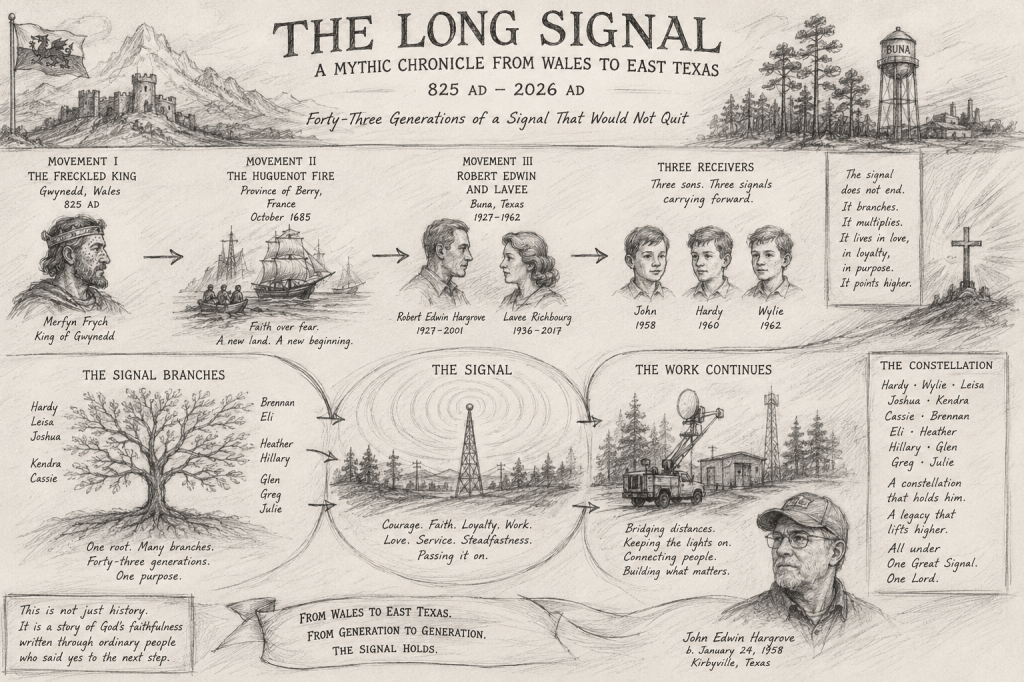
But the Farmers version undersells what I actually know. The adjuster who wrote that line sees a lot of claims. He does not stay through them. My knowing came from staying. Staying with the design when the elegant answer failed. Staying with my wife Leisa through forty-five years. Staying with a grief that did not have the decency to keep to any timetable. Staying at the foot of the bed on the nights the signal was mostly noise.
I know a thing or two because I stayed through a thing or two. That is the honest version.
But that is not the deepest thing I learned this week. That was only the doorway.
—
I have been carrying a hard pastoral situation for months. Nothing I need to describe in detail here — every congregation has seasons where the weight comes down at once. I have been working the problem the way I have always worked problems. Building frameworks. Writing plans. Drafting careful documents. Mapping the personalities. Analyzing the fault lines. Preparing sixty questions for the next difficult conversation.
A trusted mentor of mine sent me a meditation on John chapter twenty-one a few months back. Two words rose up out of it and pressed on me until I could not ignore them: follow me.
Two words. I had written sixty questions. Somewhere between those two documents was the diagnosis.
I have been engineering a pastoral situation because pastoral situations do not yield to engineering, and engineering is what I know. I did not do it out of pride. I did it out of the responsibility instinct that forty-seven years of infrastructure work drilled into me — if you do not solve it, no one will. That instinct saved careers. It kept the lights on. It also does not translate to the Kingdom. In the Kingdom, if I do not solve it, He will. And often He was already solving it before I picked up my tools.
Here is the sentence that came to me plainly, in my own voice, and would not leave:
I am trying to engineer where the true Engineer is working, and I am getting in His way. I need to listen. I need to follow Him.
—
Go back to John twenty-one. The disciples have fished all night and caught nothing. Jesus stands on the shore and tells them to throw the net on the other side. They do. It fills. They drag it in — a hundred and fifty-three fish, the net unbroken.
Then they get to the shore. And there is a sentence in that chapter that I somehow missed for most of my life.
He already had a fire going. He already had fish cooking on it. He already had bread.
He asked them to bring some of what they caught. But he did not need it. He was feeding them before they brought the net.
That is the pastoral recognition of my week, and it may be the pastoral recognition of my life. Anywhere I have ever loved something enough to want it to work — a project, a marriage, a study, a church, a manuscript — I have been tempted to build the structure myself and call it faithfulness. Sometimes the building was the calling. Sometimes it was me getting in front of Him. Both are true. That is the honest accounting.
—
I want to say clearly what this recognition is not.
It is not repentance for a wasted life. It is not a call to put the tools down. I am still an engineer. I am still a pastor. I still have work to finish and a wife to love and a congregation to shepherd. The call is not to stop building. The call is to ask, before I pick up the tools, a different question. Not what should I do — that question I know how to answer. The new question is this:
Is He already working here? Am I being invited to join Him, or am I about to get in front of Him?
That is the question Peter finally learned to ask on the shore.
The engineer’s temptation is not pride. It is responsibility. Everyone I know who has ever carried something heavy for a long time has felt it — the belief that if you loosen your grip for one moment, the whole thing will fall. Sometimes that belief is accurate. More often it is a lie the enemy of our souls is happy to let us keep believing, because as long as we believe it, we will never trust the Engineer who was there first.
—
You do not have to be an engineer for this to apply. Anyone who has ever loved something enough to want it to work has felt the pull to build the structure themselves and call it faithfulness. A parent with a struggling child. A pastor with a fractured congregation. A spouse holding a marriage together. A caregiver managing a decline. A leader carrying an organization through a hard season.
If any of that is you today, I offer you the question that stopped me in my tracks this week:
Is He already working here? Am I being invited to join Him, or am I about to get in front of Him?
You may find, as I am finding, that the fish are already on the fire. That the bread is already prepared. That He has been feeding the people you have been trying to protect long before you knew you were tired.
And you may find, as I am finding, that the answer is not more effort. The answer is two words spoken to a fisherman on a beach in the morning light.
Follow me.
—
John Edwin Hargrove • Buna, Texas • August 2026

