
The 450 MHz Line: Stu Phillips and the Combiner Test Bench
“A security radio system doesn’t get to fail quietly. It fails in front of an NRC inspector, or it fails when someone is already climbing a fence.”
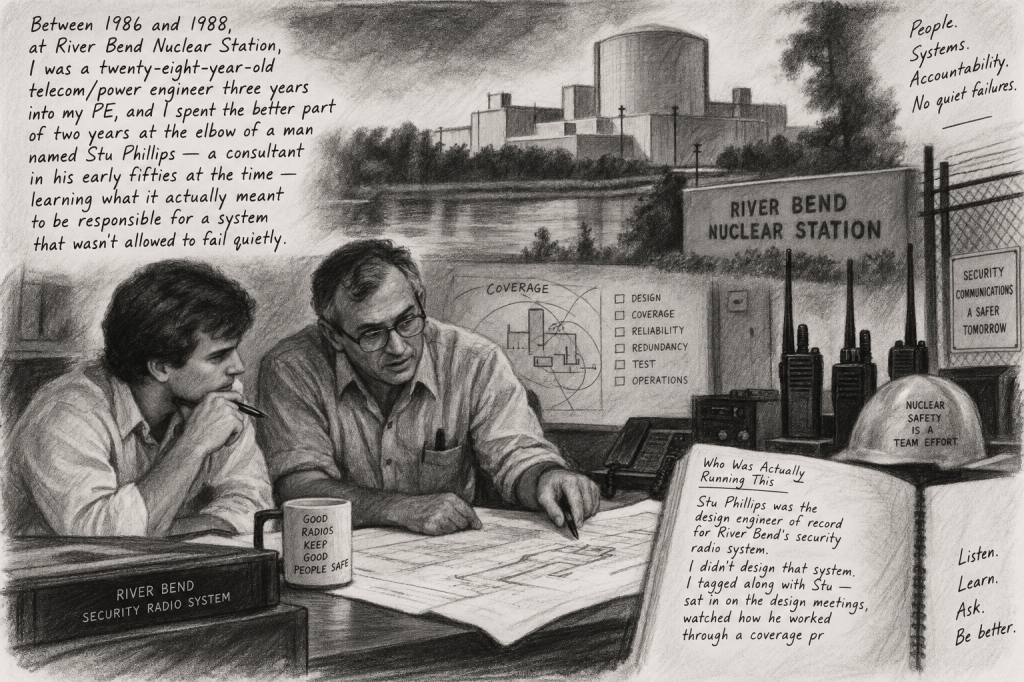
Between 1986 and 1988, at River Bend Nuclear Station, I was a twenty-eight-year-old telecom/power engineer three years into my PE, and I spent the better part of two years at the elbow of a man named Stu Phillips — a consultant in his early fifties at the time — learning what it actually meant to be responsible for a system that wasn’t allowed to fail quietly.
Who Was Actually Running This
Stu Phillips was the design engineer of record for River Bend’s security radio system. I didn’t design that system. I tagged along with Stu — sat in on the design meetings, watched how he worked through a coverage problem, and ended up running the qualification program that turned his design into something the plant could actually trust.
What made Stu a mentor rather than just a senior colleague was his posture toward the work itself: he expected not to fail, but to learn from the testing measurements what changes physics itself would demand. He wasn’t defending a guess. He was running an experiment and expecting the data to talk back to him.
Stu also seemed to realize early on that I could help him facilitate the whole process, not just execute my piece of it. I naturally started innovating as I learned from him — figuring out how to leverage the student EIT resource I had access to, and how to work the systems at both GSU and River Bend to get things done faster and more rigorously than the original plan called for. I’m the one who suggested automating the testing rather than doing it by hand, unit by unit, with a stopwatch and a notepad. The River Bend project engineer, Tom, funded the test equipment for that — a PC and the various instruments the automated bench needed. Tom gained confidence in us as that automation came together and started producing real, trustworthy data faster than anyone had expected.
The rest of the field team rounded out what Stu could do alone. Dale was a trusted associate of Stu’s, carrying his own deep well of RF experience — the kind of person Stu brought along because he’d already proven himself on other jobs. Robert Smith was a former Navy ESW technician and a chief petty officer in the reserves, and it showed in how he worked: precise, methodical, a details guy who didn’t let a measurement pass until he trusted it. Between Stu’s design judgment, Dale’s RF depth, and Robert’s Navy-trained precision, I was the junior man in a field team that had more collective rigor than I’d worked alongside before.
This story runs across roughly nineteen months inside the larger 1986–1988 window, in four phases: design and discovery, about six months; qualification testing in Beaumont, about two months; field testing, about four months; and installation and final testing, about seven months.
What the Regulation Actually Required
Neither Stu nor I sat down in 1986 with a copy of 10 CFR 73.55 open on the bench. Stu had a coverage problem to solve and a design that had to work; I had a test program to run. But it’s worth naming what was standing behind the whole effort, because it explains why a spreadsheet model and fifty-five passive splitters both got the kind of scrutiny normally reserved for something with a power supply and a failure mode.
River Bend had received its operating license in November 1985 and gone commercial in June 1986 — right at the front edge of this project. Under 10 CFR 73.55, every guard and armed responder on duty had to be capable of maintaining continuous communication with a continuously manned alarm station. That’s a performance requirement — it doesn’t say what frequency to use or what cable to run. It says the guard has to be able to talk, period, wherever that guard is standing. River Bend’s construction — heavy concrete, steel, stairwells, below-grade spaces, a radiologically controlled area layered on top of all of it, spread across multiple stories and dozens of separate chambers, rooms, and enclosed spaces — was never going to give a conventional UHF handheld system reliable coverage everywhere a guard needed to walk. That gap between “the rule says continuous” and “the building says otherwise” is what Stu’s Radiax design, and everything that followed, was built to close.
The same regulation required that security communications equipment be maintained in operable condition and backed by compensatory measures whenever something degraded. A coverage gap wasn’t a maintenance annoyance — it was a condition that could force compensatory measures or a finding during an NRC inspection.
I want to be precise about what I’m claiming and what I’m not. The NRC never told River Bend to use 450 MHz, never specified Radiax by name, and never told Stu how to model RF propagation through a reactor building. Those were engineering decisions Stu made to meet a performance requirement in a building that made the requirement hard to satisfy.
Phase One: Design and Discovery — Six Months
Before anyone touched a splitter or ran a cable, Stu spent roughly six months building a room-by-room, area-by-area RF coverage model of the plant in Lotus 1-2-3. He modeled the environment itself — the steel, the twelve-inch concrete walls, corridors, hatches, vessels — accounting for reflection and attenuation characteristics of each material, working through dozens of separate chambers, rooms, and enclosed spaces spread across multiple stories, plus a handful of larger open areas that behaved differently from a tight corridor or stairwell.
By the time the modeling was finished in 1987, that spreadsheet ran to thousands of rows — every one of those distinct spaces and material combinations tracked as its own set of entries. Stu ran it on his own Compaq Portable III, the transportable IBM PC/AT-compatible machine Compaq had introduced that year: a 12 MHz 80286 processor, 640 KB of RAM, a 20 or 40 MB hard drive, a 1.2 MB 5¼-inch floppy drive, and a sharp amber gas-plasma display, all packed into an eighteen-to-twenty-pound suitcase that ran on AC power rather than batteries. It wasn’t a laptop by any modern definition — it was a portable professional workstation, and it was the machine Stu carried with him wherever the modeling needed to go, powerful enough to hold a spreadsheet that size and still function as a field terminal.
This was also the phase where the working relationship between Stu and me started to take its real shape. A man in his early fifties, decades into a career, and a twenty-eight-year-old three years past his PE — he wasn’t just tolerating a junior engineer tagging along. He seemed to recognize I could take some of the process load off him, and he let me run with that. That’s where the idea of automating the qualification testing came from, and where Tom, the River Bend project engineer, stepped in to fund a proper test setup rather than making do with whatever was already sitting on a bench somewhere.
Phase Two: Qualification Testing — Beaumont, Two Months
The design told us what the finished system needed to deliver: over fifteen thousand feet of Radiax, connected through fifty-five splitters and combiners, all of it depending on those passive components performing exactly the way their data sheets claimed.
For the bench work itself, we ran the automated testing on an IBM PC in Beaumont — separate hardware from Stu’s own Compaq, dedicated to the qualification program. I had Scott Burt, an EIT working for me, write the QuickBASIC code that ran the test bench — two HP 436A power meters and a signal generator swept from 400 to 500 MHz over the HP-IB bus, stepping in 10 kHz increments across that full band, all controlled from that Beaumont IBM PC. At every 10 kHz step, on every port of every one of the fifty-five units, we took three or more power readings in dBm — a full, repeated, swept dataset per device. Scott ran most of that testing day to day, compressed into about two months, and the automation Tom had funded is what made a dataset that size possible in that short a window.
Twenty-five percent of the units failed that testing outright and had to go back to the factory for repair. If we had trusted the data sheets instead of the bench, roughly a quarter of the passive network feeding a nuclear plant’s security radio system would have gone into the wall carrying a defect nobody would have found until a guard’s radio went dead somewhere it shouldn’t have.
Phase Three: Field Testing — Four Months
Getting the qualified hardware verified against Stu’s model, inside the actual plant, took about four months and involved Stu, Dale, Robert Smith, and me. Before any of us went to work inside River Bend’s radiologically controlled area, we went through operations and RCA training and got full-body radiological scans to establish exposure baselines. From that point on, every one of us wore a TLD badge, and we scanned in and out of the controlled area every time we crossed the boundary. The test equipment stayed inside the plant for the duration while we worked our way through the non-RCA areas first, then the RCA.
This is where the makeup of the team mattered. Dale’s RF experience meant he could look at a reading that seemed wrong and know, faster than I could at twenty-eight, whether it was a real coverage gap or an artifact of how we’d set up the measurement. Robert’s Navy training showed up in exactly the way you’d expect from a chief petty officer — he was the one who made sure a measurement got repeated until it was trustworthy.
Forty percent of the original design required correction based on what we actually measured in the field. Not fine-tuning — real correction, room by room, of assumptions that six months of careful modeling had gotten wrong. The reflective areas and the larger open rooms proved the most difficult by far. A tight corridor with twelve-inch concrete walls behaves close enough to how you’d predict it. A large open space with steel structure and multiple reflective surfaces does something much harder to model on paper.
So the work shifted from verification to correction: we went back through the flagged areas with a signal generator and a spectrum analyzer and measured RF attenuation and reflection directly. Stu brought his own Compaq portable into the plant with us to log the readings and update his model on the spot, room by room, rather than carrying paper notes back to an office to transcribe later. We fed those measured values back into the model until it reflected what the building actually did to a 450 MHz signal instead of what a set of reasonable engineering estimates said it should do.
This is where Stu’s posture from the beginning of the project made all the difference. He had never expected the model to be right on the first pass — he expected physics to tell him where it was wrong, and he treated a forty-percent correction rate not as a failure but as the process doing exactly what it was supposed to do.
Phase Four: Installation and Final Testing — Seven Months
With the model corrected against real measurements, and the twenty-five percent of failed hardware repaired and requalified, the system itself went in: over fifteen thousand feet of Radiax, fed through the corrected combiner network, threaded through dozens of chambers, rooms, and enclosed spaces across multiple stories and the plant’s larger open areas, all feeding back to a set of Motorola repeaters. That installation and the final round of testing behind it ran another seven months. Every corrected assumption from the field-testing phase had to be verified again once the actual cable and hardware were in place.
When it was finished, the coverage met the requirement — and something else had been built alongside the RF network. The Baton Rouge division telecom staff had learned to trust us over the course of the project: Joe Ducote, Steve Perrin, and others at River Bend had watched the whole process unfold — the automated testing, the failed units caught before installation, the field corrections — and that visible rigor is what earned the confidence of the people who’d have to live with the system after we were gone.
The Olive Garden, 1995
Seven years after the project closed out, Stu and I met for a meal at an Olive Garden in north Houston. Leisa and Joshua were there with me — this wasn’t a business lunch squeezed between meetings, it was something closer to a family occasion.
Stu was winding down. He handed me the River Bend box that day: the account, the relationship, the responsibility for a system the two of us had spent two years proving would work. The project and the client that had once consumed nineteen months of my life became history for someone else to handle. That someone was me.
I don’t know exactly when Stu passed. I believe it was sometime in the early 2000s. What I know clearly is that Olive Garden meal in 1995 — Leisa and Joshua at the table, Stu passing along a piece of his life’s work to the engineer who’d once been the junior man carrying test equipment behind him — was the last real marker I have of him stepping back from a career that had shaped mine.
What It Actually Bought Us
Nineteen months, four phases, and a security radio system proven three separate ways: modeled against the plant’s actual construction on Stu’s own Compaq Portable III, qualified component by component on an automated IBM PC bench in Beaumont, and verified — then corrected, then verified again — in the field. Twenty-five percent of the hardware failed and had to be repaired. Forty percent of the original design had to be rebuilt around real measurements instead of careful guesses.
At the end of it all, I saw the wisdom of what a real PE actually does: engineering process, discipline, experience, and patience with physics, applied together, to yield a design that performed. That was my lesson. And when Stu handed me the box at that Olive Garden table in 1995, with my wife and son beside me, it became a lesson I’d carry forward on my own, long after he stepped back — and long after he was gone.
 John Hargrove Seeking Truth and Reality