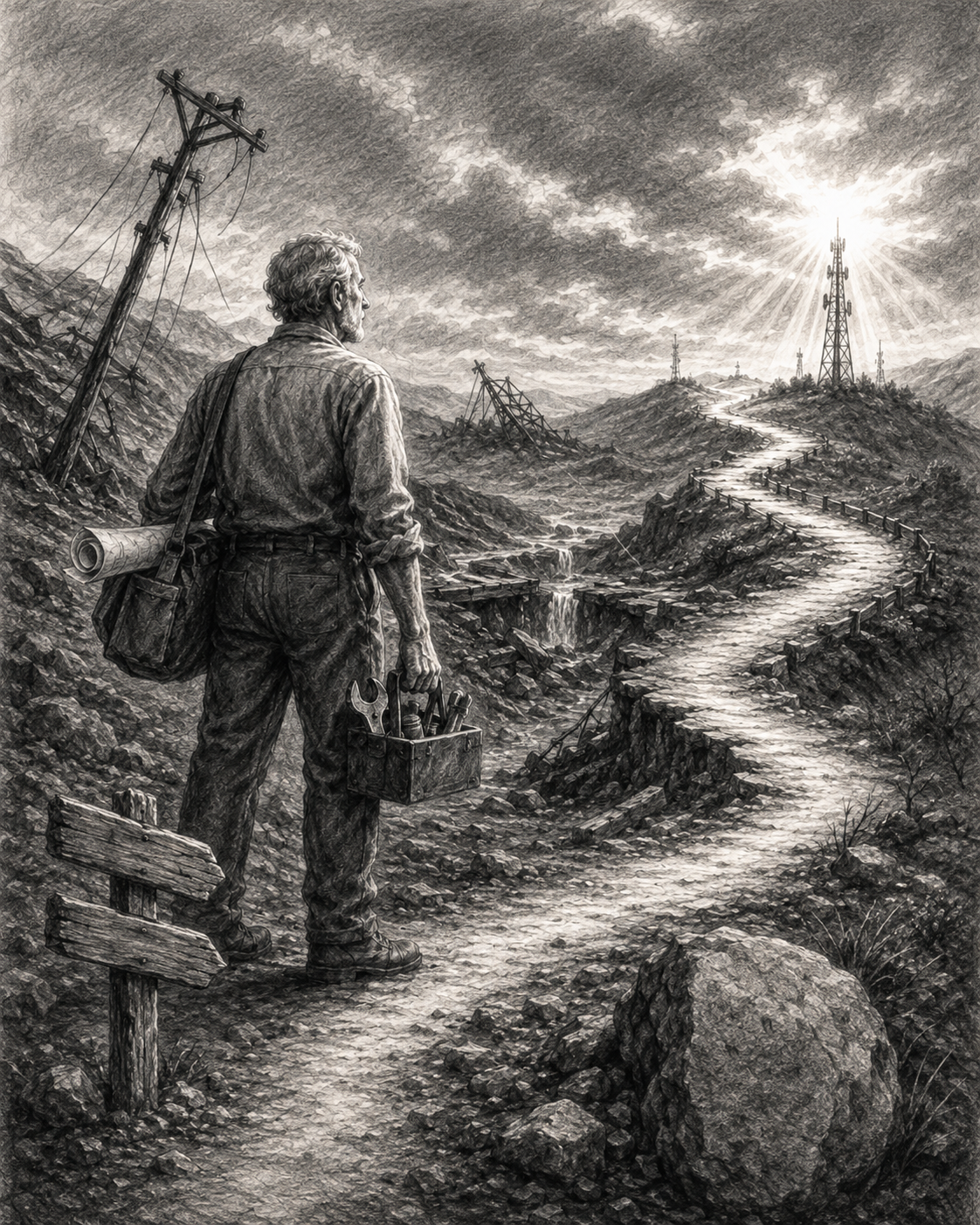

There are seasons when nothing is catastrophically wrong in a single moment, yet everything feels heavy.
A dream is ending.
Money has been lost.
Plans that once seemed promising have not worked.
People we love are struggling.
Ministry or relationships have become complicated.
Responsibilities keep arriving faster than strength returns.
And somewhere in the middle of all of it, we realize we are grieving.
Sometimes we are grieving more than an event. We are grieving the future we thought we were building.

That kind of grief can become especially painful when we know some of the circumstances resulted from our own decisions. Looking backward, we see things we should have done differently. Decisions delayed. Warnings ignored. Pride disguised as determination. Fear disguised as prudence. Attempts to rescue situations that perhaps should have been released much earlier.

Scripture does not ask us to pretend those things are not real.
David wrote:
“I acknowledged my sin to You and did not hide my iniquity.”
— Psalm 32:5
Repentance requires truth.
But repentance is not the same thing as condemnation.
There is an important difference between saying:
“I made serious mistakes”
and
“My life is a failure.”
Between:
“I lost something important”
and
“Everything was wasted.”
Between:
“I bear responsibility for some of what happened”
and
“Everything that happened is my fault.”
The first statements can lead us toward repentance, wisdom, reconciliation, and change.
The second can imprison us in shame.
Psalm 32 begins not with a man who never failed, but with a forgiven man:
“Blessed is he whose transgressions are forgiven, whose sins are covered.”
— Psalm 32:1
There is another difficult lesson in seasons of loss.
Not everything can be fixed.
Some losses must simply be mourned.
Some money will never be recovered.
Some opportunities will not return.
Some relationships cannot be repaired by one person.
Some organizations cannot be saved merely by working harder.
Some consequences must be accepted rather than reversed.
And some dreams may have to end.
For those of us accustomed to solving problems, this can be particularly difficult. We instinctively ask:
“How do I fix this?”
Sometimes that is exactly the right question.
But sometimes God may be calling us to ask something different:
“Lord, what is actually mine to do, what is mine to repent of, and what am I still trying to control that I need to release to You?”
There is faith in admitting, “I cannot carry all of this.”
The Psalms give us permission to say that our souls are downcast.
“Why are you downcast, O my soul? Why is there such unease within me? Put your hope in God.”
— Psalm 42:5
Notice that Scripture does not pretend the sorrow isn’t there.
It names it.
And then it turns toward God.
Christian hope does not require us to believe that every business will recover, every financial loss will be restored, every relationship will reconcile, every ministry will flourish, or every earthly dream will eventually come true.
Our hope is deeper than favorable circumstances.
Christ remains when outcomes do not.
Paul learned to live in abundance and in need. His confidence was ultimately not that circumstances would always improve, but that Christ would sustain him through whatever circumstances came.
There are therefore days when faithfulness may look surprisingly small.
Tell the truth.
Confess what needs confessing.
Make restitution where possible.
Ask forgiveness where necessary.
Do today’s responsibility.
Love the person in front of you.
Seek wise counsel.
Stop pretending you control what belongs to God.
And allow yourself to grieve what has actually been lost.
Jesus Himself wept.
Grief is not necessarily evidence that faith has failed.
Sometimes tears are simply the truthful response of a human being who has lost something he loved.
Perhaps the prayer for such a season is simply this:
Father, I cannot carry my failures, losses, responsibilities, relationships, fears, and future in my own strength.
Show me my sin without allowing me to hide behind excuses or drown in condemnation.
Show me my responsibilities without letting me confuse responsibility with control.
Give me courage to tell the truth, humility to accept consequences, wisdom for today’s decisions, tenderness toward those who are hurting with me, and grace to mourn what is ending.
I place before You what I cannot repair.
Keep my heart near Christ.
Give me enough light for the next faithful step.
Amen.